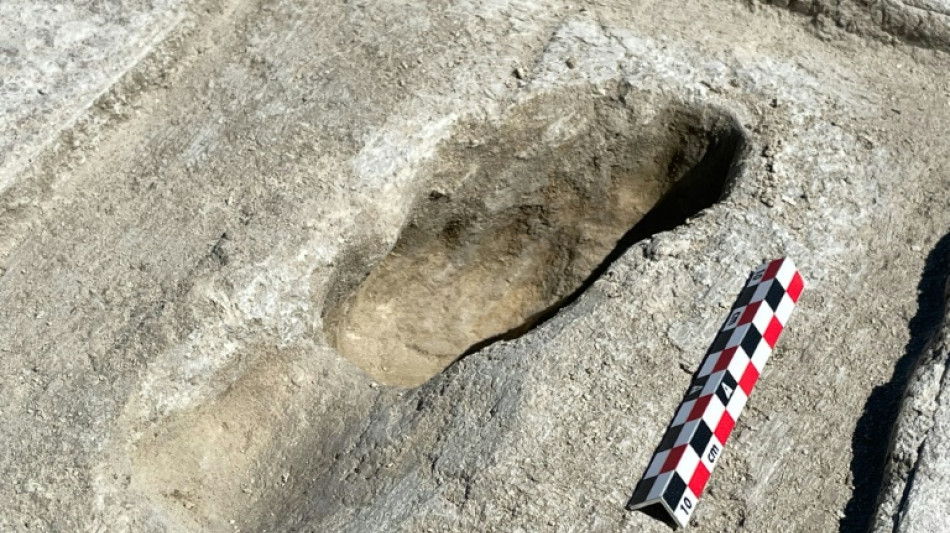
Ice-age footprints shed light on North America's early humans / Photo: Handout - HANDOUT/AFP

 'He's here with me': Japan cycle queen dedicates gold to late brother

 Japan Olympic chief says 'lot more' athletes at Games than expected

 Asian carmakers besting US rivals at home, China poised to strike

 Widgets & Web Offers All-Inclusive Investor Relations Websites for Public Companies, IPOs and SPACs

 Adams named new US captain to 2030 World Cup

 China a better influence in Latin America than US: poll

 Judge pauses construction of border project in Texas national park

 Belgium's De Bruyne fires double to sink Turkey, France held by Italy

 US jobs data boosts stocks as oil prices dip

 US Supreme Court to hear high-stakes climate case
 Trump expected to name intel chief Clayton as AI czar: reports

 Argentina unveils passports-for-investment scheme

 Brazil election debate chaos sparks censorship row

 England's Carse charged by cricket body over nightclub incident

 Amazon vows $1 bn for data center towns, decries 'myths'
 Oil prices drop on G7 fuel release, US jobs data boosts stocks

 G7 agrees deal to ease global energy supply concerns

 Spain's government dealt blow as lawmakers reject housing bills

 Food, medicine shortages deepen in Russian-occupied Oleshky

 Man City whistleblower Rui Pinto facing 'dire consequences' - lawyers

 Russia 'tearing Kyiv apart', mayor says, as strikes paralyse traffic

 Taiwan boxer Lin wins Games gold as Japan edge North Korea on penalties

 Japan tame North Korea to win Games gold after shootout drama

 US posts weak job growth data in September

 Ethiopia's conflict: the regional dimension

Footprints laid down by Ice-Age hunter-gatherers and recently discovered in a US desert are shedding new light on North America's earliest human inhabitants.
Dozens of fossilized prints found in dried-up riverbeds in the western state of Utah reveal more details about how the continent's original occupants lived more than 12,000 years ago -- just as the frozen planet was starting to thaw.
The fossils could have remained unnoticed if not for a chance glance out of a moving car as researchers Daron Duke and Thomas Urban drove through Hill Air Force Base chatting about footprints.
"We were talking about 'what would they look like?'," Duke told AFP. "And he said: Kind of like that out the window.'"
What the two men had found turned out to be 88 distinct prints left by a mixture of adults and children.
"They vary between just looking like discolored patches on the ground and... little pop ups, little pieces of dirt around them or on them. But they look like footprints," Duke said.
What came next was a painstaking few days of very careful digging -- sometimes lying on his belly -- to ensure that what they were looking at was as old as it appeared.
"What I found was bare feet of people... that had stepped in what looks to be shallow water where there was a mud sub layer," Duke explained.
"The minute they pulled their foot out, the sand infilled that and has preserved it perfectly."
Duke, of the Nevada-based Far Western Anthropological Research Group, had been in the area looking for evidence of prehistoric campfires built by the Shoshone, a people whose descendents still live in the western United States.
He had brought Urban over from Cornell University because of his expertise in uncovering evidence of ancient humans -- including the discovery of human tracks in New Mexico's White Sands National Park that are thought to be up to 23,000 years old.
- 'Awestruck' -
The new fossils add to a wealth of other finds from the area, including stone tools, evidence of tobacco use, bird bones and campfire remains, that are starting to provide a more complete record of the Shoshone and their continuous presence in the region beginning 13,000 years ago.
"These are the resident indigenous people of North America, this is where they lived, and this is where they still live today," Urban said.
For him personally, finding the footprints has been a professional high point.
"Once I... realized I was digging a human footprint, I was seeing toes, I was seeing the thing in immaculate condition... I was just kind of awestruck by it," he said.
"Nothing beats the sense of discovery and awe that maybe as an archaeologist, you are actually chasing your whole career."
And sharing the discovery with the distant descendents of the people who made the prints was immensely rewarding, Urban said.
"You realize the same thing is happening -- what the connection is to such a distant past and to something so human, I think it gets to everybody in one way or another eventually."
C.Cassis--PC



