'We can live together': church helps bridge Bosnia's deep divisions / Photo: ELVIS BARUKCIC - AFP

 'He's here with me': Japan cycle queen dedicates gold to late brother
 Japan Olympic chief says 'lot more' athletes at Games than expected
 Asian carmakers besting US rivals at home, China poised to strike

 Widgets & Web Offers All-Inclusive Investor Relations Websites for Public Companies, IPOs and SPACs

 Adams named new US captain to 2030 World Cup

 China a better influence in Latin America than US: poll

 Judge pauses construction of border project in Texas national park

 Belgium's De Bruyne fires double to sink Turkey, France held by Italy

 US jobs data boosts stocks as oil prices dip

 US Supreme Court to hear high-stakes climate case

 Trump expected to name intel chief Clayton as AI czar: reports

 Argentina unveils passports-for-investment scheme

 Brazil election debate chaos sparks censorship row

 England's Carse charged by cricket body over nightclub incident

 Amazon vows $1 bn for data center towns, decries 'myths'

 Oil prices drop on G7 fuel release, US jobs data boosts stocks

 G7 agrees deal to ease global energy supply concerns
 Spain's government dealt blow as lawmakers reject housing bills
 Food, medicine shortages deepen in Russian-occupied Oleshky
 Man City whistleblower Rui Pinto facing 'dire consequences' - lawyers
 Russia 'tearing Kyiv apart', mayor says, as strikes paralyse traffic

 Taiwan boxer Lin wins Games gold as Japan edge North Korea on penalties

 Japan tame North Korea to win Games gold after shootout drama
 US posts weak job growth data in September
 Ethiopia's conflict: the regional dimension

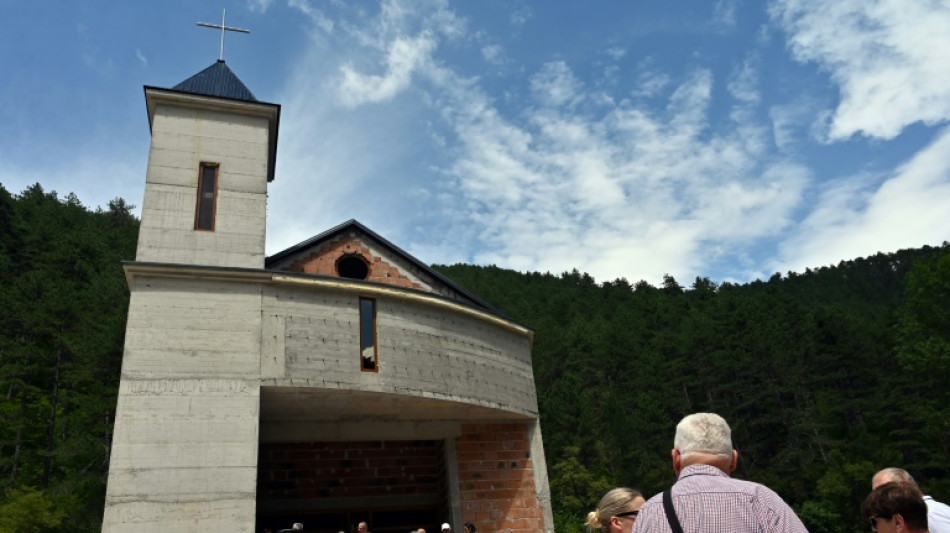
Decades after bloody fighting between Catholics and Muslims ripped apart Bosnia's Bugojno, a new church has provided a rare opportunity to bridge the divides in the deeply fractured Balkan country.
Still under construction, the Catholic place of worship in the central Bosnian town is being built on land donated by Husejn Smajic, a 68-year-old Muslim resident, after he discovered the foundation of a medieval church on his property.
For Smajic, the new church represents a small step in a quest to rebuild the communal harmony common in Bosnia before the war in the 1990s.
"I did this so that people can see that we can all live together. There cannot be beauty of life here without the mixture of communities. It is our wealth," Smajic told AFP.
Amid the bloody dissolution of Yugoslavia, Bosnia erupted into a vicious civil war pitting the country's Orthodox Serbs, Catholic Croats and Bosniak Muslims against each other in a conflict that killed around 100,000 people.
Bugojno was hard hit during the war that was defined by bouts of ethnic cleansing, mass displacement and atrocities committed by all sides.
Most of the town's Catholic Croats, who made up more than a third of Bugojno's 47,000 inhabitants, were expelled by Bosniak Muslim forces.
- Life after war -
Nearly three decades later, many of the divisions that were exacerbated by the conflict have largely hardened, with Bosnia's three main groups rarely mixing.
A peace deal that succeeded in ending the war has left the country partitioned and controlled by ethno-religious political parties that have exploited Bosnia's divisions in a bid to maintain power.
With few economic opportunities, hundreds of thousands have moved abroad in the search of a better and more stable future.
The fracturing of Bosnia has been particularly painful for people like Smajic, who is in a mixed marriage with his Catholic wife.
Before the war, mixed marriages were once common across Bosnia, but like many aspects of life it is becoming increasingly rare.
But the discovery of the medieval church on his land -- which was likely sacked in the 15th century during the Ottoman invasion of Bosnia -- provided an opportunity in Smajic's eyes.
After donating a portion of his property to the Catholic Church, Smajic has provided a guiding hand to help complete the project, proving the country's communities can still work together to build, rather than destroy.
Smajic -- who owns a nearby sawmill and two small hydroelectric power plants -- has financed a large share of the operations, while members of the Croat, Muslim and Serb communities have also donated money and supplies.
- 'We can live together' -
During a recent ceremony to consecrate the church, hundreds attended the celebration and the festivities that followed, including a barbecue of traditional Bosnian sausages and dancing.
"We can live together if we respect each other," said Vinko Puljic, the former leader of the Catholic Church in Bosnia, who oversaw the consecration of the new church.
Smajic's efforts have proven to be an inspiration to others.
"If we were all like him, if we all had this love for each other, I think this country would be so happy and nobody would move to Germany, Austria or Switzerland anymore. We would make Switzerland here," said resident Mihovil Klisanin.
"People like Husejn are rare in Bosnia, especially after these tragic conflicts. He has a heart as big as a mountain," added Frano Glavas, a 58-year-old Croat from Bugojno who now lives in Croatia.
For Smajic, rebuilding Bosnia and the ties that once bound the nation requires both vigilance and empathy, while avoiding the country's divisive political scene that has continued to fan the flames of separatism.
"If you love this country and if you love this people, I mean all its people, you have to work against the politicians," said Smajic.
"From this valley will come messages of peace, love and respect for all peoples."
R.Veloso--PC



