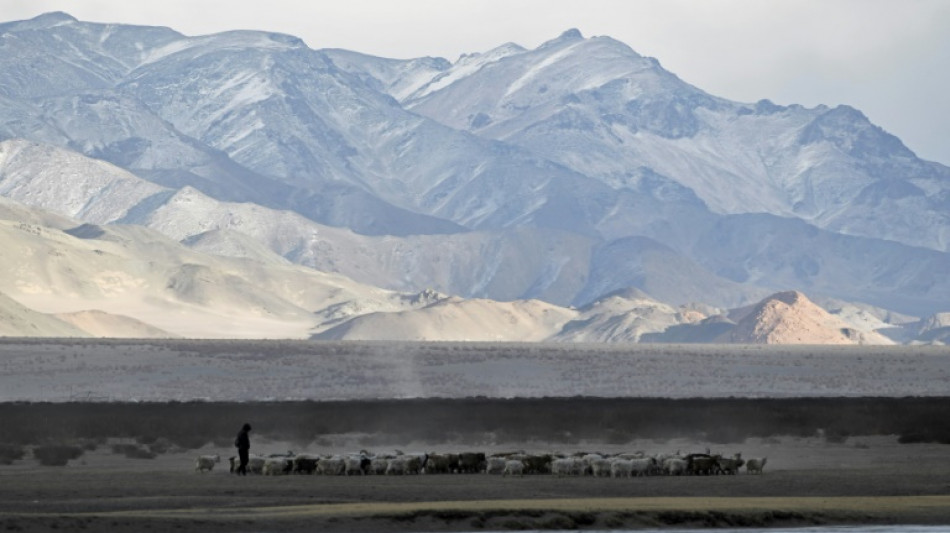
Tibetan Plateau water stores under threat: study / Photo: Parvaiz BUKHARI - AFP/File

 Split loyalties for Indian football fans at Brazil friendly

 India-Pakistan blockbuster brings cricket fever to Japan baseball field

 Wong waiting on Rafa after winning Asian Games tennis gold

 With Russia next door and rising costs, Latvia goes to the polls

 Penalty hero rues empty seats as Games hosts Japan win football gold

 North Korea fires ballistic missile after Seoul's apology demand

 US regulator finds Boeing 737 MAX software bug 'not a safety concern'

 Ohtani 'managing' injuries as Dodgers launch MLB post-season

 Botched US execution leaves murderer unconscious on ventilator: lawyers

 Cornell rape case exposes sexual violence at US colleges
 France held by Italy in Zidane's homecoming after Olise stunner

 Ethiopian pro-government militia claims Tigray airport as regional tensions spike

 Ohtani shaking off injuries as Dodgers launch MLB post-season
 Sea levels to rise in California as coastal wave surges up west coast

 New rallies urged in France as protests disrupt over 730 schools

 Djokovic survives China Open scare, Sabalenka starts strong

 King Charles to evoke colonial 'darkest days' on Caribbean tour

 Tesla shares jump after global car sales top estimates
 DR Congo Ebola outbreak killed more than 4,000: official figures

 Djokovic survives China Open scare against wildcard world no. 104

 Lula, Bolsonaro trade blows in final scramble for votes in Brazil

 New clashes erupt as protests disrupt over 560 French schools

 NY governor vows to close loophole after alleged Cornell gang rape

 Ethiopia Tigray rebels pushed back as regional tensions spike
 Stocks rise, yields fall as US job numbers disappoint

The Tibetan Plateau will experience significant water loss this century due to global warming, according to research published Monday that warns of severe supply stress in a climate change "hotspot".
The reservoirs of the Tibetan Plateau, which covers much of southern China and northern India, are fed by monsoons and currently supply most of the water demand for nearly two billion people.
But the plateau's complex terrain has made it difficult for scientists to predict how warming temperatures and altered weather patterns linked to climate change will affect the region's water stores.
Researchers based in China and the United States used satellite-based measurements to determine the net change in water and ice mass over the past two decades.
They added in direct measurements of glaciers, lakes and sub-surface water levels to estimate changes in the water mass, then used a machine learning technique to predict storage changes under scenarios such as higher air temperature and reduced cloud cover.
They found that due to an increasingly warm and wet climate, the Tibetan Plateau has lost just over 10 billion tonnes of water a year since 2002.
Writing in the journal Nature Climate Change, the team projected changes in water storage across the plateau under a middle-of-the-road emissions scenario, where levels of carbon pollution stay roughly at current levels before falling gradually after 2050.
They found two river basins were particularly vulnerable to water loss.
For the Amu Darya, central Asia's largest river, water loss could be equivalent to 119 percent of the current demand.
Communities reliant on the Indus basement for water supply could see a loss equivalent to 79 percent of current demand, the study showed.
The authors recommended that governments begin to explore alternative water supply options, including more groundwater extraction, to make up for the anticipated shortfall.
Michael Mann, director of the Penn Center for Science, Sustainability and the Media, said "substantial reductions in carbon emissions over the next decade" would limit global warming and the "predicted collapse of the Tibetan Plateau water towers".
"But even in a best-case scenario, further losses are likely unavoidable, which will require substantial adaptation to decreasing water resources in this vulnerable, highly populated region of the world. Just what that would look like is hard to say -- we're in unchartered waters," Mann, a study co-author, told AFP.
"Suffice it to say, some amount of suffering is locked in."
N.Esteves--PC



