
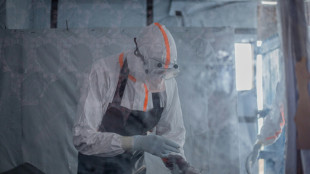
Scientists find simple, safe method to destroy 'forever chemicals' / Photo: Karim SAHIB - AFP/File

 Split loyalties for Indian football fans at Brazil friendly

 India-Pakistan blockbuster brings cricket fever to Japan baseball field

 Wong waiting on Rafa after winning Asian Games tennis gold

 With Russia next door and rising costs, Latvia goes to the polls

 Penalty hero rues empty seats as Games hosts Japan win football gold

 North Korea fires ballistic missile after Seoul's apology demand

 US regulator finds Boeing 737 MAX software bug 'not a safety concern'

 Ohtani 'managing' injuries as Dodgers launch MLB post-season

 Botched US execution leaves murderer unconscious on ventilator: lawyers

 Cornell rape case exposes sexual violence at US colleges

 France held by Italy in Zidane's homecoming after Olise stunner

 Ethiopian pro-government militia claims Tigray airport as regional tensions spike

 Ohtani shaking off injuries as Dodgers launch MLB post-season

 Sea levels to rise in California as coastal wave surges up west coast

 New rallies urged in France as protests disrupt over 730 schools

 Djokovic survives China Open scare, Sabalenka starts strong

 King Charles to evoke colonial 'darkest days' on Caribbean tour

 Tesla shares jump after global car sales top estimates

 DR Congo Ebola outbreak killed more than 4,000: official figures

 Djokovic survives China Open scare against wildcard world no. 104

 Lula, Bolsonaro trade blows in final scramble for votes in Brazil

 New clashes erupt as protests disrupt over 560 French schools

 NY governor vows to close loophole after alleged Cornell gang rape

 Ethiopia Tigray rebels pushed back as regional tensions spike

 Stocks rise, yields fall as US job numbers disappoint

"Forever chemicals" used in daily items like nonstick pans have long been linked to serious health issues –- a result of their toxicity and extreme resistance to being broken down as waste products.
Chemists in the United States and China on Thursday said they had finally found a breakthrough method to degrade these polluting compounds, referred to as PFAS, using relatively low temperatures and common reagents.
Their results were published in the journal Science, potentially offering a solution to a longstanding source of harm to the environment, livestock and humans.
"It really is why I do science -- so that I can have a positive impact on the world," senior author William Dichtel of Northwestern University told reporters during a news conference.
PFAS, or per- and polyfluoroalkyl substances, were first developed in the 1940s and are now found in a variety of products, including nonstick pans, water-resistant textiles, and fire suppression foams.
Over time, the pollutants have accumulated in the environment, entering the air, soil, groundwater and lakes and rivers as a result of industrial processes and from leaching through landfills.
A study published last week by Stockholm University scientists found rainwater everywhere on the planet is unsafe to drink because of PFAS contamination.
Chronic exposure to even low levels has been linked to liver damage, high cholesterol, reduced immune responses, low birth weights, and several kinds of cancer.
Although PFAS chemicals can be filtered out of water, there are few good solutions for how to dispose of them once they have been removed.
- 10 down, thousands to go -
Current methods to destroy PFAS require harsh treatments, such as incineration at extremely high temperatures or irradiating them ultrasonic waves.
PFAS' indestructability comes from their carbon-flouride bonds, one of the strongest types of bonds in organic chemistry.
Fluorine is the most electronegative element and wants to gain electrons, while carbon is keen to share them.
PFAS molecules contain long chains of these bonds, but the research team was able to identify a glaring weakness common to a certain class of PFAS.
At one end of the molecule, there is a group of charged oxygen atoms which can be targeted using a common solvent and reagent at mild temperatures of 80-120 degrees Celsius, decapitating the head group and leaving behind a reactive tail.
"Once that happens, that provides access to previously unrecognized pathways that cause the entire molecule to fall apart in a cascade of complex reactions," said Dichtel, ultimately making benign end products.
A second part of the study involved using powerful computational methods to map out the quantum mechanics behind the chemical reactions the team performed to destroy the molecules.
The new knowledge could eventually guide further improvements to the method.
The current study focused on 10 PFAS chemicals including a major pollutant called GenX, which for example has contaminated the Cape Fear River in North Carolina.
But it represents just the tip of the iceberg, since the US Environmental Protection Agency has identified more than 12,000 PFAS chemicals.
"There are other classes that don't have the same Achilles’ heel, but each one will have its own weakness," said Dichtel in a statement.
"If we can identify it, then we know how to activate it to destroy it."
F.Carias--PC



