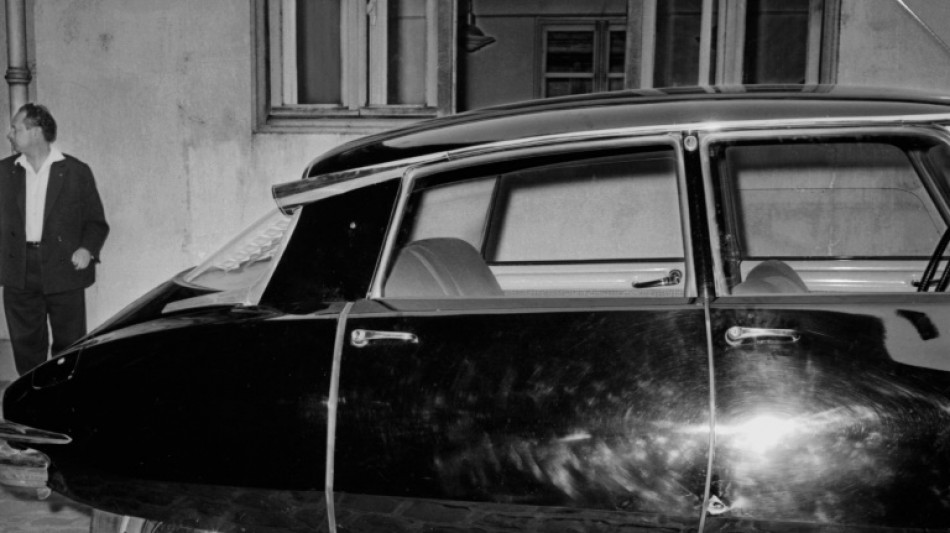
'Close shave!' How De Gaulle escaped assassin's bullets 60 years ago / Photo: © AFP/File

 Split loyalties for Indian football fans at Brazil friendly
 India-Pakistan blockbuster brings cricket fever to Japan baseball field
 Wong waiting on Rafa after winning Asian Games tennis gold
 With Russia next door and rising costs, Latvia goes to the polls

 Penalty hero rues empty seats as Games hosts Japan win football gold

 North Korea fires ballistic missile after Seoul's apology demand

 US regulator finds Boeing 737 MAX software bug 'not a safety concern'

 Ohtani 'managing' injuries as Dodgers launch MLB post-season

 Botched US execution leaves murderer unconscious on ventilator: lawyers

 Cornell rape case exposes sexual violence at US colleges

 France held by Italy in Zidane's homecoming after Olise stunner

 Ethiopian pro-government militia claims Tigray airport as regional tensions spike

 Ohtani shaking off injuries as Dodgers launch MLB post-season

 Sea levels to rise in California as coastal wave surges up west coast

 New rallies urged in France as protests disrupt over 730 schools

 Djokovic survives China Open scare, Sabalenka starts strong

 King Charles to evoke colonial 'darkest days' on Caribbean tour

 Tesla shares jump after global car sales top estimates

 DR Congo Ebola outbreak killed more than 4,000: official figures

 Djokovic survives China Open scare against wildcard world no. 104
 Lula, Bolsonaro trade blows in final scramble for votes in Brazil
 New clashes erupt as protests disrupt over 560 French schools
 NY governor vows to close loophole after alleged Cornell gang rape
 Ethiopia Tigray rebels pushed back as regional tensions spike
 Stocks rise, yields fall as US job numbers disappoint
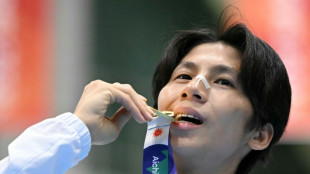
August 22, 1962: French President Charles de Gaulle and his wife are being whisked by car through the Paris suburb of Petit-Clamart for a flight back to their country home, when a man on the side of the road waves a newspaper.
The signal has been given.
A group of right-wing extremists spring into action and rake the presidential Citroen DS with gunfire.
Three of the bullets penetrate the bodywork and pass within inches of De Gaulle's head but he and his wife Yvonne miraculously escape unharmed.
"They're such bad shots!," France's World War II hero later jokes about the attempt on his life which shocks the country and gives De Gaulle an opportunity to boost the powers of his office.
Yvonne's immediate concern meanwhile is for the jellied chicken she has in the boot of the car, having stocked up on the delicacy while in the capital.
- Hail of bullets -
Speeding along that summer evening towards a military airfield where they will board a plane taking them to their estate in the village of Colombey-les-Deux-Eglises, the presidential car is flanked by an escort vehicle and two motorcycle outriders.
Night is falling when the signal comes from the mastermind of the attack, Jean-Marie Bastien-Thiry, an engineer in the Air Ministry with the rank of lieutenant-colonel.
Bastien-Thiry is a member of the Secret Armed Organization, known by its French acronym OAS, a far-right paramilitary group incensed by De Gaulle's decision to grant independence to Algeria after a brutal eight-year liberation war.
The dozen-strong hit squad is a mix of "pieds-noirs" -- Europeans born in Algeria during French rule which lasted from 1830 to 1962 -- as well as former soldiers and students. The youngest is just 20 years old.
They open fire first with a machine gun from a yellow van, then from a second vehicle parked further down the road.
The attack lasts just 45 seconds.
More than 150 bullets are fired and there are eight impacts on the car body. One bullet goes through to the back passenger seat, shattering the window by the president and his wife, showered in glass.
The De Gaulles owe a debt of gratitude to the sangfroid of their driver Francis Marroux, who had also been at the wheel a year earlier when the presidential car survived a first assassination attempt -- later attributed to Bastien-Thiry -- in the northeastern village of Pont-sur-Seine.
Marroux manages to keep control of the vehicle and speeds off on two flat tyres under more fire.
De Gaulle's son-in-law Alain de Boissieu also plays a key role. Sitting in the front of the car he shouts "Get down, father!" to France's leader.
- 'Close shave' -
The unflappable De Gaulle, aged 71 at the time, initially acts as if nothing has happened. On arrival at Villacoublay military airport he reviews the troops as usual.
But when boarding the plane with Yvonne he admits to de Boissieu: "This time, it was a close shave!"
Jean-Noel Jeanneney, French historian and author of a book on the attack, says a combination of factors explains the failure of the 1962 hit, notably that none of those involved were ready to die for the cause.
Interviewed by AFP in 2012, one survivor of the cell blamed weapons jamming and shooters not being sufficiently trained.
"They're such bad shots," De Gaulle tells Prime Minister Georges Pompidou in a phone call on the night of the attack.
News of the assassination attempt spreads quickly.
"Failed attack against De Gaulle" AFP writes in a first "flash" at 8:55 pm.
Another follows: "Shots were fired shortly after 8:00 pm against General De Gaulle's car near Villacoublay. No one was hit".
Later it emerges that a man driving in the opposite direction was hit on the hand by a stray bullet but only lightly injured.
- Mastermind executed -
The hunt for the culprits is swift and efficient, with one of the suspects spilling the beans on the whole operation after his arrest.
Nearly all those involved are caught, including Bastien-Thiry. Nine men are put on trial, three of whom are sentenced to death.
De Gaulle pardons two of them but refuses clemency for Bastien-Thiry, who is the last person to be executed by firing squad in France on March 11, 1963 at the age of 35.
Ever the strategist, De Gaulle harnesses public outrage over the attack to build support for a constitutional amendment to have the president elected by popular vote, rather than by an electoral college.
The attack he confides to one of his ministers came "at just the right time."
Nogueira--PC



