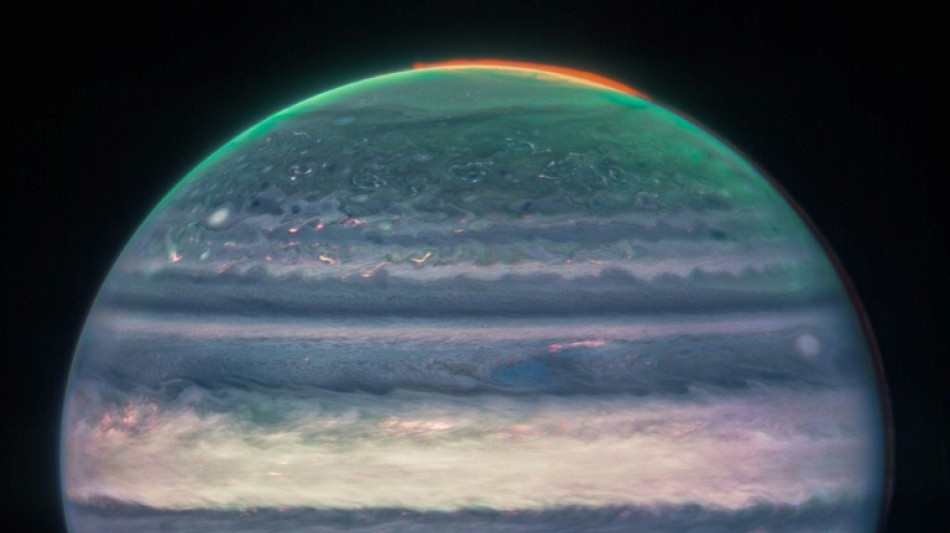
James Webb telescope captures stunning images of Jupiter / Photo: Handout - NASA/AFP

 Split loyalties for Indian football fans at Brazil friendly

 India-Pakistan blockbuster brings cricket fever to Japan baseball field

 Wong waiting on Rafa after winning Asian Games tennis gold

 With Russia next door and rising costs, Latvia goes to the polls

 Penalty hero rues empty seats as Games hosts Japan win football gold

 North Korea fires ballistic missile after Seoul's apology demand

 US regulator finds Boeing 737 MAX software bug 'not a safety concern'

 Ohtani 'managing' injuries as Dodgers launch MLB post-season

 Botched US execution leaves murderer unconscious on ventilator: lawyers

 Cornell rape case exposes sexual violence at US colleges

 France held by Italy in Zidane's homecoming after Olise stunner

 Ethiopian pro-government militia claims Tigray airport as regional tensions spike

 Ohtani shaking off injuries as Dodgers launch MLB post-season

 Sea levels to rise in California as coastal wave surges up west coast

 New rallies urged in France as protests disrupt over 730 schools

 Djokovic survives China Open scare, Sabalenka starts strong

 King Charles to evoke colonial 'darkest days' on Caribbean tour

 Tesla shares jump after global car sales top estimates

 DR Congo Ebola outbreak killed more than 4,000: official figures

 Djokovic survives China Open scare against wildcard world no. 104

 Lula, Bolsonaro trade blows in final scramble for votes in Brazil

 New clashes erupt as protests disrupt over 560 French schools

 NY governor vows to close loophole after alleged Cornell gang rape

 Ethiopia Tigray rebels pushed back as regional tensions spike

 Stocks rise, yields fall as US job numbers disappoint

NASA's James Webb Space Telescope has captured stunning images of the planet Jupiter showing two tiny moons, faint rings and auroras at the northern and southern poles.
"We hadn't really expected it to be this good, to be honest," said planetary astronomer Imke de Pater of the University of California, Berkeley.
"It's really remarkable that we can see details on Jupiter together with its rings, tiny satellites, and even galaxies in one image," she said.
De Pater headed the observations of Jupiter, the largest planet in our solar system, with Thierry Fouchet of the Paris Observatory.
The composite images were taken with the observatory's Near-Infrared Camera (NIRCam) and were artificially colored because infrared light is not visible to the human eye.
The auroras above the northern and southern poles of Jupiter have been mapped in redder colors while the Great Red Spot, a storm bigger than Earth, appears white.
One image shows Jupiter's faint rings and its moons Amalthea and Adrastea.
Launched in December 2021 from French Guiana on an Ariane 5 rocket, Webb is orbiting the Sun at a distance of a million miles (1.6 million kilometers) from Earth, in a region of space called the second Lagrange point.
It took the spacecraft almost a month to reach the region, where it remains in a fixed position behind the Earth and Sun to give it a clear view of the cosmos.
The Webb telescope is an international collaboration between the US space agency NASA, the European Space Agency, and the Canadian Space Agency, involving more than 10,000 people.
C.Amaral--PC



