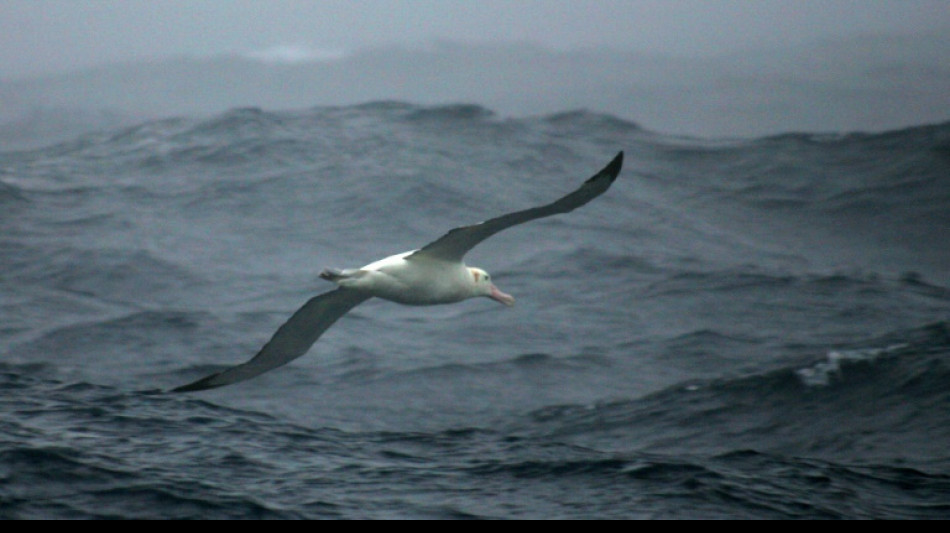
Shy male albatrosses prefer divorce to confrontation: study / Photo: MARCEL MOCHET - AFP/File

 Split loyalties for Indian football fans at Brazil friendly

 India-Pakistan blockbuster brings cricket fever to Japan baseball field

 Wong waiting on Rafa after winning Asian Games tennis gold

 With Russia next door and rising costs, Latvia goes to the polls

 Penalty hero rues empty seats as Games hosts Japan win football gold

 North Korea fires ballistic missile after Seoul's apology demand

 US regulator finds Boeing 737 MAX software bug 'not a safety concern'

 Ohtani 'managing' injuries as Dodgers launch MLB post-season

 Botched US execution leaves murderer unconscious on ventilator: lawyers

 Cornell rape case exposes sexual violence at US colleges

 France held by Italy in Zidane's homecoming after Olise stunner

 Ethiopian pro-government militia claims Tigray airport as regional tensions spike

 Ohtani shaking off injuries as Dodgers launch MLB post-season

 Sea levels to rise in California as coastal wave surges up west coast

 New rallies urged in France as protests disrupt over 730 schools

 Djokovic survives China Open scare, Sabalenka starts strong

 King Charles to evoke colonial 'darkest days' on Caribbean tour
 Tesla shares jump after global car sales top estimates

 DR Congo Ebola outbreak killed more than 4,000: official figures

 Djokovic survives China Open scare against wildcard world no. 104

 Lula, Bolsonaro trade blows in final scramble for votes in Brazil

 New clashes erupt as protests disrupt over 560 French schools

 NY governor vows to close loophole after alleged Cornell gang rape

 Ethiopia Tigray rebels pushed back as regional tensions spike

 Stocks rise, yields fall as US job numbers disappoint

Most albatrosses mate for life but shy males who avoid confrontation are more likely to get dumped, researchers said Wednesday, adding it was the first time personality had been shown to predict divorce in a wild animal.
Wandering albatrosses, which traverse the Southern Hemisphere and have the largest wingspan of any bird at more than three metres (10 feet), are among the most monogamous animals.
They can live for more than 50 years, and while they spend much of that time on the wing, they meet up every two years with the same partner to breed.
Divorce is a "super rare event", occurring around 13 percent of the time, Ruijiao Sun, the lead author of a new study published in the journal Biology Letters, told AFP.
But "if they find that their breeding success is too low with a specific partner they may look for another one," said the PhD student at Woods Hole Oceanographic Institution in the US.
To find out how an individual bird's personality affects their likeliness of getting divorced, the researchers drew on a unique database.
Since 1959, scientists have been tracking a colony of wandering albatrosses on Possession Island, in the southern Indian Ocean's Crozet archipelago.
"We put a stainless ring on the leg with a number," marine biologist and study co-author Stephanie Jenouvrier told AFP.
"Because they're not really scared we can approach very slowly and we can read the number," she added, saying it allowed the team to "reconstruct the entire history of these birds".
Sun said the birds "breed every two years because they take a whole year to rear their chick and it's super energy-consuming, so they take a one-year sabbatical after to recover and they do not spend that time together".
- Shy guys finish last -
Over more than a decade, the researchers measured the boldness of nearly 2,000 birds by observing how they respond to a human approaching their nest.
They found that shyer male albatrosses were up to twice as likely to get divorced than their bolder rivals -- but no difference was found in females.
"We show for the first time the link between personality and divorce in a wild species, thanks to probably the best dataset in the world," Sun said.
Wandering albatrosses have "elaborate courtship processes", the study said, as the birds raise up their wings, squawk and generally dance around.
Sometimes during the process, a pushy outsider male couple tries to cut in. That is when the shyer males avoid confrontation -- and accept divorce.
However there are other factors affecting divorce rates, the researchers said.
There are more male than female albatrosses, because females tend to forage in areas where they are more likely to get caught up in fishing lines.
The surplus of males means that females quickly find a new mate, but it can take males more than four years, the study found.
Also, "individuals that are in a long-term relationship are less likely to divorce than the ones that are new to each other," Jenouvrier said.
Last year research indicated that climate change could also be driving albatrosses to divorce, as the birds have to travel farther to find decreasing numbers of fish.
T.Resende--PC



