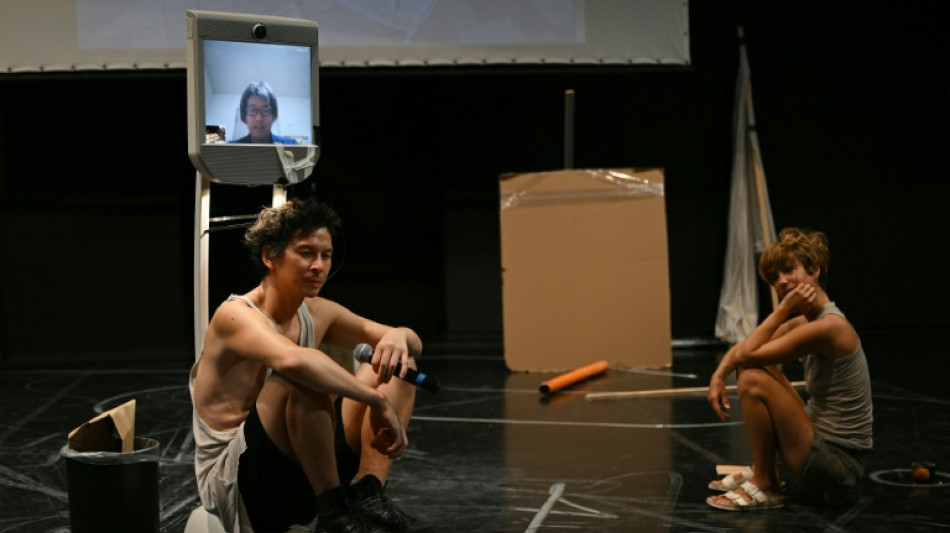
Theatre project aims to ease isolation of Japan's social recluses / Photo: Christophe SIMON - AFP

 'Glad it's over': Kim powers to Games gold and military exemption

 After 11 World Cups, football finally comes home for one Indian fan

 Marc Marquez wins sprint at Japan MotoGP, Martin grabs pole

 Alcaraz fends off Arnaldi to reach Japan Open quarters

 Antonelli tops times in final practice at Bahrain GP

 Gauff digs deep to beat Osorio in China Open second round
 Fresh protests to hit Spain after housing measures defeated
 'He's here with me': Japan cycle queen dedicates gold to late brother

 Japan Olympic chief says 'lot more' athletes at Games than expected
 Asian carmakers besting US rivals at home, China poised to strike

 Widgets & Web Offers All-Inclusive Investor Relations Websites for Public Companies, IPOs and SPACs

 Adams named new US captain to 2030 World Cup

 China a better influence in Latin America than US: poll

 Judge pauses construction of border project in Texas national park

 Belgium's De Bruyne fires double to sink Turkey, France held by Italy

 US jobs data boosts stocks as oil prices dip

 US Supreme Court to hear high-stakes climate case

 Trump expected to name intel chief Clayton as AI czar: reports

 Argentina unveils passports-for-investment scheme

 Brazil election debate chaos sparks censorship row
 England's Carse charged by cricket body over nightclub incident

 Amazon vows $1 bn for data center towns, decries 'myths'

 Oil prices drop on G7 fuel release, US jobs data boosts stocks

 G7 agrees deal to ease global energy supply concerns

 Spain's government dealt blow as lawmakers reject housing bills

Disillusioned by work and tired of life, Seiji Yoshida withdrew from the world for seven years, but now he's taking part in a play about the experiences of Japan's "hikikomori", or social recluses.
The 42-year-old spent most of his thirties shut inside his home.
"I was going through the motions of life, but lying to myself. Apart from work, I had nothing. I'd just had enough," he told AFP at a workshop for the international production.
Yoshida was among more than a million Japanese aged 15 to 64 who lead highly reclusive lives, withdrawing from all social contact for at least six months, according to a 2020 government estimate.
Through an experimental theatre project, two French artists are hoping to offer hikikomori -- or "shut-ins" as they are often referred to in English -- a chance to express themselves and regain self-confidence.
Their play "Hiku" -- to be shown next year in France, Belgium and elsewhere in Europe -- aims to give hikikomori a platform for self-expression, while respecting their desire for isolation.
It features robots controlled by participants at home in Japan and voice recordings of conversations held through bedroom doors.
It also includes footage from small but noisy street demonstrations staged by hikikomori who are taking steps towards leaving their confinement -- but who feel oppressed by Japan's demanding work culture.
"We don't want to be forced to work! Stop oppressing us!" participants chanted at one demonstration filmed in the city of Takatsuki in western Japan.
Yoshida, who took part in the protest, told AFP he was "very proud" to be part of the theatre production.
- Robot 'avatars' -
The producers are working in Takatsuki with a local organisation, New Start Kansai, which provides support and company for hikikomori to help them gradually readjust to life in society.
"It's a social problem... but society has made (hikikomori) believe that the problem comes from them," said Atsutoshi Takahashi, a mediator at the association.
Nicolas Tajan, a psychoanalyst and associate professor at Kyoto University, said hikikomori often faced difficulties in childhood.
In Japan, "childhood and adolescent psychological difficulties are not addressed and not treated," he told AFP.
"That means in adulthood it can crystallise into a type of social withdrawal".
As adults, they face additional problems as they "are looked down on because they don't work," he added, noting that "work is really a very important part of Japanese identity."
Around a dozen recovering hikikomori are taking part in the project.
Some will control robots from 10,000 kilometres (6,200 miles) away during the play, painting messages on the floor and talking to spectators through microphones.
The robots are "a sort of avatar" to explore "being present and absent at the same time, a recurring theme for hikikomori," said co-director Eric Minh Cuong Castaing, a visual artist and dancer.
He hopes the production will help audiences reflect on their own lives, arguing that while hikikomori are sometimes regarded as weak, their actions represent a kind of resistance to being "a soldier in a suit and tie".
- 'Prejudices' -
When the French artists began researching the project in Japan, they took time to build connections with the isolated people introduced to them by New Start Kansai.
"It was a big challenge for some of them to let us into their homes and speak to us," said co-director Anne-Sophie Turion, who will perform in the play as a narrator.
She said being strangers from another country may have made things easier, "because the usual prejudices weren't there".
"We found people who we felt closer to than we ever could have imagined."
Recovery can be difficult for hikikomori, who fear once they have withdrawn from society, they won't be allowed back in, psychoanalyst Tajan said.
"This reinforces their avoidant behaviour."
But art can help reclusive individuals "reconnect with creativity" and envisage "another world" beyond psychiatric treatment or re-entering employment, he said.
G.Machado--PC



