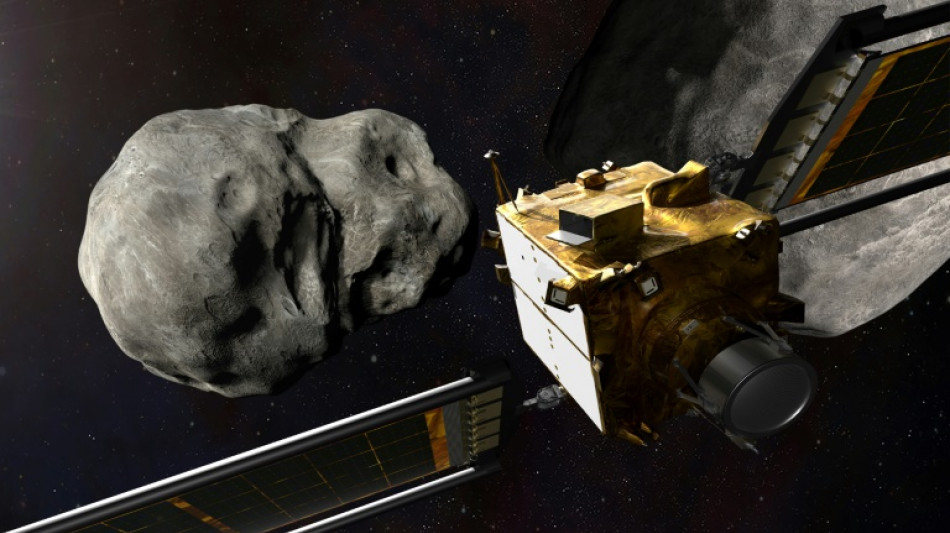
After asteroid collision, Europe's Hera will probe 'crime scene' / Photo: Handout - NASA/AFP/File

 'Glad it's over': Kim powers to Games gold and military exemption

 After 11 World Cups, football finally comes home for one Indian fan

 Marc Marquez wins sprint at Japan MotoGP, Martin grabs pole

 Alcaraz fends off Arnaldi to reach Japan Open quarters

 Antonelli tops times in final practice at Bahrain GP

 Gauff digs deep to beat Osorio in China Open second round

 Fresh protests to hit Spain after housing measures defeated

 'He's here with me': Japan cycle queen dedicates gold to late brother

 Japan Olympic chief says 'lot more' athletes at Games than expected

 Asian carmakers besting US rivals at home, China poised to strike

 Widgets & Web Offers All-Inclusive Investor Relations Websites for Public Companies, IPOs and SPACs

 Adams named new US captain to 2030 World Cup

 China a better influence in Latin America than US: poll

 Judge pauses construction of border project in Texas national park

 Belgium's De Bruyne fires double to sink Turkey, France held by Italy

 US jobs data boosts stocks as oil prices dip

 US Supreme Court to hear high-stakes climate case

 Trump expected to name intel chief Clayton as AI czar: reports

 Argentina unveils passports-for-investment scheme

 Brazil election debate chaos sparks censorship row

 England's Carse charged by cricket body over nightclub incident

 Amazon vows $1 bn for data center towns, decries 'myths'

 Oil prices drop on G7 fuel release, US jobs data boosts stocks

 G7 agrees deal to ease global energy supply concerns

 Spain's government dealt blow as lawmakers reject housing bills

After NASA deliberately smashes a car-sized spacecraft into an asteroid next week, it will be up to the European Space Agency's Hera mission to investigate the "crime scene" and uncover the secrets of these potentially devastating space rocks.
NASA's Double Asteroid Redirection Test (DART) aims to collide with the asteroid moonlet Dimorphos on Monday night, hoping to slightly alter its trajectory -- the first time such an operation has been attempted.
While Dimorphos is 11 million kilometres (6.8 million miles) away and poses no threat to Earth, the mission is a test run in case the world someday needs to deflect an asteroid from heading our way.
Astronomers around the world will watch DART's impact, and its effect will be closely followed to see if the mission passed the test.
Then, the European Space Agency's Hera mission, named after the ancient Greek queen of the gods, will follow in its footsteps.
The Hera spacecraft is planned to launch in October 2024, aiming to arrive at Dimorphos in 2026 to measure the exact impact DART had on the asteroid.
But scientists are not only excited to see DART's crater, but also to explore an object that is very much out of this world.
- 'A new world' -
Dimorphos, which orbits a larger asteroid Didymos as they hurtle together through space, provides not only a "perfect testing opportunity for a planetary defence experiment, but it is also a completely new environment," the ESA's Hera mission manager Ian Carnelli said.
Hera will be loaded up with cameras, spectrometers, radars and even toaster-sized nano-satellites to measure the asteroid's shape, mass, chemical composition and more.
NASA's Bhavya Lal said that it was critically important to understand the size and composition of such asteroids.
"If an asteroid is made up of, for example, loose gravel, approaches to disrupt it may be different than if it was metal or some other kind of rock," she told the International Astronautical Congress in Paris this week.
So little is known about Dimorphos that scientists will discover "a new world" at the same time as the public on Monday, Hera mission principal investigator Patrick Michel said.
"Asteroids are not boring space rocks -- they are super exciting because they have a great diversity" in size, shape and composition, Michel said.
And because they have low gravity compared to Earth, matter there could behave completely differently than expected.
"Unless you touch the surface, you cannot know the mechanical response," he said.
- 'Behaved almost like fluid' -
For example, when a Japanese probe dropped a small explosive near the surface of the Ryugu asteroid in 2019, it was expected to make a crater of two or three metres. Instead, it blasted a 50-metre hole.
"There was no resistance," Michel said.
"The surface behaved almost like a fluid," rather than solid rock, he added. "How weird is that?"
One way the Hera mission will test Dimorphos will be to land a nano-satellite on its surface, in part to see how much it bounces.
Binary systems like Dimorphos and Didymos represent around 15 percent of known asteroids, but have not yet been explored.
With a diameter of just 160 metres -- around the size of the Great Pyramid of Giza -- Dimorphos will also be the smallest asteroid ever studied.
Learning about the impact of DART is not only important for planetary defence, Michel said, but also for understanding the history of our Solar System, where most cosmic bodies were formed through collisions and are now riddled with craters.
That's where DART and Hera could shine a light not just on the future, but on the past.
E.Raimundo--PC



