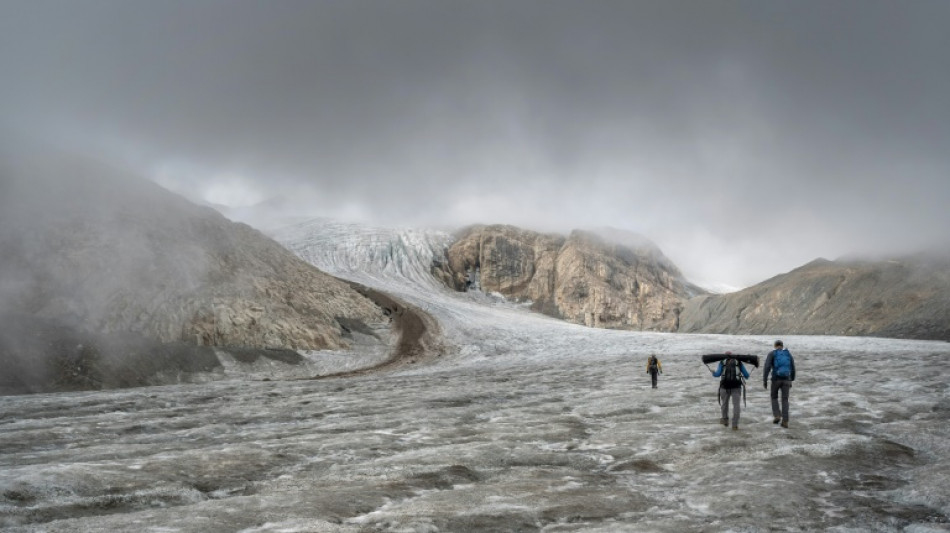
Swiss glaciers melting away at record rate / Photo: Fabrice COFFRINI - AFP

 'Glad it's over': Kim powers to Games gold and military exemption

 After 11 World Cups, football finally comes home for one Indian fan

 Marc Marquez wins sprint at Japan MotoGP, Martin grabs pole

 Alcaraz fends off Arnaldi to reach Japan Open quarters

 Antonelli tops times in final practice at Bahrain GP
 Gauff digs deep to beat Osorio in China Open second round

 Fresh protests to hit Spain after housing measures defeated
 'He's here with me': Japan cycle queen dedicates gold to late brother
 Japan Olympic chief says 'lot more' athletes at Games than expected
 Asian carmakers besting US rivals at home, China poised to strike

 Widgets & Web Offers All-Inclusive Investor Relations Websites for Public Companies, IPOs and SPACs

 Adams named new US captain to 2030 World Cup

 China a better influence in Latin America than US: poll

 Judge pauses construction of border project in Texas national park

 Belgium's De Bruyne fires double to sink Turkey, France held by Italy

 US jobs data boosts stocks as oil prices dip

 US Supreme Court to hear high-stakes climate case
 Trump expected to name intel chief Clayton as AI czar: reports
 Argentina unveils passports-for-investment scheme

 Brazil election debate chaos sparks censorship row
 England's Carse charged by cricket body over nightclub incident

 Amazon vows $1 bn for data center towns, decries 'myths'
 Oil prices drop on G7 fuel release, US jobs data boosts stocks

 G7 agrees deal to ease global energy supply concerns

 Spain's government dealt blow as lawmakers reject housing bills
Switzerland's glaciers lost six percent of their total volume this year due to a dry winter and repeated summer heatwaves, shattering previous ice melt records, a report revealed Wednesday.
The study by the Cryospheric Commission (CC) of the Swiss Academy of Sciences laid bare the drastic scale of glacial retreat -- which is only set to get worse.
"2022 was a disastrous year for Swiss glaciers: all ice melt records were smashed," the CC said, adding that a two percent loss in 12 months had previously been considered "extreme".
Three cubic kilometres of ice -- three trillion litres of water -- have melted away, the report said.
"It's not possible to slow down the melting in the short term," said glaciology professor Matthias Huss, head of Glacier Monitoring in Switzerland, which documents long-term glacier changes in the Alps and is coordinated by the CC.
If carbon dioxide emissions are reduced and the climate protected, "this might save about one third of the total volumes in Switzerland in the best case", he told AFP.
Otherwise, the country "will be losing almost everything by the end of the century".
- Saharan dust speeds melt -
At the start of the year, the snow cover in the Alps was exceptionally light, then a large volume of sand dust blew in from the Sahara Desert between March and May, settling on the surface.
The contaminated snow absorbed more heat and melted faster, depriving the glaciers of their protective snow coating by early in the European summer.
The continuous heat between May and early September therefore ravaged the glacial ice.
By mid-September, the once-thick layer of ice that covered the pass between the Scex Rouge and Tsanfleuron glaciers had completely melted away, exposing bare rock that had been frozen over since at least the Roman era.
And in early July, the collapse of a section of the Marmolada glacier, the biggest in the Italian Alps, killed 11 people and highlighted how serious the situation had become.
According to an Intergovernmental Panel on Climate Change report published in February, the melting of ice and snow is one of the 10 key threats from climate change.
- Smallest glaciers hardest hit -
"The loss was particularly dramatic for small glaciers," the CC said.
The Pizol, Vadret dal Corvatsch and Schwarzbachfirn glaciers "have practically disappeared -- measurements were discontinued", the commission said.
In the Engadine and southern Valais regions, both in the south, "a four to six-metre-thick layer of ice at 3,000 metres above sea level vanished," said the report.
Significant losses were recorded even at the very highest measuring points, including the Jungfraujoch mountain, which peaks at nearly 3,500 metres.
"Observations show that many glacier tongues are disintegrating and patches of rock are rising out of the thin ice in the middle of glaciers. These processes are further accelerating the decline," said the report.
"The trend also reveals how important glaciers are to the water and energy supply in hot, dry years," the report stressed -- something to consider given that hydroelectricity provides more than 60 percent of Switzerland's total energy production.
The glacial meltwater in July and August alone would have provided enough water this year to completely fill all the reservoirs in the Swiss Alps.
But Huss said that if the country experienced this year's meteorological conditions in 50 years' time, "the impact would be much stronger, because in 50 years, we expect that almost all glaciers are gone and therefore cannot provide water in a hot and dry summer".
- Melt reveals macabre finds -
The melting of the glaciers has also had some unexpected consequences.
Hikers are regularly making macabre discoveries as bodies are being freed from the ice they have been encased in for decades or even centuries.
The melting can also be a boon for archaeologists who suddenly have access to objects that are thousands of years old.
Meanwhile the melting of a glacier between Italy and Switzerland has moved the border that ran along the watershed, forcing lengthy diplomatic negotiations.
M.Carneiro--PC



