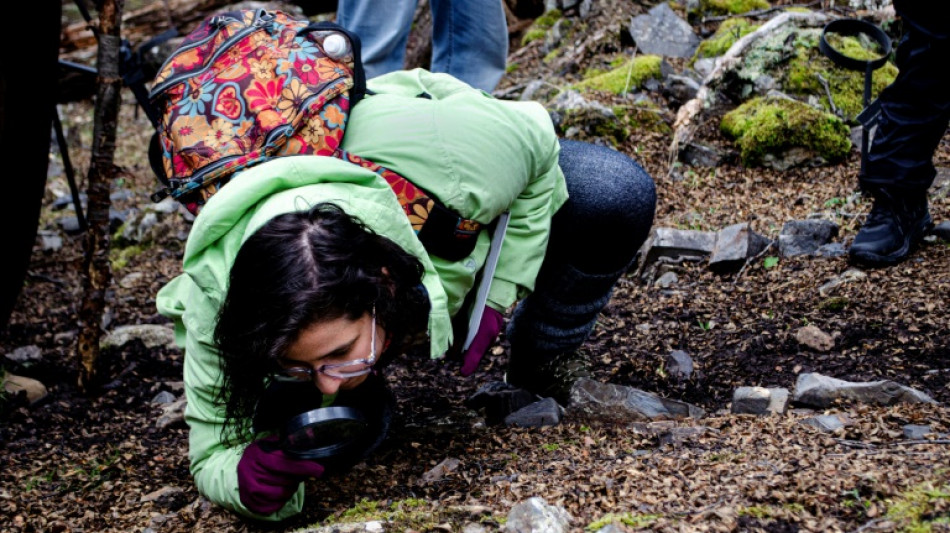
Chile's distant paradise where scientists study climate change / Photo: Alberto PEÑA - AFP

 'Glad it's over': Kim powers to Games gold and military exemption

 After 11 World Cups, football finally comes home for one Indian fan
 Marc Marquez wins sprint at Japan MotoGP, Martin grabs pole

 Alcaraz fends off Arnaldi to reach Japan Open quarters

 Antonelli tops times in final practice at Bahrain GP

 Gauff digs deep to beat Osorio in China Open second round

 Fresh protests to hit Spain after housing measures defeated

 'He's here with me': Japan cycle queen dedicates gold to late brother

 Japan Olympic chief says 'lot more' athletes at Games than expected
 Asian carmakers besting US rivals at home, China poised to strike

 Widgets & Web Offers All-Inclusive Investor Relations Websites for Public Companies, IPOs and SPACs

 Adams named new US captain to 2030 World Cup

 China a better influence in Latin America than US: poll

 Judge pauses construction of border project in Texas national park

 Belgium's De Bruyne fires double to sink Turkey, France held by Italy

 US jobs data boosts stocks as oil prices dip

 US Supreme Court to hear high-stakes climate case

 Trump expected to name intel chief Clayton as AI czar: reports

 Argentina unveils passports-for-investment scheme

 Brazil election debate chaos sparks censorship row

 England's Carse charged by cricket body over nightclub incident

 Amazon vows $1 bn for data center towns, decries 'myths'

 Oil prices drop on G7 fuel release, US jobs data boosts stocks

 G7 agrees deal to ease global energy supply concerns

 Spain's government dealt blow as lawmakers reject housing bills

Hidden inside pristine forests in Chile's deep south, known as the end of the world, lie potential early warning signs of climate change.
Puerto Williams on Navarino island, which is separated from the South American mainland by the Beagle Channel, is the world's southern-most town.
Far from the pollution that blights major urban and industrial centers, it is a paradise that provides unique conditions to study global warming.
"There is nowhere else like it," Ricardo Rozzi, director of the Cape Horn International Center for global change studies and bio-cultural conservation in Puerto Williams, told AFP.
It is "a place that is especially sensitive to climate change" as average temperatures do not rise above five degrees Celsius.
This cold and windy area is the last inhabited southern frontier before reaching the Antarctic.
The ethnobotanical Omora park is home to an immense variety of lichens, mosses and fungi that scientists study by crouching down onto their knees with magnifying glasses.
In the crystal clear Robalo river, minuscule organisms act as sentinels of the changes produced by global warming.
In both the park and river, the alarm bells are ringing.
- Moss and lichen on the move -
At this latitude -- 55 degrees south -- climate change has an exponential effect on flora that react by seeking out low temperatures, said Rozzi, 61.
"The most obvious aspect of climate change is the rising temperatures," he said.
"These lichens cannot survive" if a certain threshold is passed.
To escape the higher temperatures, they move.
"In the case of (mosses) we've noticed that they have moved. Before they were between 50 and 350 (meters above sea level) and now they are between 100 and 400," said Rozzi.
He says Omora has more diversity per square meter of lichens and mosses than anywhere else in the world.
They also help to absorb carbon dioxide.
Another aspect is the elevational diversity gradient, an ecological pattern in which biodiversity changes with elevation.
The 700-meter high Bandera hill's biodiversity changes every 200 meters and there is a mammoth 1.5 degrees Celsius difference in temperature between top and bottom.
"We can see what changes happen in the high mountains and in the area close to the sea in a very short distance, and we can see how the temperature affects the biodiversity that lives in this river," Tamara Contador, 38, a biologist at the Cape Horn International Center, told AFP.
She studies the gradients themselves.
If the height difference between gradients rises or falls on the mountain, scientists can determine whether there has been a global change in temperature.
They say there has been.
- Avoiding 'extermination' -
"On a global level, the polar and subpolar ecosystems are the most affected by climate change, so we are in a place where climate change has a much bigger effect on biodiversity than other places," said Contador.
River organisms also form part of the alert system.
"The organisms that live here are also indicators of water quality and global environmental change," added Contador.
River organisms move about and have already increased their reproductive cycle, says Rozzi. This confirms there has been a small change to the climate in the area that could have been much greater elsewhere on the planet.
"Some insects that have an annual eggs to larvae to adulthood cycle are now having two cycles because the temperature has risen," said Rozzi.
By studying these organisms and learning from them "we can avoid crossing the threshold that brings us to the extermination of humanity and other life forms," he added.
A.Magalhes--PC



