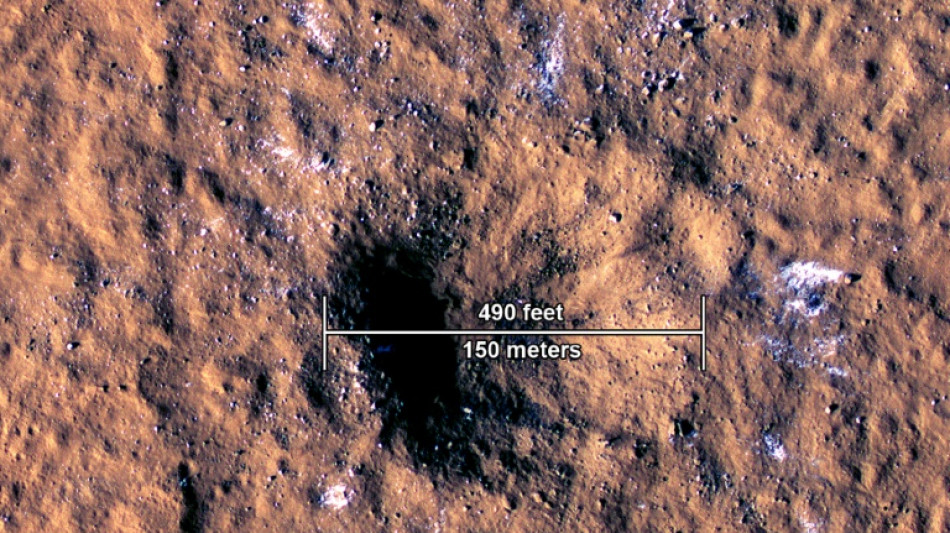
Meteorite that smashed into Mars shook planet, NASA says / Photo: - - NASA/JPL-Caltech/University of Arizona/AFP

 World No.1 Sinner pulls out of Shanghai Masters to delay return

 Red Bull's Verstappen grabs pole position for Bahrain GP

 India beat Pakistan in blockbuster as golfer Kim wins 'crazy' gold

 India beat arch-rivals Pakistan to win Asian Games cricket gold

 Ethiopia's Tigray rebels abandon regional capital as govt advances: journalist

 Tom Kim powers to Games gold and exemption from military service

 Split loyalties for Indian football fans at Brazil friendly

 India-Pakistan blockbuster brings cricket fever to Japan baseball field

 Wong waiting on Rafa after winning Asian Games tennis gold

 With Russia next door and rising costs, Latvia goes to the polls

 Penalty hero rues empty seats as Games hosts Japan win football gold

 North Korea fires ballistic missile after Seoul's apology demand

 US regulator finds Boeing 737 MAX software bug 'not a safety concern'

 Ohtani 'managing' injuries as Dodgers launch MLB post-season

 Botched US execution leaves murderer unconscious on ventilator: lawyers

 Cornell rape case exposes sexual violence at US colleges

 France held by Italy in Zidane's homecoming after Olise stunner

 Ethiopian pro-government militia claims Tigray airport as regional tensions spike

 Ohtani shaking off injuries as Dodgers launch MLB post-season
 Sea levels to rise in California as coastal wave surges up west coast

 New rallies urged in France as protests disrupt over 730 schools

 Djokovic survives China Open scare, Sabalenka starts strong

 King Charles to evoke colonial 'darkest days' on Caribbean tour

 Tesla shares jump after global car sales top estimates

 DR Congo Ebola outbreak killed more than 4,000: official figures

Scientists who study Mars on Thursday revealed the remarkable Christmas gift they received from the planet last year.
On December 24, 2021, a meteorite hit Mars' surface, triggering magnitude 4 tremors, which were detected by NASA's InSight spacecraft -- which landed on the planet four years ago -- some 2,200 miles (3,500 kilometers) away.
The true origin of this so-called marsquake was only confirmed when the Mars Reconnaissance Orbiter (MRO) was able to take a picture of the newly formed crater created by the hit when it flew over the impact site less than 24 hours later.
The image is impressive, showing blocks of ice that were spewed up onto the planet's surface around the 492-foot (150-meter) wide and 70-foot (21-meter) deep hole.
The crater is the largest ever observed since the MRO began its Mars orbit 16 years ago.
And though meteorite impacts on Mars are not rare, "we never thought we'd see anything that big," Ingrid Daubar, who works on the InSight and MRO missions, told reporters at a press conference Thursday.
Researchers estimate that the meteorite itself would have measured between 16 to 39 feet across. An object of that size would have disintegrated in Earth's atmosphere before falling to the ground here.
"It is simply the biggest meteorite impact on the ground that we have heard since science has been done with seismographs or seismometers," said planetology professor Philippe Lognonne, who participated in two studies related to the observation published in the journal Science Thursday.
NASA released an audio recording of the collision, which was made by speeding up the vibrations collected by the seismometer.
- 'Useful' ice presence -
The valuable information gathered in studying the crash will contribute to deeper knowledge of Mars' interior and the history of how the planet was created, scientists said.
The presence of ice, in particular, is "surprising," said Daubar, who also co-authored the two studies.
"This is the warmest spot on Mars, the closest to the equator, we've ever seen water ice," she said.
In addition to the information this discovery offers about the Martian climate, the presence of water at this latitude -- and not just near the poles -- could prove "really useful" for future human visitors to Mars, director of NASA's Planetary Science Division Lori Glaze said.
"We'd want to land the astronauts as near to the equator as possible," she said, to take advantage of warmer temperatures.
"That ice could be converted into water, oxygen or hydrogen," Glaze said.
The impact was powerful enough to generate seismic waves both down to the planet's core and across its crust horizontally, making it possible to study Mars' internal structure -- revealing that the crust on which InSight sits is less dense than the crust the waves traveled over from the crater site.
The end of InSight's mission -- which recorded more than 1,300 marsquakes in total -- could come in the next couple of months, according to Bruce Banerdt of NASA's Jet Propulsion Lab, due to the expected accumulation of dust on the lander's solar power panel.
It's "sad," he said, while celebrating that the probe worked "marvelously" for four years.
O.Salvador--PC



