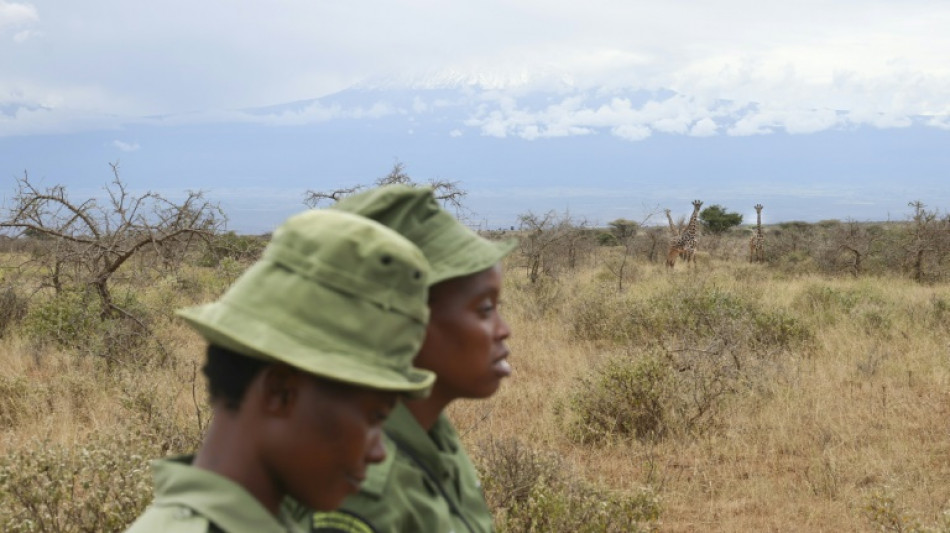
Women rangers fight poachers and prejudice in Kenya / Photo: Tony KARUMBA - AFP

 Saudi Arabia, Turkey, Pakistan sign defence pact amid regional war

 Trump renews effort to remove US Fed Governor Lisa Cook

 Abelardo de la Espriella, the flamboyant millionaire taking power in Colombia

 Germany holds security meeting over explosive drone amid Russia protest

 Austrian writer Stefan Zweig, who fled Nazis, honoured in London
 Mexico and Peru reestablish ties after asylum spat
 Dollar drops, stocks climb as weak US jobs data eases rate fears

 Japan defender Tomiyasu joins Crystal Palace
 Celtic boss O'Neill out of hospital after 'small procedure'

 Man City reject Barcelona bid for Rodri - reports

 US unexpectedly loses jobs in blow to Trump ahead of midterms

 Dollar drops, stocks climb after surprise US jobs miss

 Thai students in disbelief after deadly school shooting

 McLaren boss glad of 'harmony' between F1 teammates Norris and Piastri
 Saudi Arabia, Turkey and Pakistan sign defence pact amid regional war

 Maradona bloated, bedridden and resigned before death, says icon's masseur

 Infantino and the failed investment plan -- What they said

 Thailand teen kills seven in home, school shooting

 Volt Funded Launches Globally with Evaluation Program Offering Up to 90% Profit Share
 Indonesia battles Mount Bromo wildfire as El Nino takes root

 STARCARES Revamps Basketball Court at the University of Lagos for Future Healthcare Professionals

 Eight dead, including teen suspect's grandparents, in Thailand shooting
 Indonesia traps monkey to end rampage that wounded 18 people
 Food security fears mount as UK farmers battle drought
 Houthi missile attacks kill 58 Saudi-backed Yemeni govt forces
Under the blazing Kenyan sun, Maasai women patrol the vast plains in the foothills of Mount Kilimanjaro, determined to tackle poachers and patriarchal prejudices.
As the unarmed members of Team Lioness move stealthily across the land bordering the famous Amboseli National Park in southern Kenya, one of them signals to the others to stop.
Just then, a giraffe appears, head bobbing above the trees, followed by a second.
One of the rangers grabs a walkie talkie: "We saw 28 antelopes, 18 zebras and six giraffes."
Keeping track of wildlife and fighting poaching is their main responsibility.
"In 2022, we arrested a man... who just butchered a giraffe," says Purity Lakara, who heads the team.
But for many of the rangers, battling age-old prejudices within the Maasai community, semi-nomadic herders living in southwest Kenya and northern Tanzania, is no less difficult than tackling poaching.
While Maasai men no longer need to kill a lion to prove their virility in a coming-of-age ceremony, many other patriarchal traditions, such as child marriage and female genital mutilation, are still practised, despite being illegal.
- 'Change the perception' -
"My community believes that a woman cannot do a physically demanding job," said Lakara, 27, listing the duties commonly assigned to Maasai women.
"A woman is only supposed to be staying at home, giving birth, milking the cows and goats, going for firewood and water," she told AFP.
"I wanted to become a ranger to change the perception of my community," she said.
Most members of Team Lioness told AFP they faced a tough time convincing their family to support their ambitions.
Sharon Nankinyi, 23, said her parents told her it was "impossible", urging her to find contentment in household chores and motherhood.
But Nankinyi persevered, along with the other women.
"We came back to the community and we proved (it to) them because they saw us with the uniforms, they saw us as we walked long distances," she said, describing herself as "a brave lady, a Maasai, who has become a ranger".
Naiswaku Parsitau, a 70-year-old Maasai community leader, told AFP she had doubts when the idea was first floated in 2019, but has since changed her mind.
Looking at her herd of goats grazing outside Risa, a small village of around 500 inhabitants, Parsitau said she had seen hyenas roaming nearby -- a source of sleepless nights.
"When we have those issues, we call the rangers and they patrol at night to protect the animals," she said.
"They help us a lot and they can inspire other women."
Fellow herder Saitrbru Kimakori, 39, told AFP he initially "doubted that the girls could succeed".
"We believed only men could deal with lions, elephants, and incidents at night," he said.
But he conceded: "They have been showing up even when called at 2:00 am at night, following up when told that lions have crossed a road or told that a cow has gotten lost somewhere."
- 'A role model' -
The 17 women are not part of the government-run Kenya Wildlife Service. Team Lioness was created by the International Fund for Animal Welfare (IFAW), which pays the rangers' salaries.
"At the beginning, there was resistance, men did not want to see women in uniforms, and it was a mountain to climb to prove that they were capable," said James Isiche, director for IFAW Africa.
But in the tiny Maasai village of Endoinyoenkai, gender stereotypes are slowly being banished, with community leader Kenneth Saei, 56, loudly proclaiming his support for the initiative.
"In every profession, there are women," he told AFP.
"In engineering there are women, in law there are women, even the pilots who shoot (at) other countries, there are women -- so why not this profession?"
At 21, Sharon Mumbi, the "only female ranger" from the village, was the cynosure of all eyes as she swapped her khaki uniform for traditional Maasai garb.
She told AFP she wanted other women to follow her path and live a "more empowered" life.
"I can say I am a role model," she smiled.
R.J.Fidalgo--PC