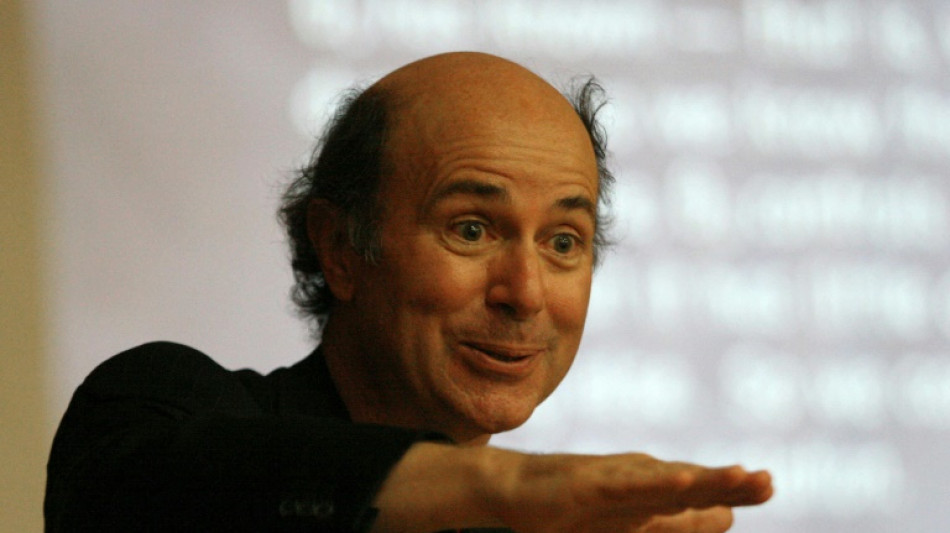
Templeton Prize-winning physicist pushes back against anti-intellectualism / Photo: RODRIGO BUENDIA - AFP/File

 Germans vote in elections threatening fresh blow to Merz

 US fears rapid escalation in Mideast after Houthis attack Riyadh

 Japan triathlete Hojo wins first gold of Asian Games

 IOC president impressed by 'beautiful' Asian Games wooden huts

 First Asian Games gold goes to Japan as China's 13-year-old Yu lights up pool

 Data centre command hub keeps AI up and running

 Pope Leo in France: the issues on the table

 Packing for a pope: behind the scenes on foreign trips

 Republicans find transgender issues a powerful political weapon in midterm campaigning

 German state elections threaten new shock waves for Merz

 Chile's Bachelet quits race to be next UN chief

 Raphinha treble fires perfect Barca to win at Sevilla

 Thiam makes winning heptathlon return at Decastar meet

 Czechs beat USA to qualify for Davis Cup finals

 Dortmund sink Stuttgart to climb to Bundesliga summit

 Trump says will not tolerate attempts to slow AI growth

 'It has to stop': runners protest women's murders in S.Africa district

 Fire erupts near Riyadh airport as Houthis claim strikes

 Cuba works to restore power after another blackout

 England thrash Sri Lanka again to return to top of T20 rankings

 Arsenal thrashed by Brighton, sorry Spurs lose again

 South Korea, Austria qualify for Davis Cup finals

 Seare shocks Ingebrigtsen to win world 5km gold

 Brigitte Bardot widower slams sale of star's belongings

 Aston Villa compound Tottenham's misery despite late rally

Frank Wilczek, the Nobel-winning theoretical physicist whose research transformed humanity's understanding of the fundamental forces of nature, was announced Wednesday as the winner of the prestigious 2022 Templeton Prize.
The 70-year-old told AFP he saw the award as a testament to the inspiring power of science, at a time when scientists themselves are increasingly under fire by anti-intellectual elements in society.
"In the United States, where I live, it's in our face in recent years, and a whole political party is dedicated towards it. It's very unfortunate," the MIT professor said.
"These people are saying, 'Oh, I can find my own information on the internet.' There wouldn't be an internet without understanding quantum mechanics and science, and all the hard work that engineers have put into this!"
Such designers and builders of complex systems, Wilczek said, "should get a certain amount of credibility from that: they build bridges that don't fall down usually, and vaccines that work."
But he acknowledged some alienation was due to "perceived arrogance" by certain members of the scientific community, who he said must earn their credibility through patience, tolerance and honesty.
Valued at more than $1.3 million, the Templeton Prize is one of the world's largest annual individual awards, honoring those who explore the deepest questions of the universe and humankind's place within it.
Past laureates include Mother Teresa and Jane Goodall.
"Throughout Dr Wilczek's philosophical reflections, there is a spiritual quality to his ideas," said Heather Templeton Dill, president of the John Templeton Foundation, in a statement.
"By uncovering a remarkable order in the natural world, Dr. Wilczek has come to appreciate different ways of thinking about reality, and through his written work, he has invited all of us to join him in the quest for understanding."
- Demystifying dark matter -
Wilczek's achievements in physics include an explanation for one of the four fundamental forces of nature: the so-called "strong interaction" between elementary particles called quarks -- for which he and two others won the 2004 Nobel prize in physics.
He also proposed a leading explanation for dark matter, which is believed to constitute 80 percent of the matter of the universe, though its nature is not yet known.
More than four decades ago, Wilczek suggested that a type of subatomic particle called an "axion" was responsible for the mysterious matter -- but it is only recently that experiments have come closer to confirming their existence, thanks to advances in technology.
If these experiments succeed, "we would make our understanding of fundamental laws considerably more beautiful. And it would also confirm that the universe is comprehensible," he said.
In 2020, French scientists confirmed the existence of another particle that Wilczek named in the 1980s: the "anyon," which can maintain a form of memory of their interactions with one another.
Microsoft is investing in this curiosity of theoretical physics to develop the next generation of quantum computing, which Wilczek says could revolutionize that nascent field.
"Without denigrating the existing platform (of quantum computing), it's like having vacuum tubes and then having transistors," he said, recalling the technology leap responsible for today's computer chips.
Beyond his research, Wilczek is known for his public engagement through his talks and popular books, including "A Beautiful Question" and "The Lightness of Being," as well as columns for The Wall Street Journal.
Bridging the gap between science and the public is vital, he said, "especially for scientists who do research that's curiosity driven and has no obvious applications."
"What they're producing is a cultural product, and it should be brought into the culture."
A.Santos--PC