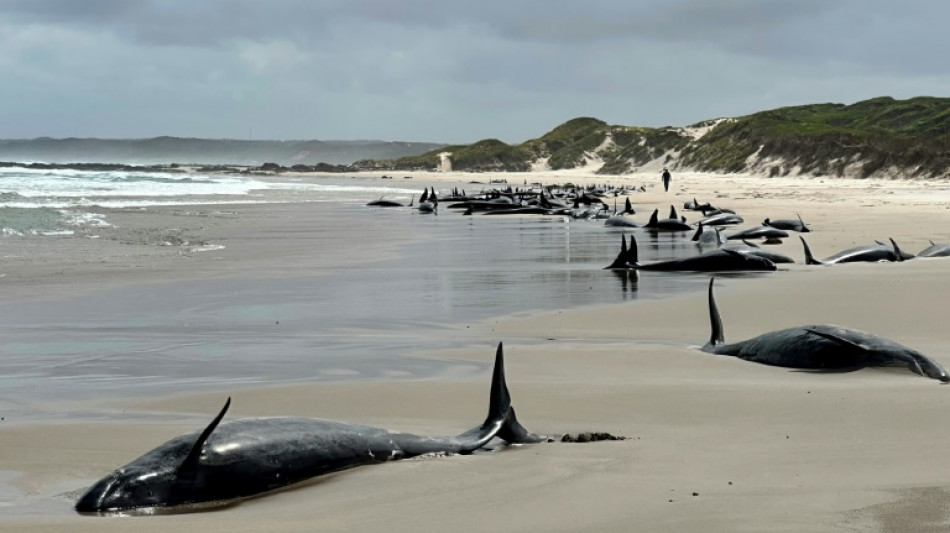
Pod of 157 dolphins stranded on remote Australian beach / Photo: Handout - Department of Natural Resources and Environment Tasmania/AFP

 Multi-Asset Trading Venue Monochrome Exchange Announces IEO of Its Native Token, $MCR

 South Korea break Japan hearts to win Asian Games basketball gold
 Acosta takes first victory at Austrian MotoGP

 PSG president Nasser al-Khelaifi under investigation in France for conflict of interest

 China swim sensation, 13, sets Games record after Japan win early

 Drones hit Moscow as Russians go to the polls

 New England boss Fleming says 'wrong' to ask Stokes to end retirement

 Germans vote in elections threatening fresh blow to Merz

 US fears rapid escalation in Mideast after Houthis attack Riyadh

 Japan triathlete Hojo wins first gold of Asian Games

 IOC president impressed by 'beautiful' Asian Games wooden huts

 First Asian Games gold goes to Japan as China's 13-year-old Yu lights up pool

 Data centre command hub keeps AI up and running

 Pope Leo in France: the issues on the table

 Packing for a pope: behind the scenes on foreign trips

 Republicans find transgender issues a powerful political weapon in midterm campaigning

 German state elections threaten new shock waves for Merz

 Chile's Bachelet quits race to be next UN chief

 Raphinha treble fires perfect Barca to win at Sevilla

 Thiam makes winning heptathlon return at Decastar meet

 Czechs beat USA to qualify for Davis Cup finals

 Dortmund sink Stuttgart to climb to Bundesliga summit

 Trump says will not tolerate attempts to slow AI growth

 'It has to stop': runners protest women's murders in S.Africa district

 Fire erupts near Riyadh airport as Houthis claim strikes

Dozens of dolphins have died after a pod of more than 150 stranded on a remote beach in Australia's southern island of Tasmania, environment officials said Wednesday.
A pod of 157 dolphins from a poorly understood deep-sea species was believed to have stranded in the past 48 hours -- with "approximately 90" still alive as of Wednesday morning.
They appeared to be members of a large dolphin species known as false killer whales, officials said, named for the orca-like shape of their skull.
State wildlife officer Brendon Clark said it would be difficult to refloat the surviving dolphins, which can weigh upwards of one tonne.
"As with any stranding euthanasia is an option to minimise suffering, and we do have vets on site to help make informed decisions if that is deemed necessary," he told reporters.
It is reasonably common for pods of false killer whales to strand themselves on Australia's beaches.
But Clark said it was the first time in 50 years they had beached in that part of Tasmania.
"They haven't displayed this type of behaviour in our waters for a long period," he said.
"They are migratory animals and they roam the open waters around the globe.
"The reasoning behind why they have stranded for the first time in 50 years, we haven't got any intel on that.
"That is something that hopefully post-mortem examination will provide some insight into."
- Poorly understood -
The dolphins were stranded on a beach near the Arthur River inlet on the west coast of Tasmania, a sparsely populated area known for its windswept coastline.
Dozens of sleek and dark-skinned dolphins were pictured Tuesday wallowing in wet sand as a shallow tide lapped against them.
"Stranding response in this area is complex due to the inaccessibility of the site, ocean conditions and the challenges of getting specialist equipment to the remote area," Tasmania's environment department said in a separate statement.
False killer whales can reach up to six metres (20 feet) in length and are known as a highly social species that gathers in pods of 50 or more.
Big adults can weigh more than one tonne, according to the US National Oceanic and Atmospheric Administration.
The species is often involved in mass strandings that can "wipe out whole schools involving hundreds of animals", according to the Australian Museum.
Little is known about false killer whales, according to a government factsheet, and there are no reliable estimates of their population size.
The Australian government lists their conservation status as "near threatened".
F.Moura--PC