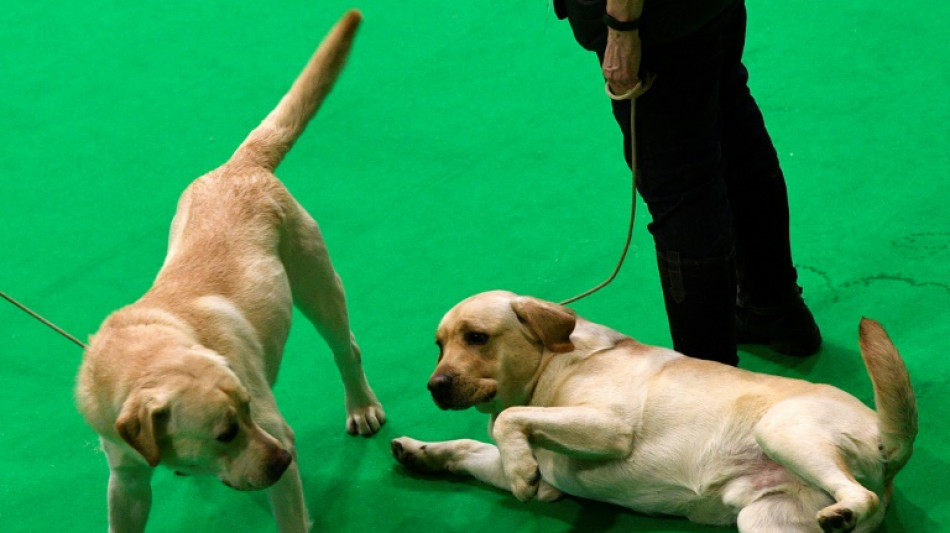
Chunky canines: Study reveals dog obesity gene shared by humans / Photo: Oli SCARFF - AFP/File

 Multi-Asset Trading Venue Monochrome Exchange Announces IEO of Its Native Token, $MCR

 South Korea break Japan hearts to win Asian Games basketball gold

 Acosta takes first victory at Austrian MotoGP

 PSG president Nasser al-Khelaifi under investigation in France for conflict of interest

 China swim sensation, 13, sets Games record after Japan win early

 Drones hit Moscow as Russians go to the polls

 New England boss Fleming says 'wrong' to ask Stokes to end retirement

 Germans vote in elections threatening fresh blow to Merz

 US fears rapid escalation in Mideast after Houthis attack Riyadh

 Japan triathlete Hojo wins first gold of Asian Games

 IOC president impressed by 'beautiful' Asian Games wooden huts

 First Asian Games gold goes to Japan as China's 13-year-old Yu lights up pool

 Data centre command hub keeps AI up and running

 Pope Leo in France: the issues on the table

 Packing for a pope: behind the scenes on foreign trips

 Republicans find transgender issues a powerful political weapon in midterm campaigning

 German state elections threaten new shock waves for Merz

 Chile's Bachelet quits race to be next UN chief

 Raphinha treble fires perfect Barca to win at Sevilla

 Thiam makes winning heptathlon return at Decastar meet

 Czechs beat USA to qualify for Davis Cup finals

 Dortmund sink Stuttgart to climb to Bundesliga summit

 Trump says will not tolerate attempts to slow AI growth

 'It has to stop': runners protest women's murders in S.Africa district

 Fire erupts near Riyadh airport as Houthis claim strikes

Obesity is on the rise not just in humans but in dogs, whose history of selective breeding makes them an ideal species for studying the balance between genetics, diet, and lifestyle in weight gain.
In a new paper published Thursday in Science, researchers identified a gene strongly linked to obesity in pet pooches -- and found it is also associated with weight gain in humans.
"The prevailing attitude towards obesity is that people are just a bit rubbish about controlling what they eat, whereas actually, our data shows that if you're a high-risk individual, it takes more effort to keep you slim," lead author Eleanor Raffan, a researcher in the University of Cambridge's Department of Physiology, Development, and Neuroscience, told AFP.
A veterinarian as well as a scientist, Raffan has long sought to study animal genetics to uncover broader biological insights that apply across species, including our own.
For this study, she and her colleagues focused on British Labrador Retrievers.
"Anyone who knows dogs will understand that starting with Labradors is a good idea because they're very prone to getting obese," she said. "They've got this reputation for being really foodie dogs, really obsessed by food."
The team collected slobber samples from 241 dogs and conducted a genome-wide association study, which examines an organism's entire set of genes to identify areas linked to a specific trait.
The top five genes were also present in humans, with the one exerting the strongest influence called DENND1B.
They also assessed how much the dogs pestered their owners for food and whether they were fussy eaters.
"Low-risk dogs tended to remain a healthy weight, irrespective of how their owners managed their food and exercise," said Raffan. "But if you were a high-genetic-risk dog, then if your owners were complacent about diet and exercise, you were likely to get really, really overweight."
For Raffan, the study has two major takeaways.
First, it sheds new light on how DENND1B affects a brain pathway responsible for regulating energy balance and appetite. Known as the leptin-melanocortin pathway, this system is a key target for some anti-obesity drugs.
"Only by understanding biology and the nuances of it can we possibly improve our treatment and management of obesity," she said.
Second, the study allowed researchers to quantify genetic risk for obesity in individual dogs -- and the level of effort required to keep them at a healthy weight. This is easier to measure in dogs than in humans, since their diet and exercise are entirely controlled by their owners.
"We shouldn't be rude to owners of overweight dogs," Raffan emphasized.
"It's not that they're hopeless individuals who don't care about their pets. It's just that they've got animals who persistently seek out opportunities to eat, and just a little bit extra every day is enough to cause weight gain over time."
L.E.Campos--PC