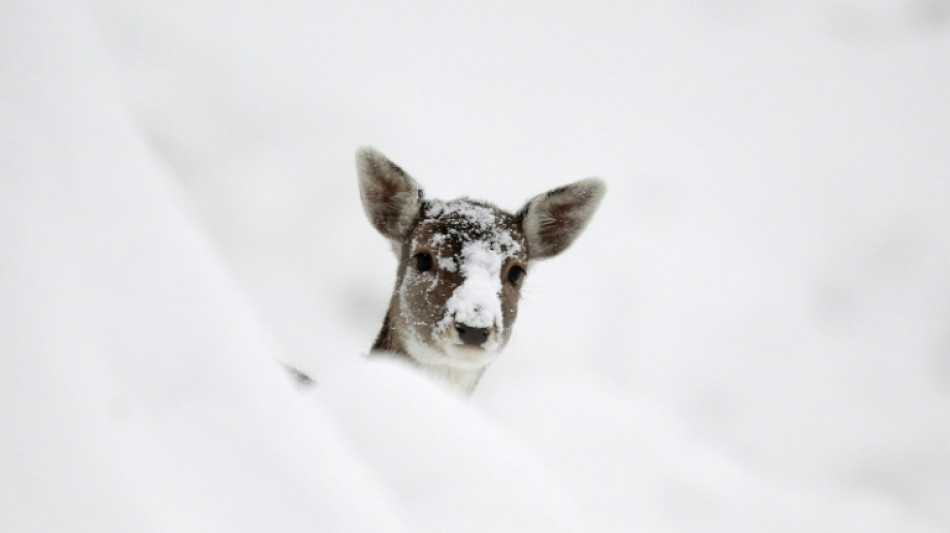
Mammals became warm-blooded later than thought: study / Photo: IAN KINGTON - AFP/File

 Drones hit Moscow as Russians go to the polls

 New England boss Fleming says 'wrong' to ask Stokes to end retirement

 Germans vote in elections threatening fresh blow to Merz

 US fears rapid escalation in Mideast after Houthis attack Riyadh

 Japan triathlete Hojo wins first gold of Asian Games

 IOC president impressed by 'beautiful' Asian Games wooden huts

 First Asian Games gold goes to Japan as China's 13-year-old Yu lights up pool

 Data centre command hub keeps AI up and running

 Pope Leo in France: the issues on the table

 Packing for a pope: behind the scenes on foreign trips

 Republicans find transgender issues a powerful political weapon in midterm campaigning

 German state elections threaten new shock waves for Merz

 Chile's Bachelet quits race to be next UN chief

 Raphinha treble fires perfect Barca to win at Sevilla

 Thiam makes winning heptathlon return at Decastar meet

 Czechs beat USA to qualify for Davis Cup finals

 Dortmund sink Stuttgart to climb to Bundesliga summit

 Trump says will not tolerate attempts to slow AI growth

 'It has to stop': runners protest women's murders in S.Africa district

 Fire erupts near Riyadh airport as Houthis claim strikes

 Cuba works to restore power after another blackout

 England thrash Sri Lanka again to return to top of T20 rankings

 Arsenal thrashed by Brighton, sorry Spurs lose again

 South Korea, Austria qualify for Davis Cup finals

 Seare shocks Ingebrigtsen to win world 5km gold

The ancestors of mammals started to become warm-blooded around 20 million years later than previously thought, researchers suggested Wednesday, after analysing inner-ear fossils hoping to solve "one of the great unsolved mysteries of palaeontology".
Warm-bloodedness is one of the quintessential characteristics of mammals, along with fur, but exactly when they first evolved the feature has long been a subject of debate.
Previous research has indicated that the ancestors of mammals began evolving warm-bloodedness, or endothermy, around 252 million years ago -- around the time of the Permian extinction, known as the "Great Dying".
However figuring out the timeline has proved difficult.
"The problem is that you cannot stick thermometers in your fossils, so you cannot measure their body temperature," said Ricardo Araujo of the University of Lisbon, one of the authors of a new study in the journal Nature.
He was part of an international team of researchers that found a new way to determine how body heat changed throughout time, by examining the semicircular canals in the inner ears of 56 extinct species of mammal ancestors.
Fluid runs through the tiny ear canals, which help animals keep their balance.
The researchers realised that as body temperatures warmed up, so did the ear fluid.
Araujo gave the example of oil used to fry hot chips.
Before you warm the oil up, it is "very viscous, very dense," he told AFP.
"But then when you heat it up, you'll see that the oil is much runnier, it flows much more easily."
The runnier ear fluid led to animals evolving narrower canals -- which can be measured in fossils, allowing the researchers to track body temperature over time.
Unlike previous research on this subject, the team developed a model that not only works on extinct mammal ancestors, but also living mammals, including humans.
"It can look at your inner ear and tell you how warm-blooded you are -- that's how accurate the model is," lead study author Romain David of London's Natural History Museum told AFP.
Using the model, they traced the beginnings of warm-bloodedness to around 233 million ago, in the Late Triassic period.
- 'Not a gradual, slow process' -
Michael Benton, a palaeontologist at Britain's University of Bristol who was not involved in the study, said the new metric "seems to work well for a wide array of modern vertebrates".
"It doesn't just provide a yes-no answer, but actually scales the 'degree' of endothermy in terms of actual typical body setpoint temperature," he told AFP.
Benton, whose previous research had given the 252 million years date, said the transition to warm-bloodedness likely took place in stages, and "there were several significant prior steps before this semicircular canal switch".
Araujo said the new research suggested that warm-bloodedness came about simply and "very quickly in geological terms, in less than a million years".
"It was not a gradual, slow process over tens of millions of years as previously thought".
David said it seemed unlikely that warm-bloodedness would begin around the extinction event 252 million years ago, because global temperatures were extremely hot then.
That would have been a disadvantage for warm-blooded animals -- but they could have thrived as temperatures cooled in the following millions of years.
"Being an endotherm allows you to be more independent of the whims of the climate, to run faster, run longer, explore different habitats, explore the night, explore polar regions, make long migrations," Araujo said.
"There were a lot of innovations at the time that started to define what a mammal is -- but also ultimately what a human being would be."
E.Paulino--PC