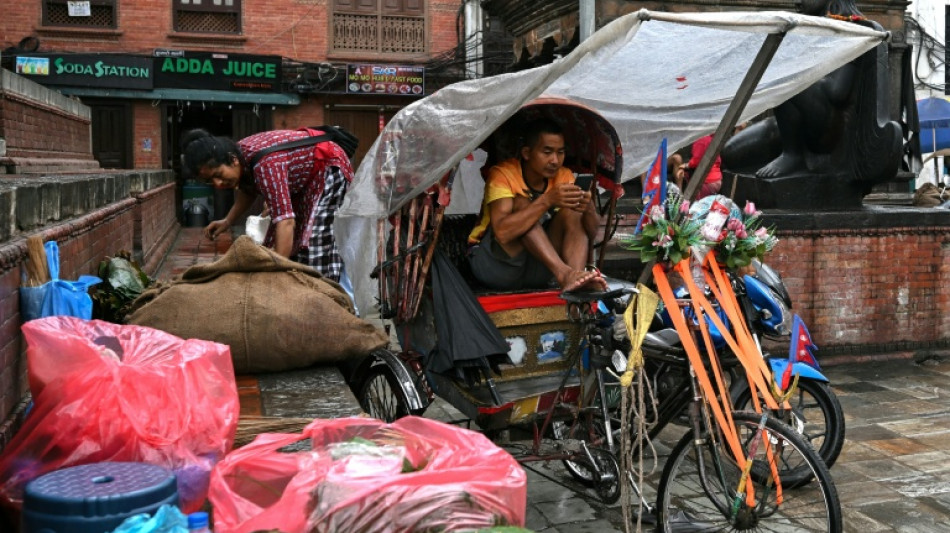
AI disinformation turns Nepal polls into 'digital battleground' / Photo: Arun SANKAR - AFP

 Drones hit Moscow as Russians go to the polls

 New England boss Fleming says 'wrong' to ask Stokes to end retirement

 Germans vote in elections threatening fresh blow to Merz

 US fears rapid escalation in Mideast after Houthis attack Riyadh

 Japan triathlete Hojo wins first gold of Asian Games

 IOC president impressed by 'beautiful' Asian Games wooden huts

 First Asian Games gold goes to Japan as China's 13-year-old Yu lights up pool

 Data centre command hub keeps AI up and running

 Pope Leo in France: the issues on the table

 Packing for a pope: behind the scenes on foreign trips

 Republicans find transgender issues a powerful political weapon in midterm campaigning

 German state elections threaten new shock waves for Merz

 Chile's Bachelet quits race to be next UN chief

 Raphinha treble fires perfect Barca to win at Sevilla

 Thiam makes winning heptathlon return at Decastar meet

 Czechs beat USA to qualify for Davis Cup finals

 Dortmund sink Stuttgart to climb to Bundesliga summit

 Trump says will not tolerate attempts to slow AI growth

 'It has to stop': runners protest women's murders in S.Africa district

 Fire erupts near Riyadh airport as Houthis claim strikes

 Cuba works to restore power after another blackout

 England thrash Sri Lanka again to return to top of T20 rankings

 Arsenal thrashed by Brighton, sorry Spurs lose again

 South Korea, Austria qualify for Davis Cup finals

 Seare shocks Ingebrigtsen to win world 5km gold

Slick AI-generated disinformation has flooded election campaigns in Nepal, which votes Thursday in the first polls since deadly protests triggered by a brief ban on social media overthrew the government.
The September 2025 protests were driven by tech-savvy youth angry at job shortages and flagrant corruption by an ageing political elite.
Now parties across the political divide are tapping social media to push their agendas and woo voters, especially the young, including a surge of people registering to cast their ballot for the first time.
But some of the content is manipulated or outright fake, experts and fact-checkers say.
"In a country where digital literacy is low, people believe what they see," said Deepak Adhikari, editor of the independent NepalCheck team.
Kathmandu-based technology policy researcher Samik Kharel described a "digital battleground" in the run-up to the landmark vote, warning that Nepal lacked the expertise to monitor the onslaught of machine-generated content.
"It is even hard for experts to figure out what is real and fake," Kharel told AFP.
Around 80 percent of all of Nepal's internet traffic is through social media platforms, he said.
Internet analytics site DataReportal estimates more than 56 percent of Nepal's 30 million people are online, including 14.8 million Facebook users and around 4.3 million on Instagram. About 2.2 million are on TikTok, according to the Internet Service Providers' Association of Nepal.
"Disinformation remains a top concern that could undermine the integrity of the election process," said Ammaarah Nilafdeen of the US-based Center for the Study of Organized Hate.
"Nepal... is grappling with the scale of the threat that disinformation poses to society and democracy at large."
- Threat to democracy -
The protests last year began after the government moved to regulate social media, briefly banning at least 26 platforms, including Facebook, Instagram, YouTube and X.
At least 77 people were killed in two days of unrest, parliament was set on fire, and the government of four-time prime minister KP Sharma Oli collapsed.
Activists used the group-chat app Discord to put forward their suggestion of interim leader -- and days later their choice, 73-year-old former chief justice Sushila Karki, was appointed to lead the country to elections.
Social media is playing a key role again.
Loyalists of the ousted premier's Marxist party have shared AI-generated images purporting to be drone photographs of a massive gathering -- which were then reposted by top leaders, boasting a sea of more than 500,000 supporters.
Analysis by Nepali online fact-check experts TechPana found the images had been created using OpenAI's ChatGPT, while police said less than 5,000 people were at the real event.
Another AI-generated video that circulated on TikTok purported to show Gagan Thapa, leader of the Nepali Congress party, urging voters to back a rival party. The platform has removed the video.
In neighbouring India, posts calling to restore Nepal's deposed Hindu monarchy have made the rounds on social media, said researcher Nilafdeen.
Such "ideological pushes" online -- in this case "amplified by Hindu far-right supporters in India" -- stand in contrast to "domestic demands for strengthening democratic institutions", she told AFP.
- Misinformation race -
The Election Commission says there is widespread use of hate speech and deepfake content, including videos created with readily available artificial intelligence tools purporting to show candidates insulting opponents or using obscene language.
"It is a concerning issue," commission information officer Suman Ghimire said.
More than 600 cases have been passed on to the authorities, he added, with around 150 handled by police.
In one case, police detained a pro-royalist supporter, Durga Prasai, for social media posts allegedly meant to intimidate potential voters.
The Election Commission can impose fines or bar candidates from running, but experts say the sheer scale of disinformation and hate speech online outstrips any effective response.
"Candidates and people close to political parties not only compete to win, but also compete to spread misinformation," said Basanta Basnet, editor-in-chief of news website Onlinekhabar, which has collaborated with Nepal FactCheck to verify posts.
The organisation has warned that "misinformation encourages citizens to take wrong decisions", which in turn could undermine the "foundation of democracy".
X.Brito--PC