Treating wounds with insects: the strange habits of Gabon chimps

 Germans vote in elections threatening fresh blow to Merz

 US fears rapid escalation in Mideast after Houthis attack Riyadh

 Japan triathlete Hojo wins first gold of Asian Games

 IOC president impressed by 'beautiful' Asian Games wooden huts

 First Asian Games gold goes to Japan as China's 13-year-old Yu lights up pool

 Data centre command hub keeps AI up and running

 Pope Leo in France: the issues on the table

 Packing for a pope: behind the scenes on foreign trips

 Republicans find transgender issues a powerful political weapon in midterm campaigning

 German state elections threaten new shock waves for Merz

 Chile's Bachelet quits race to be next UN chief

 Raphinha treble fires perfect Barca to win at Sevilla

 Thiam makes winning heptathlon return at Decastar meet

 Czechs beat USA to qualify for Davis Cup finals

 Dortmund sink Stuttgart to climb to Bundesliga summit

 Trump says will not tolerate attempts to slow AI growth

 'It has to stop': runners protest women's murders in S.Africa district

 Fire erupts near Riyadh airport as Houthis claim strikes

 Cuba works to restore power after another blackout

 England thrash Sri Lanka again to return to top of T20 rankings

 Arsenal thrashed by Brighton, sorry Spurs lose again

 South Korea, Austria qualify for Davis Cup finals

 Seare shocks Ingebrigtsen to win world 5km gold

 Brigitte Bardot widower slams sale of star's belongings

 Aston Villa compound Tottenham's misery despite late rally

How to treat a wound?
For humans, the first instinct would be to disinfect it and then cover it with a bandage.
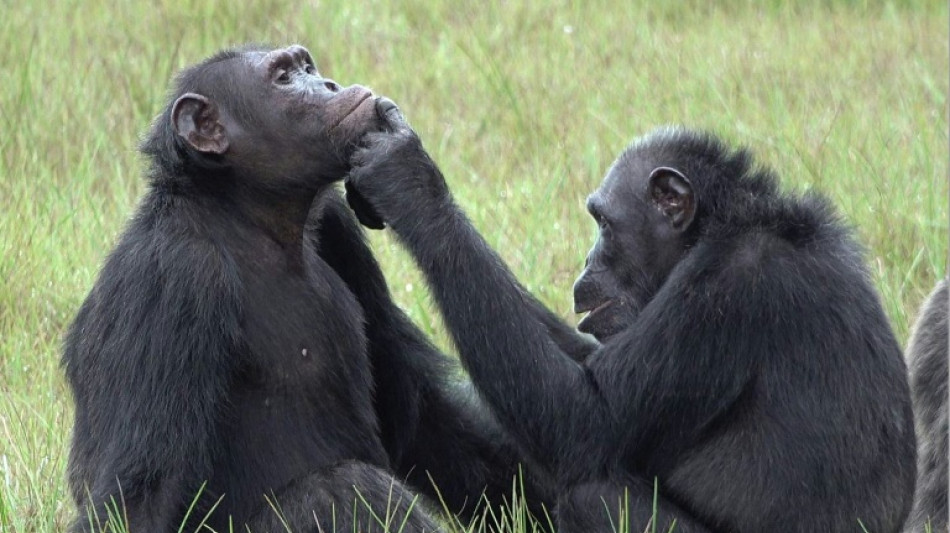
But chimpanzees have invented a more creative method: catching insects and applying them directly to the open wound.
Scientists observed this behavior in chimpanzees in the West African nation of Gabon, noticing that the apes not only use insects to treat their own wounds, but also those of their peers.
The research, published Monday in the journal Current Biology, marks an important contribution to ongoing scientific debate about the ability of chimpanzees -- and of animals in general -- to selflessly help others.
"When you're going to school and you read in your biology books about the amazing things that animals can do," Simone Pika, a biologist at the University of Osnabruck in Germany and a co-author of the study, told AFP. "I think it could really be something like that that will end up in those books."
The project began in 2019, when an adult female chimpanzee named Suzee was observed inspecting a wound on the foot of her adolescent son.
Suzee then suddenly caught an insect out of the air, put it in her mouth, apparently squeezed it, and then applied it to her son's wound.
After extracting the insect from the wound, she applied it two more times.
The scene unfolded in Loango National Park on Gabon's Atlantic coast, where researchers are studying a group of 45 central chimpanzees, an endangered species.
Over the following 15 months, scientists saw chimpanzees administer the same treatment on themselves at least 19 times.
And on two other occasions they observed injured chimpanzees being treated in the same way by one or several fellow apes.
The wounds, sometimes several centimeters wide, can come from conflicts between members of same or an opposing group.
Far from protesting the treatment, the bruised chimpanzees were happy to be tended to.
"It takes lot of trust to put an insect in an open wound," said Pika. "They seem to understand that if you do this to me with this insect, then my wound gets better. It's amazing."
- Soothing properties? -
Researchers have not been able to identify what bug was used on the wounds, but they believe it to be a flying insect given the chimpanzees' rapid movement to catch it.
Pika says the insect could contain anti-inflammatory substances that have a soothing effect.
Insects are known to have various medical properties and researches will need to conduct more work to detect and study the insect in question.
Birds, bears, elephants and other animals have already been observed self-medicating, for example by eating plants.
But what is unique about chimpanzees is that they will treat not just themselves, but also help others.
Some scientists, however, still doubt the ability of animal species to exhibit prosocial behaviors, such as selflessly caring for others, Pika said.
But here the chimpanzees have nothing to gain, she stressed. So why do they do it?
In humans, prosocial behavior is generally linked to empathy.
Could the same feeling be at play in chimpanzees, Pika wondered.
"It is a hypothesis that we must study," she said.
L.Torres--PC