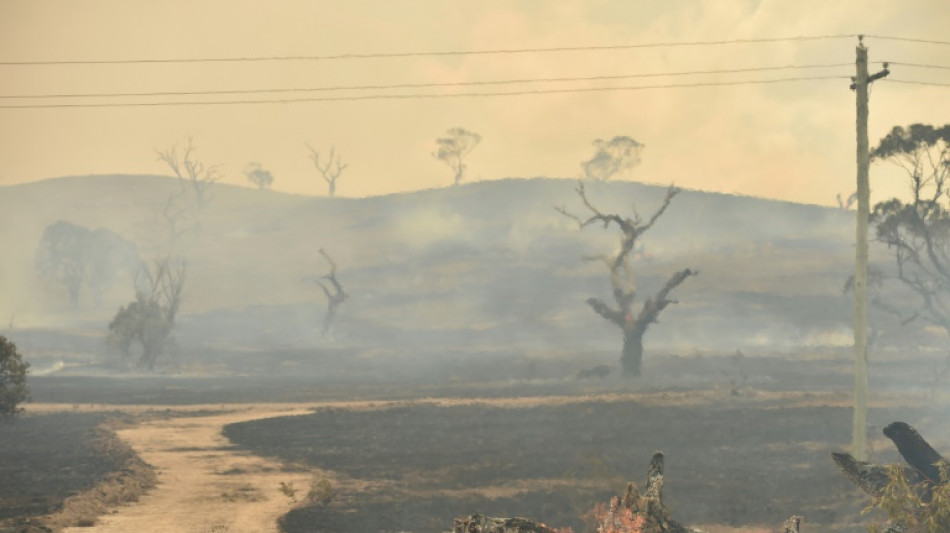
Australian bushfires may have helped trigger La Nina / Photo: PETER PARKS - AFP

 Trump's beef policies irk Texas ranchers, testing their loyalty

 Nvidia, OpenAI CEOs to attend Xi dinner at White House

 Anthropic picks Accenture for in-house AI safety evaluation

 Balogun returns as Monaco beat Lens to continue strong Ligue 1 start

 'Pause' on overt repression in Venezuela, but reforms still needed: HRW

 Global stocks mixed as yen falls despite Bank of Japan rate hike

 Cuba hit with seventh major blackout of the year

 Murray out with concussion so Wentz will start for Vikings

 UN chief 'deeply regrets' US visa refusal to Abbas for annual meeting

 England quick Carse to face no charges over alleged nightclub assault

 Mancini brings nine newcomers into the first squad of his Italy comeback

 Czechs level Davis Cup tie against USA as South Korea eye Finals

 New France boss Zidane confirms Mbappe as captain after naming first squad

 California governor signs order to explore AI 'kill switch'

 Head leads run spree as Australia win Zimbabwe ODI series

 In-form Raphinha wants to finish career at Barcelona

 Warren Buffett steps down as Berkshire Hathaway chairman

 Carrick confident Man Utd can 'work through' tough time

 Mbappe ends Nike partnership to join Swiss brand On

 Liverpool boss Iraola puts Bournemouth love affair on hold

 'A disaster' if Man City do not win says Maresca after flawless start

 Kerry James Marshall: American 'blackness' painter celebrated in Europe

 Spain coach De la Fuente offers 'full support' to people of Ceuta

 Russia seizes assets of Nestle, French firms over West's Ukraine support

 England can build on World Cup 'spirit', says Tuchel

Australia's "Black Summer" bushfire catastrophe coughed up so much smoke it may have fuelled the global onset of La Nina in 2020, according to new research published Thursday.
The report, in peer-reviewed journal Science Advances, said the bushfires were "exceptional" in their severity -- pumping out emissions on a scale similar to major volcanic eruptions.
It suggested this led to the formation of vast banks of cloud over the southeastern Pacific Ocean, which soaked up radiation from the sun and led to the cooling of surface water temperatures.
These disruptions could have helped trigger the start of an unusually long La Nina weather pattern, the researchers found.
The "Black Summer" bushfires raged across Australia's eastern seaboard from late 2019 to early 2020, razing swathes of forest, killing millions of animals, and blanketing cities in noxious smoke.
A rare "triple-dip" La Nina shaped global weather patterns between September 2020 and March 2023, whipping up a series of devastating tropical cyclones while exacerbating droughts in other parts of the planet.
Researchers John Fasullo and Nan Rosenbloom, from the National Center for Atmospheric Research in the United States, used modelling to demonstrate how emissions from the bushfires could shift weather patterns.
Bushfire smoke is laden with particles that act as "condensation nuclei", which attract water molecules in the atmosphere, seeding the formation of clouds.
- Atmospheric impact -
This blanket of cloud could cause "widespread surface cooling" in the tropical Pacific Ocean, the modelling showed, which is one of the key ingredients for the start of La Nina.
"The results here suggest a potential connection between this emergence of cool conditions in the eastern Pacific Ocean and the climate response to the Australian wildfire emissions," the paper stated.
Australian climate scientist Tom Mortlock said the bushfires caused clouds to form in a part of the Pacific that plays a crucial role in global climate regulation.
"The southeast corner of the Pacific is a really sensitive and important area for what goes on with El Nino and La Nina," he told AFP.
"Often we see the first signs of an El Nino or La Nina forming in that part of the ocean."
Pete Strutton, from the Australian Centre of Excellence for Climate Extremes, said it demonstrated the sheer scale of the bushfires.
"We've got an event that happened on the land in southeast Australia, which is having an impact on the atmosphere," he told AFP.
A separate team of British researchers last year found that the "Black Summer" bushfires spewed millions of tonnes of emissions into the atmosphere, likely aggravating the Antarctic ozone hole.
Global weather patterns oscillate between cooling La Nina and warming El Nino cycles -- with neutral conditions in between.
T.Batista--PC


