-
 Trump's beef policies irk Texas ranchers, testing their loyalty
-
Kennedy Center: future unclear for iconic Washington arts hub

-
 Nvidia, OpenAI CEOs to attend Xi dinner at White House
-
Trump claims 'infinite' Greenland security deal with Denmark

-
 Anthropic picks Accenture for in-house AI safety evaluation
-
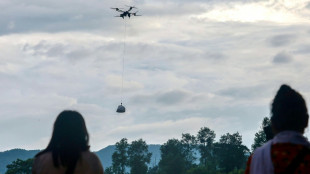
Helicopters battle wildfire threatening Ecuador's capital

-
 Balogun returns as Monaco beat Lens to continue strong Ligue 1 start
-
Brentford batter Chelsea to undo Alonso's promising start

-
 'Pause' on overt repression in Venezuela, but reforms still needed: HRW
-
Kane hits Bundesliga century as Bayern rout Union

-
 Global stocks mixed as yen falls despite Bank of Japan rate hike
-
Trump says CNN, MS NOW, Politico banned from White House

-
 Cuba hit with seventh major blackout of the year
-
Hushing and hedging: US companies retreat on climate

-
 Murray out with concussion so Wentz will start for Vikings
-
Springboks to face Fiji before 2027 Rugby World Cup

-
 UN chief 'deeply regrets' US visa refusal to Abbas for annual meeting
-
Nigeria miners struggled to breathe in cell before 37 died: survivors

-
 England quick Carse to face no charges over alleged nightclub assault
-
McIlroy on the charge at PGA Championship as Reed withdraws

-
 Mancini brings nine newcomers into the first squad of his Italy comeback
-
McIlroy on the charge at PGA Championship

-
 Czechs level Davis Cup tie against USA as South Korea eye Finals
-
Crisis-wracked Volkswagen warns of 10-bn-euro hit to profits

-
 New France boss Zidane confirms Mbappe as captain after naming first squad
-
Costa Rica's Grynspan tops third informal poll for UN chief: diplomat

-
 California governor signs order to explore AI 'kill switch'
-
Stock markets retreat after central bank rate hikes

-
 Head leads run spree as Australia win Zimbabwe ODI series
-
Russia labels director of Cannes Grand Prix winner a 'foreign agent'

-
 In-form Raphinha wants to finish career at Barcelona
-
Macron warns of Russian 'hybrid' threat after meeting presidential hopefuls

-
 Warren Buffett steps down as Berkshire Hathaway chairman
-
UN holds third informal poll for new chief

-
 Carrick confident Man Utd can 'work through' tough time
-
Kulusevski return can spark Spurs: De Zerbi

-
 Mbappe ends Nike partnership to join Swiss brand On
-
Shakira to cap off world tour with Madrid 12-gig run

-
 Liverpool boss Iraola puts Bournemouth love affair on hold
-
Isolated Syrian-Druze city blames Damascus for shortages

-
 'A disaster' if Man City do not win says Maresca after flawless start
-
Isolated Syrian-Druze city shortages

-
 Kerry James Marshall: American 'blackness' painter celebrated in Europe
-
Dutch drop Depay for Germany match in Xavi's first pick

-
 Spain coach De la Fuente offers 'full support' to people of Ceuta
-
Ronaldo named in Portugal squad for Nations League

-
 Russia seizes assets of Nestle, French firms over West's Ukraine support
-
Stock markets diverge after central bank rate hikes

-
 England can build on World Cup 'spirit', says Tuchel
-
Anti-Assad music star makes triumphant return to Syria

Category 5 Cyclone Mocha hits Myanmar, Bangladesh
Cyclone Mocha crashed ashore in Myanmar and southeastern Bangladesh on Sunday, uprooting trees, scattering flimsy homes in Rohingya displacement camps and bringing a storm surge into low-lying areas.
Packing winds of up to 195 kilometres (120 miles) per hour, Mocha hit between Cox's Bazar, home to nearly one million Rohingya refugees in Bangladesh, and Myanmar's Sittwe, according to Bangladesh's weather office.
Streets in Sittwe were turned into rivers as the biggest storm to hit the Bay of Bengal in more than a decade surged through the seaside town.
"The water is gradually rising," social worker Wai Hun Aung told AFP from Sittwe.
"The tide has reached to the drain in front of a school... Soon we will move our important belongings upstairs."
The wind ripped apart homes made of tarpaulin and bamboo at one camp for displaced Rohingya at Kyaukphyu in Myanmar's Rakhine state.
Its residents were anxiously watching the rising sea tide, camp leader Khin Shwe told AFP.
"We are now going to check whether sea water is increasing to our place... if the sea water rises, our camp can be flooded," Khin Shwe said.
In Teknaf in Bangladesh, high winds uprooted trees, brought traffic to a halt and sent residents running for cover, an AFP correspondent said.
"Our camp houses, which are constructed with bamboo and tarpaulins, can be blown away in soft, light winds," Mohammad Sayed, 28, told AFP from Nayapara refugee camp in Cox's Bazar.
"The schools, which are designated as cyclone shelters... are not strong shelters that can withstand the winds of a cyclone. We are scared."
Thousands left Sittwe on Saturday, packing into trucks, cars and tuk-tuks and heading for higher ground inland as meteorologists warned of a storm surge of up to 3.5 metres (11 feet).
"We are not OK because we didn't bring food and other things to cook," said Maung Win, 57, who spent the night in a shelter in Kyauktaw town further inland. "We can only wait to get food from people's donations."
Bangladeshi authorities had moved 190,000 people in Cox's Bazar and nearly 100,000 in Chittagong to safety, divisional commissioner Aminur Rahman told AFP late Saturday.
- 'Major emergency' -
The Myanmar Red Cross Society said it was "preparing for a major emergency response".
In Bangladesh, authorities have banned Rohingya refugees from constructing concrete homes, fearing it may encourage them to settle permanently rather than return to Myanmar, which they fled five years ago following a brutal military crackdown.
The camps are generally slightly inland but most of them are built on hillsides, exposing them to the threat of landslides.
Forecasters expect the cyclone to bring a deluge of rain, which can trigger landslips.
"The wind started about 8:30 this morning and it's getting stronger," a Rohingya community leader in the Kyaukphyu displacement camp told AFP.
"A house at the camp collapsed and the roof of a shelter built by UNHCR was blown away," they said, requesting anonymity.
Hundreds of people also fled Bangladesh's Saint Martin's island, a local resort area right in the storm's path, with thousands more moving to cyclone shelters on the coral outcrop.
Those left behind said they feared the storm's approach.
"We are in a panic because we don't have enough cyclone shelters here," Saint Martin's resident Jahangir Sarwar, 23, told AFP by phone.
"We asked the administrators many times that everyone should be evacuated to a safe place in mainland Teknaf town. But no action was taken."
Cyclone Mocha is the most powerful storm to hit Bangladesh since Cyclone Sidr, Azizur Rahman, the head of Bangladesh's Meteorological Department, told AFP.
Sidr hit Bangladesh's southern coast in November 2007, killing more than 3,000 people and causing billions of dollars in damage.
Operations were suspended at Bangladesh's largest seaport, Chittagong, with boat transport and fishing also halted.
Cyclones -- the equivalent of hurricanes in the North Atlantic or typhoons in the Northwest Pacific -- are a regular and deadly menace on the coast of the northern Indian Ocean where tens of millions of people live.
Cyclone Nargis devastated Myanmar's Irrawaddy Delta in 2008, killing at least 138,000 people.
Scientists have warned that storms are becoming more powerful as the world gets warmer because of climate change.
burs-rma/pdw/pbt
P.Queiroz--PC