Early warning systems send disaster deaths plunging: UN / Photo: Sai Aung MAIN - AFP

 Trump's beef policies irk Texas ranchers, testing their loyalty

 Nvidia, OpenAI CEOs to attend Xi dinner at White House

 Anthropic picks Accenture for in-house AI safety evaluation

 Balogun returns as Monaco beat Lens to continue strong Ligue 1 start

 'Pause' on overt repression in Venezuela, but reforms still needed: HRW

 Global stocks mixed as yen falls despite Bank of Japan rate hike

 Cuba hit with seventh major blackout of the year

 Murray out with concussion so Wentz will start for Vikings

 UN chief 'deeply regrets' US visa refusal to Abbas for annual meeting

 England quick Carse to face no charges over alleged nightclub assault

 Mancini brings nine newcomers into the first squad of his Italy comeback

 Czechs level Davis Cup tie against USA as South Korea eye Finals

 New France boss Zidane confirms Mbappe as captain after naming first squad

 California governor signs order to explore AI 'kill switch'

 Head leads run spree as Australia win Zimbabwe ODI series

 In-form Raphinha wants to finish career at Barcelona

 Warren Buffett steps down as Berkshire Hathaway chairman

 Carrick confident Man Utd can 'work through' tough time

 Mbappe ends Nike partnership to join Swiss brand On

 Liverpool boss Iraola puts Bournemouth love affair on hold

 'A disaster' if Man City do not win says Maresca after flawless start

 Kerry James Marshall: American 'blackness' painter celebrated in Europe

 Spain coach De la Fuente offers 'full support' to people of Ceuta

 Russia seizes assets of Nestle, French firms over West's Ukraine support

 England can build on World Cup 'spirit', says Tuchel

Weather-related disasters have surged over the past 50 years, causing swelling economic damage even as early warning systems have meant dramatically fewer deaths, the United Nations said Monday.
Extreme weather, climate and water-related events caused 11,778 reported disasters between 1970 and 2021, new figures from the UN's World Meteorological Organization (WMO) show.
Those disasters killed just over two million people and caused $4.3 trillion in economic losses.
"The most vulnerable communities unfortunately bear the brunt of weather, climate and water-related hazards," WMO chief Petteri Taalas said in a statement.
The report found that over 90 percent of reported deaths worldwide due to disasters over the 51-year-period occurred in developing countries.
But the agency also said improved early warning systems and coordinated disaster management had significantly reduced the human casualty toll.
WMO pointed out in a report issued two years ago covering disaster-linked deaths and losses between 1970 and 2019, that at the beginning of the period the world was seeing more than 50,000 such deaths each year.
By the 2010s, the disaster death toll had dropped to below 20,000 annually.
And in its update of that report, WMO said Monday that 22,608 disaster deaths were recorded globally in 2020 and 2021 combined.
- 'Early warnings save lives' -
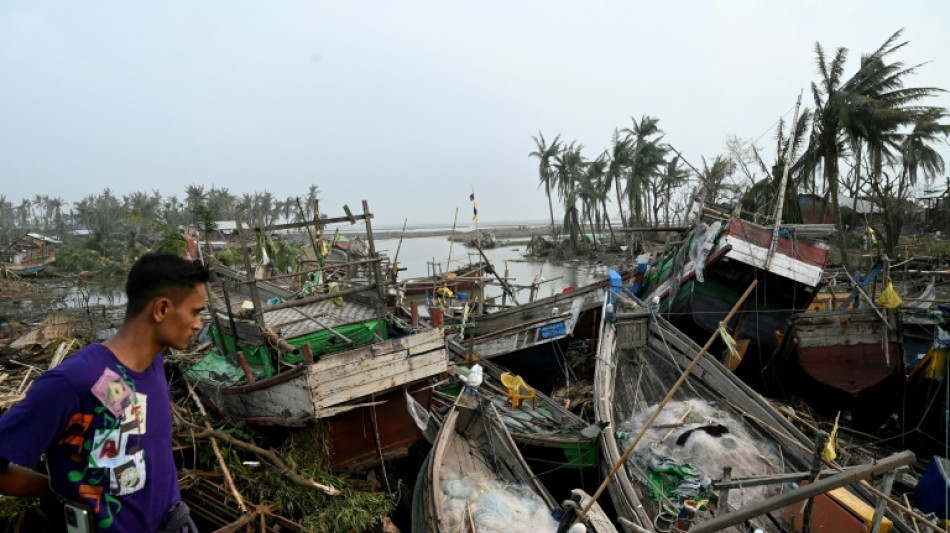
Cyclone Mocha, which wreaked havoc in Myanmar and Bangladesh last week, exemplifies this, Taalas said.
Mocha "caused widespread devastation... impacting the poorest of the poor," he said.
But while Myanmar's junta has put the death toll from the cyclone at 145, Taalas pointed out that during similar disasters in the past, "both Myanmar and Bangladesh suffered death tolls of tens and even hundreds of thousands of people".
"Thanks to early warnings and disaster management these catastrophic mortality rates are now thankfully history. Early warnings save lives."
The UN has launched a plan to ensure all nations are covered by disaster early warning systems by the end of 2027.
Endorsing that plan figures among the top strategic priorities during a meeting of WMO's decision-making body, the World Meteorological Congress, which opens Monday.
To date, only half of countries have such systems in place.
- Surging economic losses -
WMO meanwhile warned that while deaths have plunged, the economic losses incurred when weather, climate and water extremes hit have soared.
The agency previously recorded economic losses increased sevenfold between 1970 and 2019, rising from $49 million per day during the first decade to $383 million per day in the final one.
Wealthy countries have been hardest hit by far in monetary terms.
The United States alone incurred $1.7 trillion in losses, or 39 percent of economic losses globally due to disasters since 1970.
But while the dollar figures on losses suffered in poorer nations were not particularly high, they were far higher in relation to the size of their economies, WMO noted.
Developed nations accounted for over 60 percent of losses due to weather, climate and water disasters, but in more than four-fifths of cases, the economic losses were equivalent to less than 0.1 percent of gross domestic product (GDP).
And no disasters saw reported economic losses greater than 3.5 percent of the respective GDPs.
By comparison, in seven percent of the disasters to hit the world's least developed countries, losses equivalent to more than five percent of their GDP were reported, with several disasters causing losses equivalent to nearly a third of GDP.
And for small island developing states, one fifth of disasters saw economic losses of over five percent of GDP, with some causing economic losses above 100 percent.
F.Carias--PC