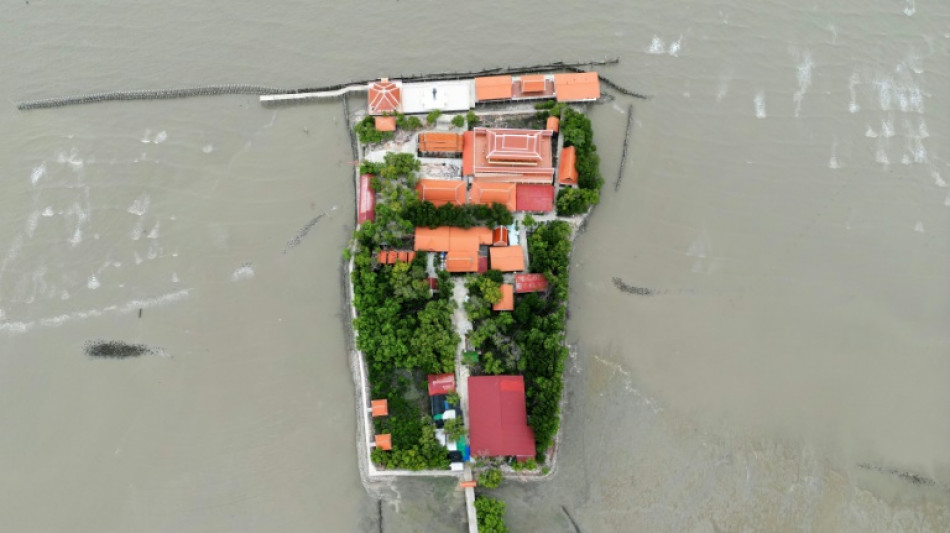
Tiny Thai school on the climate change front line / Photo: Manan VATSYAYANA - AFP

 Drone owners rush to offload devices ahead of Beijing ban

 Trump's beef policies irk Texas ranchers, testing their loyalty

 Nvidia, OpenAI CEOs to attend Xi dinner at White House

 Anthropic picks Accenture for in-house AI safety evaluation

 Balogun returns as Monaco beat Lens to continue strong Ligue 1 start

 'Pause' on overt repression in Venezuela, but reforms still needed: HRW

 Global stocks mixed as yen falls despite Bank of Japan rate hike

 Cuba hit with seventh major blackout of the year

 Murray out with concussion so Wentz will start for Vikings

 UN chief 'deeply regrets' US visa refusal to Abbas for annual meeting

 England quick Carse to face no charges over alleged nightclub assault

 Mancini brings nine newcomers into the first squad of his Italy comeback

 Czechs level Davis Cup tie against USA as South Korea eye Finals

 New France boss Zidane confirms Mbappe as captain after naming first squad

 California governor signs order to explore AI 'kill switch'

 Head leads run spree as Australia win Zimbabwe ODI series

 In-form Raphinha wants to finish career at Barcelona

 Warren Buffett steps down as Berkshire Hathaway chairman

 Carrick confident Man Utd can 'work through' tough time

 Mbappe ends Nike partnership to join Swiss brand On

 Liverpool boss Iraola puts Bournemouth love affair on hold

 'A disaster' if Man City do not win says Maresca after flawless start

 Kerry James Marshall: American 'blackness' painter celebrated in Europe

 Spain coach De la Fuente offers 'full support' to people of Ceuta

 Russia seizes assets of Nestle, French firms over West's Ukraine support
Each morning, four children stand barefoot in a line and proudly sing the national anthem as the Thai flag is raised outside their school, perched on a finger of land surrounded by the sea.
They are the last pupils left at the school in Ban Khun Samut Chin, a coastal village less than 10 kilometres (six miles) from the edge of Bangkok that is slowly being devoured by the waves.
About 200 people cling on in the village, in a glimpse of what the future may hold for countless coastal communities around the world as climate change melts glaciers and ice sheets, causing sea levels to rise.
"I used to have many friends, around 20 or 21 classmates when I started kindergarten," says 11-year-old Jiranan Chorsakul.
"I'm a bit lonely and I would like new students to enrol."
At a Buddhist temple, supported on posts as it juts far out into the turbid brown-green waters of the Bay of Bangkok, village head Wisanu Kengsamut tells AFP that two kilometres of land have been lost to the sea in the past 60 years.
"Behind me there used to be a village and a mangrove forest and you could easily walk from the village to this temple... Villagers started moving inland, further and further away from the temple," he says.
Now the only visible signs of where the village once stood are old power poles sticking out of the water.
- Vision of the future -
United Nations climate experts warn that sea levels have already risen by 15 to 25 centimetres (six to 10 inches) since 1900, and the pace is accelerating, especially in some tropical areas.
If warming trends continue, the oceans could rise by nearly one additional metre around the Pacific and Indian Ocean islands by the end of the century.
The effects would hit Thailand hard. An estimated 17 percent of the kingdom's population -- about 11 million people -- live by the coast and are dependent on fishing or tourism for their livelihoods.
Dublin City University environmental politics assistant professor Danny Marks says Ban Khun Samut Chin is a vivid warning of what a "climate-ravaged world could look like".
"We can see this as a stark microcosm of the risk that sea-level rise poses to us, particularly in the developing world," he told AFP.
The severe erosion at Ban Khun Samut Chin has been exacerbated by poor management of the local environment and storm surges made more powerful by climate change.
Groundwater has been over-exploited and thick mangroves -- which acted as a barrier to tame the waves -- were destroyed to make way for prawn farms.
And dams upstream on the Chao Phraya -- the river that flows through Bangkok and discharges near the village -- have slowed the deposition of sediment in the bay.
The village has been working for some years with a Chulalongkorn University research project to put in bamboo and concrete pillars and replant mangroves to hold back the sea.
But in the long term "these measures might not be enough to withstand the force of nature and the village could be lost", Wisanu says.
"We have no plans to move the village further inland because there is no more land for us to move to, so we must try to preserve what we have somehow," he says.
Appeals to the government for help have led nowhere, he adds.
"I've given up hope that the government will step in. We have to save ourselves."
- Bleak future -
The village has a homestay programme and hopes to use eco-tourism tours to raise money and educate the public about their fight for survival.
The children are studying the local ecology, learning to identify plants and animals, and might one day be tour guides, school principal Mayuree Khonjan says.
Back in the classroom decked out with four tiny pink chairs and desks, Jiranan concentrates hard as his teacher writes numbers on the board.
"I want to be a teacher so I can pass on knowledge to other students. I want to teach at this school, if it's still here," Jiranan says.
But next year one boy will graduate to high school, and only three youngsters will be left to line up and sing the national anthem each morning.
F.Ferraz--PC