Climate change challenges hydropower-dependent Austria / Photo: JOE KLAMAR - AFP

 Drone owners rush to offload devices ahead of Beijing ban

 Trump's beef policies irk Texas ranchers, testing their loyalty

 Nvidia, OpenAI CEOs to attend Xi dinner at White House

 Anthropic picks Accenture for in-house AI safety evaluation

 Balogun returns as Monaco beat Lens to continue strong Ligue 1 start

 'Pause' on overt repression in Venezuela, but reforms still needed: HRW

 Global stocks mixed as yen falls despite Bank of Japan rate hike

 Cuba hit with seventh major blackout of the year

 Murray out with concussion so Wentz will start for Vikings

 UN chief 'deeply regrets' US visa refusal to Abbas for annual meeting

 England quick Carse to face no charges over alleged nightclub assault

 Mancini brings nine newcomers into the first squad of his Italy comeback

 Czechs level Davis Cup tie against USA as South Korea eye Finals

 New France boss Zidane confirms Mbappe as captain after naming first squad

 California governor signs order to explore AI 'kill switch'

 Head leads run spree as Australia win Zimbabwe ODI series

 In-form Raphinha wants to finish career at Barcelona

 Warren Buffett steps down as Berkshire Hathaway chairman

 Carrick confident Man Utd can 'work through' tough time

 Mbappe ends Nike partnership to join Swiss brand On

 Liverpool boss Iraola puts Bournemouth love affair on hold

 'A disaster' if Man City do not win says Maresca after flawless start

 Kerry James Marshall: American 'blackness' painter celebrated in Europe

 Spain coach De la Fuente offers 'full support' to people of Ceuta

 Russia seizes assets of Nestle, French firms over West's Ukraine support
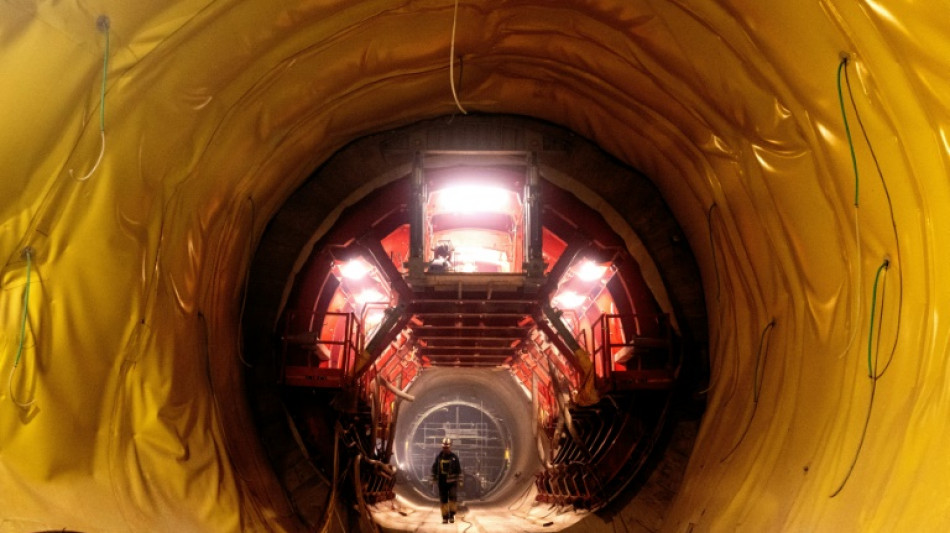
High in the Austrian Alps, hundreds of construction workers toil in a huge underground project aimed at storing hydropower as climate change has reduced the country's water-dependent electricity production.
Austria draws more than 60 percent of its electricity output from the renewable energy source, compared to a global average of 16 percent, with more than 3,100 dams spread across its rivers.
But the amount of electricity generated through hydropower in the European Union country is down -- from some 45 terawatt hours (TWh) in 2020 to 42 TWh in 2021 -- as water levels are falling.
For the first time last year, Austria -- which also still relies heavily on Russian gas -- had to import electricity, ringing alarm bells.
Inside the snow-capped mountain range, above the Austrian village of Kaprun in the Salzburg region, trucks thunder in and out of the vast subterranean construction site, which is dotted with statues of Saint Barbara, patron of miners and others plying dangerous trades.
Excavation work for the Limberg 3 pumped storage power plant is wrapping up.
- 'Well prepared' -
The plant is to be operational by 2025 to store power in order to cater to peaks in electricity consumption and mitigate a change in weather patterns, including increasingly capricious and irregular rainfall.
"We want to be prepared well," said Klaus Hebenstreit, an executive of main electricity producer Verbund.
"The distribution (of water) over the year will change: we will have less water in summer (due to drought) and more in winter" due to snow melt, he added.
Two years of drought have hit Austria, like the rest of Europe, according to Roman Neunteufel, a senior researcher at Vienna's University of Natural Resources and Life Sciences.
"If there are several dry years in a row, then this becomes very noticeable... Water levels have never been lower since records began" some 100 years ago, he said.
Europe should brace for more deadly heatwaves driven by climate change, said a report last month by the World Meteorological Organization and the European Union's Copernicus Climate Change Service.
The report noted the world's fastest-warming continent was some 2.3 degrees Celsius hotter last year than in pre-industrial times.
In the Alps, glaciers saw a new record mass loss for a single year in 2022, caused by very low winter levels of snow, a hot summer as well as deposits of wind-blown Saharan dust.
- Difficult diversification -
Verbund, a semi-public company, continues to pour billions of euros into hydropower generation despite criticism from activists who say the dams and plants have a big impact on the environment.
"Hydropower expansion must be ecologically and socially compatible.... The complete expansion of hydropower is not the solution to our energy problem. Instead, it is necessary to save energy," the Word Wildlife Fund says on its site.
Verbund is looking at alternatives.
"Water will continue to be extremely important for us, but we also want to develop photovoltaic and wind energy... We are diversifying," Hebenstreit told AFP in Vienna on a day temperatures soared to 37 degrees Celsius (99 degrees Fahrenheit).
Austria, which aims to draw all of its electricity from renewable energy by 2030, has been slow to develop wind and solar power, which make up only 13 percent of its electricity.
"Solar energy is wonderfully abundant in summer... But production is too low in winter, precisely when we need it for heating," Neunteufel said.
"And with wind, it's even harder to plan: There can be days any time without wind, and then wind power production largely stops," he said.
A.Motta--PC