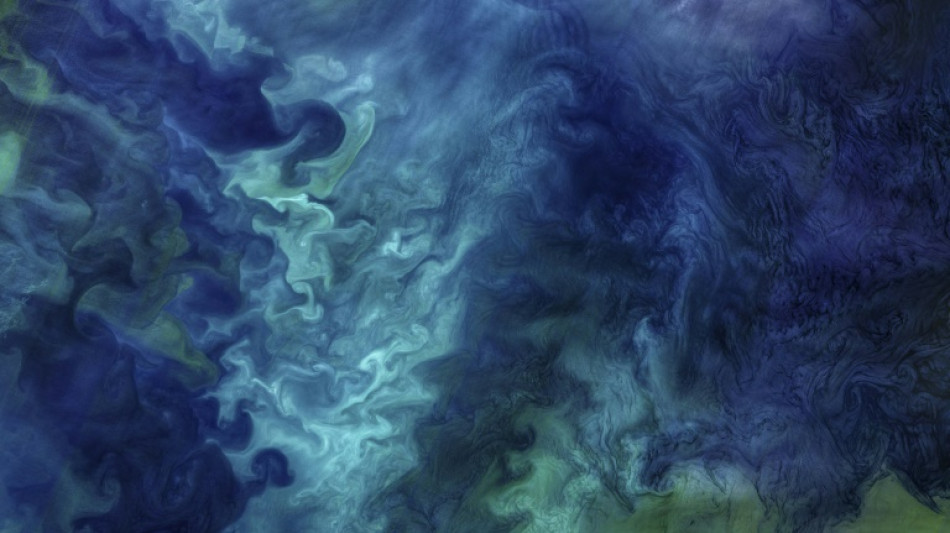
Oceans are changing colour and climate change may be to blame / Photo: HO - NASA/AFP/File

 Drone owners rush to offload devices ahead of Beijing ban

 Trump's beef policies irk Texas ranchers, testing their loyalty

 Nvidia, OpenAI CEOs to attend Xi dinner at White House

 Anthropic picks Accenture for in-house AI safety evaluation

 Balogun returns as Monaco beat Lens to continue strong Ligue 1 start

 'Pause' on overt repression in Venezuela, but reforms still needed: HRW

 Global stocks mixed as yen falls despite Bank of Japan rate hike

 Cuba hit with seventh major blackout of the year

 Murray out with concussion so Wentz will start for Vikings

 UN chief 'deeply regrets' US visa refusal to Abbas for annual meeting

 England quick Carse to face no charges over alleged nightclub assault

 Mancini brings nine newcomers into the first squad of his Italy comeback

 Czechs level Davis Cup tie against USA as South Korea eye Finals

 New France boss Zidane confirms Mbappe as captain after naming first squad

 California governor signs order to explore AI 'kill switch'

 Head leads run spree as Australia win Zimbabwe ODI series

 In-form Raphinha wants to finish career at Barcelona

 Warren Buffett steps down as Berkshire Hathaway chairman

 Carrick confident Man Utd can 'work through' tough time

 Mbappe ends Nike partnership to join Swiss brand On

 Liverpool boss Iraola puts Bournemouth love affair on hold

 'A disaster' if Man City do not win says Maresca after flawless start

 Kerry James Marshall: American 'blackness' painter celebrated in Europe

 Spain coach De la Fuente offers 'full support' to people of Ceuta

 Russia seizes assets of Nestle, French firms over West's Ukraine support

Over the past 20 years huge swathes of the world's oceans have changed colour, displaying a subtle greening towards the tropics that researchers say points to the effect of climate change on life in the world's seas.
In the new research published on Wednesday, scientists said they had detected shifts in colours across more than half of the world's oceans -- an expanse bigger than Earth's total land area.
Authors of the study in Nature think that is down to changes in ecosystems, and particularly in tiny plankton, which are the centrepiece of the marine food web and play a crucial part in stabilising our atmosphere.
"The reason we care about the colour changes is because the colour reflects the state of the ecosystem, so colour changes mean ecosystem changes," lead author B.B. Cael, of Britain's National Oceanography Centre, told AFP.
The colour of the seas when seen from space can paint a picture of what is going on in the upper layers of the water.
A deep blue would tell you that there is not much life, while if the water is greener it is likely to have more activity, specifically from the photosynthesising phytoplankton, which like plants contain the green pigment chlorophyll.
These produce a significant amount of the oxygen we breathe, are a crucial part of the global carbon cycle and are a foundational part of the ocean food web.
- Life colours -
Researchers are keen to develop ways of monitoring changes in ecosystems in order to track climate changes and enshrine protected areas.
But previous studies have suggested you would need three decades of ocean chlorophyll monitoring to detect a trend because of annual variations.
In the latest study, researchers broadened the colour spectrum, looking at seven hues of ocean colour monitored by the MODIS-Aqua satellite from 2002 to 2022.
These are too subtle for humans to see and would look largely blue to the naked eye.
The authors analysed the observational data to detect a trend above the year-to-year variability and then compared it to computer models of what would be expected with climate change.
They found that the real-world observations tallied closely with the changes predicted.
While the researchers said more work would be needed to find out what exactly those colour changes might mean, they said climate change was very likely to be the cause.
"I've been running simulations that have been telling me for years that these changes in ocean colour are going to happen," said co-author Stephanie Dutkiewicz, of MIT's Department of Earth, Atmospheric and Planetary Sciences at the Center for Global Change Science.
"To actually see it happening for real is not surprising, but frightening. And these changes are consistent with man-induced changes to our climate."
T.Vitorino--PC


