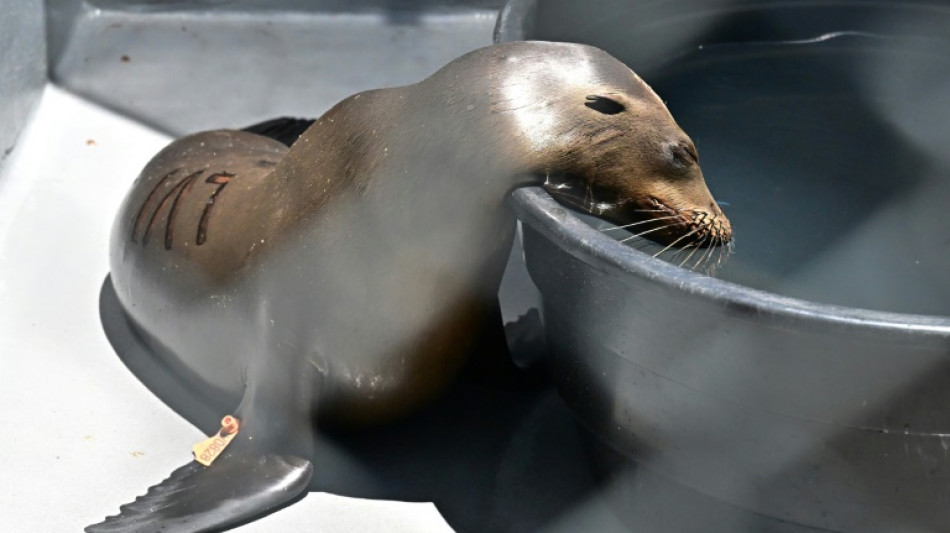
Marine animal poisonings overwhelm California volunteers / Photo: Frederic J. BROWN - AFP

 Drone owners rush to offload devices ahead of Beijing ban

 Trump's beef policies irk Texas ranchers, testing their loyalty

 Nvidia, OpenAI CEOs to attend Xi dinner at White House

 Anthropic picks Accenture for in-house AI safety evaluation

 Balogun returns as Monaco beat Lens to continue strong Ligue 1 start

 'Pause' on overt repression in Venezuela, but reforms still needed: HRW

 Global stocks mixed as yen falls despite Bank of Japan rate hike

 Cuba hit with seventh major blackout of the year

 Murray out with concussion so Wentz will start for Vikings

 UN chief 'deeply regrets' US visa refusal to Abbas for annual meeting

 England quick Carse to face no charges over alleged nightclub assault

 Mancini brings nine newcomers into the first squad of his Italy comeback

 Czechs level Davis Cup tie against USA as South Korea eye Finals

 New France boss Zidane confirms Mbappe as captain after naming first squad

 California governor signs order to explore AI 'kill switch'

 Head leads run spree as Australia win Zimbabwe ODI series

 In-form Raphinha wants to finish career at Barcelona

 Warren Buffett steps down as Berkshire Hathaway chairman

 Carrick confident Man Utd can 'work through' tough time

 Mbappe ends Nike partnership to join Swiss brand On

 Liverpool boss Iraola puts Bournemouth love affair on hold

 'A disaster' if Man City do not win says Maresca after flawless start

 Kerry James Marshall: American 'blackness' painter celebrated in Europe

 Spain coach De la Fuente offers 'full support' to people of Ceuta

 Russia seizes assets of Nestle, French firms over West's Ukraine support

Denise Christ regularly comes across injured wildlife in her work rescuing beached or stranded marine mammals along the California coast.
But she's been shocked by the hundreds of sea lions and dolphins found on the shore in recent weeks, dead or dying from neurotoxin poisoning.
"Heartbreaking, to say the least," said Christ, the Ventura County stranding coordinator for the Channel Islands Marine and Wildlife Institute (CIMWI).
The animals were sickened by domoic acid, a neurotoxin produced by algae that are a food source for fish, which are then eaten by sea lions and dolphins.
Algal blooms are not unusual this time of year, but this summer's crisis follows another one less than a year ago, alarming and overwhelming the CIMWI team based about 120 miles (190 kilometers) north of Los Angeles.
"We had a pretty intense bloom last summer but this year is way worse than we've ever seen in the 35 years I've been practicing marine mammal medicine," said Sam Dover, the executive director and cofounder of CIMWI.
Added Ken Hughes, Christ's colleague in neighboring Santa Barbara County: "We had over 300 sea lions up on the beach. And over 150 dolphins that also were affected by it. It was just so sad."
- 'New reality' of climate change -
There is no official explanation for the outbreak, but experts have several theories.
Algal blooms are fed by agricultural runoff, and this year California experienced heavier than normal rainfall.
"So there's a lot more runoff from the whole state, not just from the local regions," Dover said.
Others from the institute said warming oceans due to climate change were spurring algae growth.
"I believe it is the new reality and things are changing. The ocean's changing," Christ said.
When sea lions consume the toxin, they suffer neurological effects that include disorientation, foaming at the mouth, head bobbing and seizures.
"They basically don't know they're a sea lion. They don't know where they're at or what they're doing," Hughes explained.
The animals will head for the shore, where they wander erratically, attracting the attention of beachgoers.
Dover said last year's domoic acid outbreak took place in mid-August, but this year his group started getting calls reporting stricken animals in late May.
"We started getting one animal a day. So we knew it was coming," he said.
"And then on June 8, literally the floodgates opened and animals just started showing up everywhere," Dover said.
"This is definitely the worst we've ever seen."
CIMWI rescued about 300 animals last year -- this year they were getting more than 300 calls each day.
- More than 100 dead dolphins-
Another unusual feature of this year's outbreak is dolphins getting sick and dying from the toxin, with Dover counting more than 110 of the mammals dead in recent weeks.
There is no cure for domoic acid poisoning, so the only way to treat the animals is with fluids, food, anti-seizure medicine and patience, the experts said.
Younger animals have a better chance of survival because they eat less fish than adults, and therefore consume less of the toxin.
"Those are the ones we're putting most of our efforts towards now and we're having some pretty good success in flushing out the toxin from their system," Dover said, as volunteers hose down spacious enclosures where the rescued sea lions eat fish, float in pools and nap.
Treating, housing and feeding the sick animals demands a lot of resources, and CIMWI stays afloat through a combination of government grants, donations and volunteer labor.
"Essentially, every day is a battle with the animals and with our finances," Dover said.
A.Motta--PC