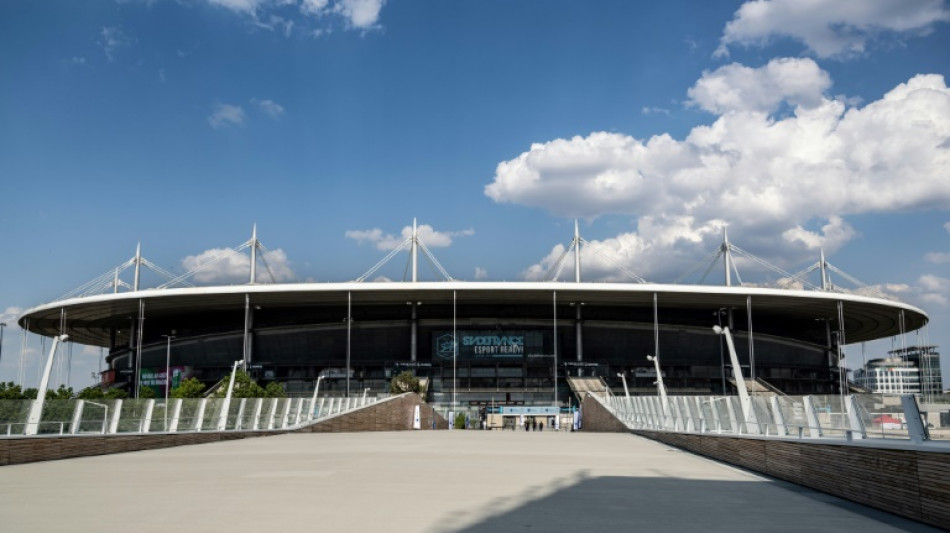
The Paris Olympics have bold climate plans, but few specifics / Photo: BERTRAND GUAY - AFP

 Drone owners rush to offload devices ahead of Beijing ban

 Trump's beef policies irk Texas ranchers, testing their loyalty

 Nvidia, OpenAI CEOs to attend Xi dinner at White House

 Anthropic picks Accenture for in-house AI safety evaluation

 Balogun returns as Monaco beat Lens to continue strong Ligue 1 start

 'Pause' on overt repression in Venezuela, but reforms still needed: HRW

 Global stocks mixed as yen falls despite Bank of Japan rate hike

 Cuba hit with seventh major blackout of the year

 Murray out with concussion so Wentz will start for Vikings

 UN chief 'deeply regrets' US visa refusal to Abbas for annual meeting

 England quick Carse to face no charges over alleged nightclub assault

 Mancini brings nine newcomers into the first squad of his Italy comeback

 Czechs level Davis Cup tie against USA as South Korea eye Finals

 New France boss Zidane confirms Mbappe as captain after naming first squad

 California governor signs order to explore AI 'kill switch'

 Head leads run spree as Australia win Zimbabwe ODI series

 In-form Raphinha wants to finish career at Barcelona

 Warren Buffett steps down as Berkshire Hathaway chairman

 Carrick confident Man Utd can 'work through' tough time

 Mbappe ends Nike partnership to join Swiss brand On

 Liverpool boss Iraola puts Bournemouth love affair on hold

 'A disaster' if Man City do not win says Maresca after flawless start

 Kerry James Marshall: American 'blackness' painter celebrated in Europe

 Spain coach De la Fuente offers 'full support' to people of Ceuta

 Russia seizes assets of Nestle, French firms over West's Ukraine support

Organisers of next year's Paris Olympics say they want its carbon footprint to be half that of previous summer Games, but with a year to go observers say they still do not have enough detail to verify the plans.
Citing climate change as "the greatest challenge humanity has ever known", organisers have said they can reduce greenhouse gases from the Games with a variety of measures, including renewable energy and using existing venues rather than building new ones.
That would, they say, allow them to halve CO2 emissions from the estimated 3.5 million tonnes generated during the 2012 London and 2016 Rio Games.
"It's a fine promise," said Martin Muller, Professor of Geography and Sustainability at the University of Lausanne, adding the target itself is a first.
But "I don't have the figures to believe it," he told AFP.
Muller would like open access to precise data. Otherwise, he said, "I can't understand on what basis this has been calculated".
- Planes, stadiums and snacks -
For the time being, the organisers have sketched out forecasts.
Expected emissions break down into three areas -- travel, buildings and other activities like accommodation, security and catering -- which each account for roughly a third of emissions.
With the venues themselves, the organisers say they have limited the construction footprint with a 95 percent reliance on existing or temporary arenas, unlike the much-criticised football World Cup in Qatar.
This decision to use as much existing infrastructure as possible was praised by Gilles Dufrasne, of Carbon Market Watch, as a "thoughtful approach".
Other ideas include using renewable energy or serving "low carbon" meals with less meat.
"The other big item is emissions from spectators arriving by plane," said Muller.
Even if venues have to be accessed by public transport, organisers will have little control over how people arrive into the country.
Around a quarter of the total emissions is expected to be from spectator travel alone.
- Offsetting -
For these types of emissions, the organisers say they are supporting projects to “offset” the carbon pollution.
"All emissions that cannot be avoided will be offset by projects designed to bring both environmental and social benefits on all five continents,” they said.
This involves, for example, financing the planting of trees to absorb CO2 or clean cookstove projects.
The organisers promise to be rigorous in their selection of projects, but offsetting in general is often subject to criticism for variable accounting methods and difficulties in verifying the amount of carbon removed.
"Offsetting is a measure of last resort," said Muller.
- What next? -
Paris 2024 organisers hope to set a "new standard" for future Olympics.
But experts argue the Games should be thinking much bigger -- by thinking smaller.
A study published in 2021 in Nature Sustainability, and led by Muller, looked at 16 Summer and Winter Olympic Games between 1992 and 2020, representing a total cost of more $70 billion.
They found that overall sustainability has declined over time and made three main recommendations.
"First, greatly reducing the size of the event," the researchers said.
"Second, rotating the Olympics among the same cities; third, enforcing independent sustainability standards."
Key is the reduction of spectators arriving by plane, with Dufrasne imagining ultimately an "all-TV" event, with broadcasts to local stadiums around the world.
O.Gaspar--PC


