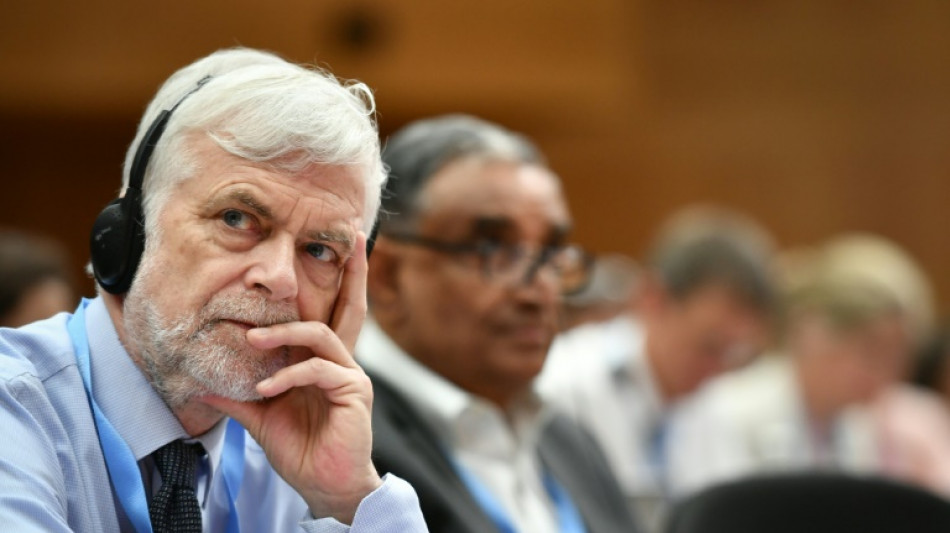
Humanity 'has agency over future': new head of UN climate panel / Photo: FABRICE COFFRINI - AFP

 Drone owners rush to offload devices ahead of Beijing ban

 Trump's beef policies irk Texas ranchers, testing their loyalty

 Nvidia, OpenAI CEOs to attend Xi dinner at White House

 Anthropic picks Accenture for in-house AI safety evaluation

 Balogun returns as Monaco beat Lens to continue strong Ligue 1 start

 'Pause' on overt repression in Venezuela, but reforms still needed: HRW

 Global stocks mixed as yen falls despite Bank of Japan rate hike

 Cuba hit with seventh major blackout of the year

 Murray out with concussion so Wentz will start for Vikings

 UN chief 'deeply regrets' US visa refusal to Abbas for annual meeting

 England quick Carse to face no charges over alleged nightclub assault

 Mancini brings nine newcomers into the first squad of his Italy comeback

 Czechs level Davis Cup tie against USA as South Korea eye Finals

 New France boss Zidane confirms Mbappe as captain after naming first squad

 California governor signs order to explore AI 'kill switch'

 Head leads run spree as Australia win Zimbabwe ODI series

 In-form Raphinha wants to finish career at Barcelona

 Warren Buffett steps down as Berkshire Hathaway chairman

 Carrick confident Man Utd can 'work through' tough time

 Mbappe ends Nike partnership to join Swiss brand On

 Liverpool boss Iraola puts Bournemouth love affair on hold

 'A disaster' if Man City do not win says Maresca after flawless start

 Kerry James Marshall: American 'blackness' painter celebrated in Europe

 Spain coach De la Fuente offers 'full support' to people of Ceuta
 Russia seizes assets of Nestle, French firms over West's Ukraine support
British professor Jim Skea told AFP on Thursday he will bring "a judicious blend of realism and optimism" to his leadership of the UN's climate expert panel, including a firm belief that humanity is not powerless to confront global warming.
Skea takes charge of the Intergovernmental Panel on Climate Change (IPCC) in a crucial decade which will determine the extent of warming and its impact on the planet for decades or even centuries to come.
The 195-nation organisation informs global policymakers on the latest science on climate change, and Skea will oversee hundreds of experts and the defining reports they produce on the best course of action.
Skea, a Professor of Sustainable Energy at Imperial College London, said extreme temperatures being felt across the globe this month were "a salutary lesson" for the task ahead as he assumes his new role.
But it was critical to offer "positive" ways for humanity to address these challenges, he said, and not just "messages of gloom that can induce a sense of existential dread about the future of the planet".
"We need to make the point that human beings do have choices they can make, and agency over their own future," Skea told AFP in Nairobi, where the elections for other IPCC leadership positions are also underway.
He said more than ever, governments wanted advice on steps they could take in the near term and there would be a "twin emphasis" on climate adaptation and mitigation under his stewardship.
Skea, 69, has decades of experience building consensus around climate change and was not "naive about the difficulty of getting the science messages across."
"I think it will be a judicious blend of realism and optimism... I am genetically optimistic," he said of his approach to the job.
- Daunting task -
The task ahead is enormous.
Under the 2015 Paris treaty, nations promised to collectively cap the rise in the planet's average temperature at "well below" 2C, and at 1.5C if possible.
To get to that more ambitious target, the IPCC says emissions need to drop 43 percent by 2030 -- and 84 percent by mid-century -- to stay within the threshold.
Yet they continue to rise, and there are concerns the next IPCC reports -- due in five to seven years -- come too near the end of this critical decade to rally a sufficient global response.
Skea said rushing out reports would risk "that gold standard credibility that has been so influential for the IPCC in the past".
Skea had a leading role in publishing a landmark 2018 IPCC report that concluded only a 1.5C cap on warming could ensure a climate-safe world that did not risk ecosystem collapse.
Experts have said it might fall on Skea to finally say the world cannot limit temperature rises to 1.5C in time -- but the new chief said this was premature.
"If it appears that 1.5 cannot be reached on a more permanent basis, we will have to say so," Skea said.
"But we are not at that point yet, and we do not have the evidence for it".
He said he would strongly resist pressure to turn out more so-called special reports like the 2018 study, saying they dragged on the IPCC's core work and resources.
"I'll say something very strongly -- over my dead body will we see lots and lots of special reports," he said.
He succeeds South Korean economist Hoesung Lee, who led the IPCC for eight years, and was elected over four other candidates including two hoping to be the first woman chair of the organisation.
Skea said the IPCC had "big issues" around gender and diversity, and said a priority of his tenure would be increasing the number of women in their ranks.
J.V.Jacinto--PC