Warming beaches threaten Yemen sea turtles' future / Photo: - - AFP

 Drone owners rush to offload devices ahead of Beijing ban

 Trump's beef policies irk Texas ranchers, testing their loyalty

 Nvidia, OpenAI CEOs to attend Xi dinner at White House

 Anthropic picks Accenture for in-house AI safety evaluation

 Balogun returns as Monaco beat Lens to continue strong Ligue 1 start

 'Pause' on overt repression in Venezuela, but reforms still needed: HRW

 Global stocks mixed as yen falls despite Bank of Japan rate hike

 Cuba hit with seventh major blackout of the year

 Murray out with concussion so Wentz will start for Vikings

 UN chief 'deeply regrets' US visa refusal to Abbas for annual meeting

 England quick Carse to face no charges over alleged nightclub assault

 Mancini brings nine newcomers into the first squad of his Italy comeback

 Czechs level Davis Cup tie against USA as South Korea eye Finals

 New France boss Zidane confirms Mbappe as captain after naming first squad

 California governor signs order to explore AI 'kill switch'

 Head leads run spree as Australia win Zimbabwe ODI series

 In-form Raphinha wants to finish career at Barcelona

 Warren Buffett steps down as Berkshire Hathaway chairman

 Carrick confident Man Utd can 'work through' tough time

 Mbappe ends Nike partnership to join Swiss brand On

 Liverpool boss Iraola puts Bournemouth love affair on hold

 'A disaster' if Man City do not win says Maresca after flawless start

 Kerry James Marshall: American 'blackness' painter celebrated in Europe

 Spain coach De la Fuente offers 'full support' to people of Ceuta

 Russia seizes assets of Nestle, French firms over West's Ukraine support

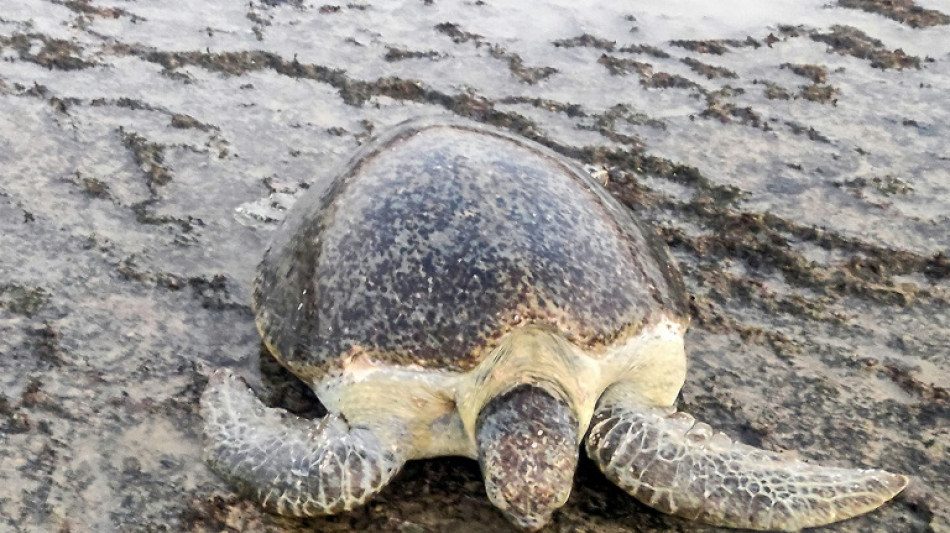
On a Yemeni beach, a sea turtle clambers ashore to lay eggs, which will likely be born female due to rising temperatures, creating a gender imbalance that brings the threat of local extinction.
With sands made hotter by climate change, eggs are rarely yielding male turtles, which require cooler temperatures during the incubation period.
Studies in several coastal regions of southern Yemen "have shown that there are 90 percent more female sea turtles than males", said Jamal Baouzir, director of the biodiversity department at the University of Aden.
The severe gender imbalance will continue until it brings about the complete extinction of sea turtles in Yemen "in the years to come", Baouzir said.
Environmental activist Hafiz Kelshat said the proportion of males had "decreased considerably" in recent years.
"Most baby turtles are female due to the change in temperature," he told AFP on a nesting beach in Mahra province, near the border with Oman.
This is especially the case in summer, when temperatures often top 31 degrees Celsius (88 degrees Fahrenheit) -- the point at which sea turtle eggs begin yielding females.
The gender imbalance is getting worse each year as longer periods of extreme heat hit the Arabian Peninsula, one of the world's hottest regions.
The problem is not unique to Yemen, wracked for nearly a decade by a devastating civil war which has created one of the world's worst humanitarian tragedies.
From the US state of Florida to Australia's Great Barrier Reef, male sea turtle numbers are dwindling due to climate change.
In 2018, US researchers found that rising temperatures meant most of the 200,000 green turtles in the northern Great Barrier Reef are female, compounding the threat of extinction.
- 'Busy with war' -
Yemen, wedged between the Red Sea and the Indian Ocean, boasts a rich variety of natural habitats and species, many of them found nowhere else in the world.
But its genetic diversity, and the potential for future tourism development it represents, are increasingly threatened by global warming.
Yemen ranks as one of the region's most climate-vulnerable countries, according to the Global Adaptation Initiative of the University of Notre Dame in the US state of Indiana.
Extreme heat and increasing rainfall variability leading to both drought and flash floods are among the challenges forecast for the Arabian Peninsula's poorest country.
Baouzir said that to tackle the deepening gender imbalance, authorities should create "a specialised technical team to monitor the turtles in their nesting places and place the eggs in appropriate incubators" to produce male offspring.
The provision of sun shields on beaches could also help reduce sand temperatures and boost the number of male hatchlings.
But environmental conservation has inevitably taken a back seat to the grinding civil war, which has killed hundreds of thousands of people and left the country's infrastructure in tatters.
"The current circumstances, of course, make it difficult to carry out" protection operations, Baouzir said.
An environment ministry official in the internationally-recognised government, which controls Mahra province along with much of the south, acknowledged that conservation efforts had suffered during the war with Iran-backed Huthi rebels.
"The authorities have worked on various plans including the creation of several reserves," Naif Ali bin Masaad said.
But they are "busy with the war against the Huthis and terrorist groups... so they do not assume their responsibilities" towards environmental protection, the official said.
A.F.Rosado--PC