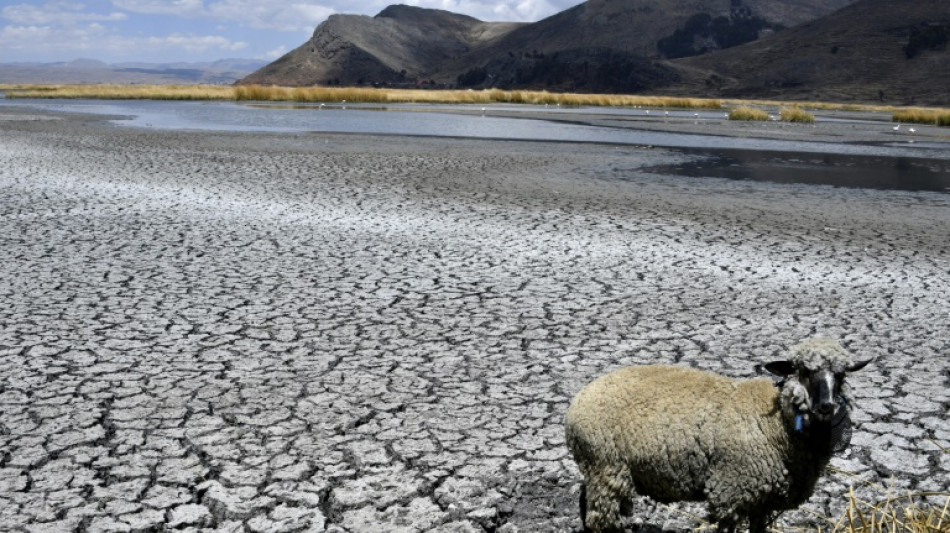
Climate change main culprit for hot South American winter / Photo: AIZAR RALDES - AFP

 Ed Sheeran returns to stage after Palestinian controversy

 Asian Games to open in Japan after troubled build-up

 Drone owners rush to offload devices ahead of Beijing ban

 Trump's beef policies irk Texas ranchers, testing their loyalty

 Nvidia, OpenAI CEOs to attend Xi dinner at White House

 Anthropic picks Accenture for in-house AI safety evaluation

 Balogun returns as Monaco beat Lens to continue strong Ligue 1 start

 'Pause' on overt repression in Venezuela, but reforms still needed: HRW

 Global stocks mixed as yen falls despite Bank of Japan rate hike

 Cuba hit with seventh major blackout of the year

 Murray out with concussion so Wentz will start for Vikings

 UN chief 'deeply regrets' US visa refusal to Abbas for annual meeting

 England quick Carse to face no charges over alleged nightclub assault

 Mancini brings nine newcomers into the first squad of his Italy comeback

 Czechs level Davis Cup tie against USA as South Korea eye Finals

 New France boss Zidane confirms Mbappe as captain after naming first squad

 California governor signs order to explore AI 'kill switch'

 Head leads run spree as Australia win Zimbabwe ODI series

 In-form Raphinha wants to finish career at Barcelona

 Warren Buffett steps down as Berkshire Hathaway chairman

 Carrick confident Man Utd can 'work through' tough time

 Mbappe ends Nike partnership to join Swiss brand On

 Liverpool boss Iraola puts Bournemouth love affair on hold

 'A disaster' if Man City do not win says Maresca after flawless start

 Kerry James Marshall: American 'blackness' painter celebrated in Europe

A wave of unusually extreme heat at the end of South America's winter was made 100 times more likely by climate change, according to a study published Tuesday.
"While many people have pointed to El Nino to explain the South America heat wave, this analysis has shown that climate change is the primary driver of the heat," said Lincoln Muniz Alves, a researcher at the Brazil National Institute for Space Research who participated in the study by the World Weather Attribution (WWA) group.
From Buenos Aires to Chile, and parts of Brazil, people found themselves in T-shirts at the height of the Southern Hemisphere winter in August and September, with temperatures shooting above 25 degrees Celsius (77 Fahrenheit), and reaching 37 degrees Celsius in some cases, breaking records.
The WWA study found that while the naturally occurring El Nino warming phenomenon had some impact, climate change was the main culprit, driving temperatures up between 1.4 and 4.3 degrees.
A team of 12 experts studied the link between the extreme weather and climate change over the 10 hottest winter days in a region encompassing Paraguay, central Brazil and regions of Bolivia and Argentina.
"The scientists found that these extreme heat episodes in South America outside the summer months would have been extremely unlikely without human-caused climate change," read a statement on the study.
"Heat episodes like these will become even more frequent and extreme if greenhouse gas emissions are not rapidly reduced to net zero."
In Sao Paulo, the biggest city in Latin America, four deaths were attributed to the heatwave.
"Heat kills, particularly in spring, before people are acclimatized to it," said Julie Arrighi, a director at the Red Cross Red Crescent Climate Centre.
"Temperatures above 40 degrees Celsius in early spring are incredibly extreme and while we are aware of just four heat-related fatalities, it's likely the true number is much higher."
The heatwave came during a winter and early spring marked by extreme weather phenomena, from torrential rains in Chile, to cyclones in southern Brazil and a drought which pushed Uruguay's potable water supply to the brink.
The heat also led to increased forest fires in the Amazon.
Unseasonable warm weather was not limited to South America, with last month dubbed the hottest September on record by the European Union climate monitor.
The El Nino phenomenon -- which warms waters in the southern Pacific and stokes hotter weather beyond -- is likely to contribute to 2023 becoming the hottest year on record in the next three months.
F.Cardoso--PC