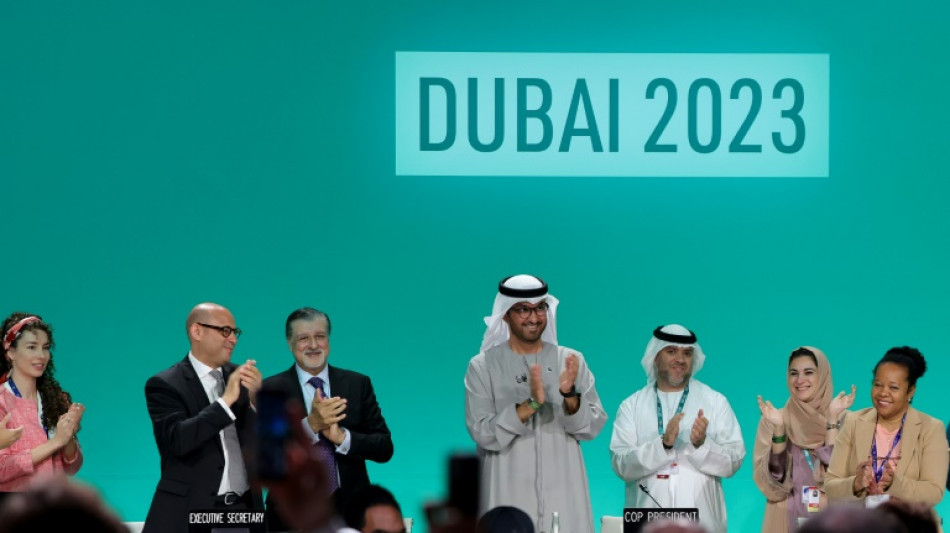
Dubai summit adopts world-first 'transition' from fossil fuels / Photo: Giuseppe CACACE - AFP

 Ed Sheeran returns to stage after Palestinian controversy

 Asian Games to open in Japan after troubled build-up

 Drone owners rush to offload devices ahead of Beijing ban

 Trump's beef policies irk Texas ranchers, testing their loyalty

 Nvidia, OpenAI CEOs to attend Xi dinner at White House

 Anthropic picks Accenture for in-house AI safety evaluation

 Balogun returns as Monaco beat Lens to continue strong Ligue 1 start

 'Pause' on overt repression in Venezuela, but reforms still needed: HRW

 Global stocks mixed as yen falls despite Bank of Japan rate hike

 Cuba hit with seventh major blackout of the year

 Murray out with concussion so Wentz will start for Vikings

 UN chief 'deeply regrets' US visa refusal to Abbas for annual meeting

 England quick Carse to face no charges over alleged nightclub assault

 Mancini brings nine newcomers into the first squad of his Italy comeback

 Czechs level Davis Cup tie against USA as South Korea eye Finals

 New France boss Zidane confirms Mbappe as captain after naming first squad

 California governor signs order to explore AI 'kill switch'

 Head leads run spree as Australia win Zimbabwe ODI series

 In-form Raphinha wants to finish career at Barcelona

 Warren Buffett steps down as Berkshire Hathaway chairman

 Carrick confident Man Utd can 'work through' tough time

 Mbappe ends Nike partnership to join Swiss brand On

 Liverpool boss Iraola puts Bournemouth love affair on hold

 'A disaster' if Man City do not win says Maresca after flawless start

 Kerry James Marshall: American 'blackness' painter celebrated in Europe

Nearly 200 nations meeting in Dubai on Wednesday approved a first-ever call for the world to transition away from fossil fuels, the top culprit of climate change behind a planetary crisis.
After 13 days of talks and another sleepless night in a country built on oil wealth, the Emirati leadership of the COP28 summit banged a gavel to signal the world had reached consensus.
"You did step up, you showed flexibility, you put common interest ahead of self-interest," said COP28 president Sultan Al Jaber, whose role as head of the United Arab Emirates' national oil company raised suspicion among many environmentalists.
The United Arab Emirates, he said, was "rightly proud" of its role in bringing "transformational change" to the planet.
"The world needed to find a new way. And by following our North Star, we have found that new path," he said to applause, referring to the goal of limiting warming to 1.5 degrees Celsius.
Jaber hours earlier released a draft of the agreement aiming to bring onboard countries from islands fearing extinction to Saudi Arabia, which has led the charge to keep exporting its oil.
Toughening language from an earlier draft that was roundly denounced, the agreement calls for "transitioning away from fossil fuels in energy systems, in a just, orderly and equitable manner, accelerating action in this critical decade, so as to achieve net zero by 2050 in keeping with the science".
It marked the first mention of all fossil fuels in 28 years of climate summits.
"For the first time in 30 years, we might now reach the beginning of the end of fossil fuels," EU climate chief Wopke Hoekstra said before heading into the plenary session.
Danish negotiator Dan Jorgensen, part of a group in charge of making headway, called the agreement "historic progress".
The text, however, stopped short of calls during the summit for a "phase-out" of oil, gas and coal, which together account for around three-quarters of the emissions responsible for the planetary crisis.
Low-lying islands fear extinction from rising sea levels and worsening storms, with the Marshall Islands denouncing the earlier draft as a "death warrant".
The bloc of small island states called the revised text "an improvement" but it reiterated concerns, saying that the deal was "incremental and not transformational".
- UAE steps up language -
Jaber's earlier draft merely suggested that nations "could" reduce the consumption and production of fossil fuels, among other options, drawing fury from green groups.
Environmentalists virtually all saw the new text as an improvement, although many cautioned that there will still far more to do.
"We are finally naming the elephant in the room. The genie is never going back into the bottle and future COPs will only turn the screws even more on dirty energy," said Mohamed Adow, director of the Power Shift Africa think tank, referring to the annual UN climate meetings known as Conferences of the Parties.
"Some people may have had their expectations for this meeting raised too high, but this result would have been unheard off two years ago, especially at a COP meeting in a petrostate," he said.
The agreement also made more explicit the near-term goals in the goal of ending net emissions by 2050.
It called for the world to cut greenhouse gas emissions by 43 percent by 2030 compared with 2019 levels.
Rachel Cleetus, policy director at the Union of Concerned Scientists, said the deal "sends a strong signal that world leaders recognise that a sharp turn away from fossil fuels toward clean energy in this critical decade and beyond, aligned with the science, is essential to meet our climate goals".
- Still loopholes -
But Jean Su of the Center for Biological Diversity, while seeing progress, said there were still "cavernous loopholes" for fossil fuels.
The agreement tackles only fossil use in energy, not in industrial areas such as production of plastics and fertiliser.
She also voiced alarm at the recognition of the role of "transitional fuels", which she saw as a codeword for producers of natural gas and other fossil fuels such as the United States on the grounds of energy security.
While not using the term "phase-out" on fossil fuels, it endorses work towards a phase-down of "unabated coal power" -- meaning that coal with carbon capture technology to reduce emissions, panned by many environmentalists as unproven, could continue.
The biggest-ever COP meeting hosted more than 88,000 people, including a record number of lobbyists from the fossil fuel industry.
The 2015 Paris summit endorsed checking warming at 1.5C -- a goal repeated in the latest draft, but which critics say is virtually impossible without serious efforts to curb oil, gas and coal.
A.Motta--PC