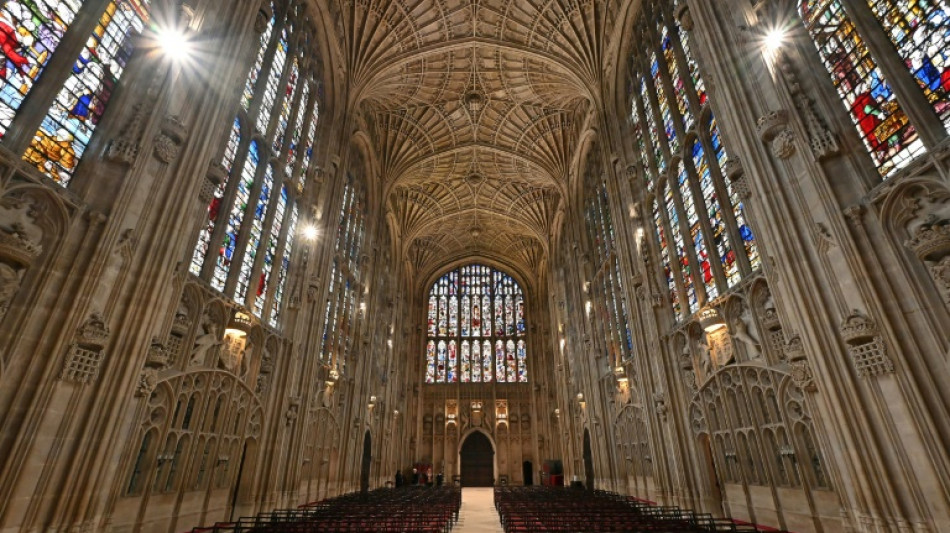
UK's iconic King's College Chapel gets controversial solar makeover / Photo: Justin TALLIS - AFP

 Ed Sheeran returns to stage after Palestinian controversy

 Asian Games to open in Japan after troubled build-up

 Drone owners rush to offload devices ahead of Beijing ban

 Trump's beef policies irk Texas ranchers, testing their loyalty

 Nvidia, OpenAI CEOs to attend Xi dinner at White House

 Anthropic picks Accenture for in-house AI safety evaluation

 Balogun returns as Monaco beat Lens to continue strong Ligue 1 start

 'Pause' on overt repression in Venezuela, but reforms still needed: HRW

 Global stocks mixed as yen falls despite Bank of Japan rate hike

 Cuba hit with seventh major blackout of the year

 Murray out with concussion so Wentz will start for Vikings

 UN chief 'deeply regrets' US visa refusal to Abbas for annual meeting

 England quick Carse to face no charges over alleged nightclub assault

 Mancini brings nine newcomers into the first squad of his Italy comeback

 Czechs level Davis Cup tie against USA as South Korea eye Finals

 New France boss Zidane confirms Mbappe as captain after naming first squad

 California governor signs order to explore AI 'kill switch'

 Head leads run spree as Australia win Zimbabwe ODI series

 In-form Raphinha wants to finish career at Barcelona

 Warren Buffett steps down as Berkshire Hathaway chairman

 Carrick confident Man Utd can 'work through' tough time

 Mbappe ends Nike partnership to join Swiss brand On

 Liverpool boss Iraola puts Bournemouth love affair on hold

 'A disaster' if Man City do not win says Maresca after flawless start

 Kerry James Marshall: American 'blackness' painter celebrated in Europe

High above the historic streets of Cambridge in eastern England, the installation of solar panels atop King's College Chapel, the world-famous university's most recognisable landmark, has stirred excitement -- and controversy.
The eco-friendly addition to the six-centuries-old Gothic structure -- the oldest surviving part of the most famous of Cambridge University's 31 colleges -- has pitted heritage guardians against environmental sustainability proponents.
Cambridge City Council and the church diocese granted permission for the nearly 500 photovoltaic panels, despite objections from local planning officials and Historic England, the public body responsible for renowned and old monuments.
It argued, among other things, that the scheme would "compromise the beauty of the chapel", while the council's own planning committee said it would erode the "authenticity and integrity" of the building, which is Grade I listed.
The Grade 1 designation is given to structures of exceptional national, architectural or historical importance, and provides them with greater protections.
The chapel, founded by King Henry VI in 1441, is considered to be one of the finest examples of late English Gothic architecture, famous for its 16th-century stained glass windows, its wooden rood screen and its extraordinary fan vaulting.
Still an active house of worship, it hosts an annual Christmas Eve carol service, televised on the BBC, that dates back more than a century.
- 'Wonderful opportunity' -
But the city council and the Church of England's Diocese of Ely opted to override the concerns, concluding that the public benefits of the solar panels outweigh their potential harm.
"When you begin to think about the younger people and their future, you have to take the climate crisis really seriously," Stephen Cherry, the dean of the chapel, told AFP.
"And so for me, it is a wonderful opportunity to marry these two things together -- backward-looking tradition and formality and the future for human beings."
The battle over the panels began after King's College decided the chapel's lead roof had exceeded its natural lifespan and was no longer watertight.
Restoration work began last year, but permission for the 438 solar panels to be laid on both the north- and south-facing roof facades did not come through until February.
The college identified the chapel roof as the single largest potential opportunity for renewable electricity generation on its site.
Once fully installed, the panels will generate 123,000 kilowatt hours of power a year, meeting 5.5 percent of the college's annual electricity demand.
King's College provost Gillian Tett said the unique project was a historic moment for the chapel and Britain's architectural heritage.
"It is only one step on the road towards cleaner, greener energy but it is a potent and inspirational symbol of our commitment to being good stewards of our environment," she said.
- 'Virtue signalling' -
But critics are unimpressed.
"King's College Chapel is one of England's most famous buildings," John Neale, head of development advice at Historic England, told AFP.
"It is a masterpiece of late medieval architecture and widely appreciated as such.
"In our view, to cover the roofs with solar panels, which are highly reflective, will introduce a very discordant element."
Although the panels will not be highly visible from the ground, Neale noted, they will appear in views of the roof and college skyline and affect the way the chapel is appreciated -- especially in sunlight.
"We are really not against doing something about climate change. We're just very keen that it be done carefully," he said.
David Abulafia, an emeritus professor of Mediterranean history at the university, penned an article in conservative magazine The Spectator at the time of the decision, deriding the choice.
He accused the chapel's caretakers of "virtue signalling", arguing the panels were "out of place in the outer fabric of one of Britain's most extraordinary buildings".
"Transforming the chapel roof for small gains and the satisfaction of making a gesture ends up doing more harm than good," he wrote.
The overhaul of the roof is expected to be complete by the end of December.
X.Matos--PC