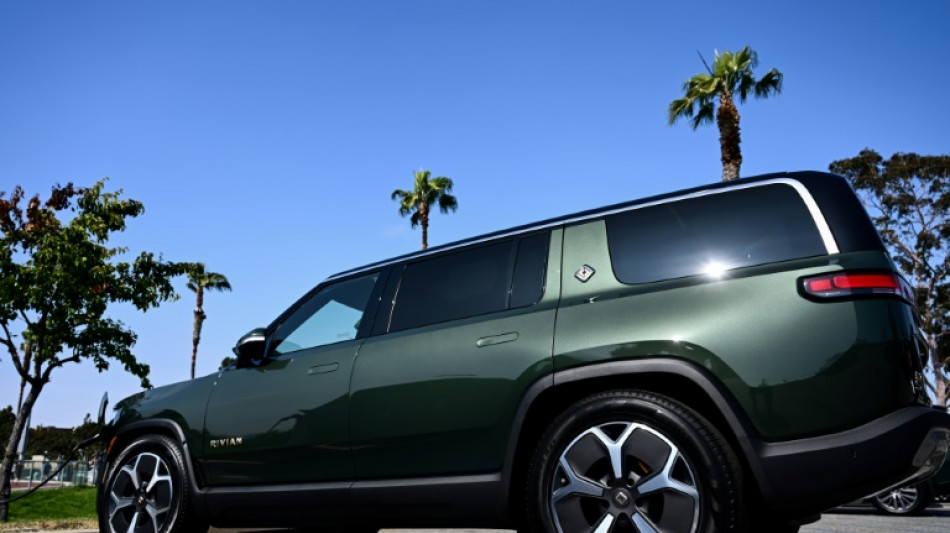
Hit them in the pocket: how cities are going after SUVs / Photo: Patrick T. Fallon - AFP/File

 Ed Sheeran returns to stage after Palestinian controversy

 Asian Games to open in Japan after troubled build-up

 Drone owners rush to offload devices ahead of Beijing ban

 Trump's beef policies irk Texas ranchers, testing their loyalty

 Nvidia, OpenAI CEOs to attend Xi dinner at White House

 Anthropic picks Accenture for in-house AI safety evaluation

 Balogun returns as Monaco beat Lens to continue strong Ligue 1 start

 'Pause' on overt repression in Venezuela, but reforms still needed: HRW

 Global stocks mixed as yen falls despite Bank of Japan rate hike

 Cuba hit with seventh major blackout of the year

 Murray out with concussion so Wentz will start for Vikings

 UN chief 'deeply regrets' US visa refusal to Abbas for annual meeting

 England quick Carse to face no charges over alleged nightclub assault

 Mancini brings nine newcomers into the first squad of his Italy comeback

 Czechs level Davis Cup tie against USA as South Korea eye Finals

 New France boss Zidane confirms Mbappe as captain after naming first squad

 California governor signs order to explore AI 'kill switch'

 Head leads run spree as Australia win Zimbabwe ODI series

 In-form Raphinha wants to finish career at Barcelona

 Warren Buffett steps down as Berkshire Hathaway chairman

 Carrick confident Man Utd can 'work through' tough time

 Mbappe ends Nike partnership to join Swiss brand On

 Liverpool boss Iraola puts Bournemouth love affair on hold

 'A disaster' if Man City do not win says Maresca after flawless start

 Kerry James Marshall: American 'blackness' painter celebrated in Europe

Two decades after London began moves to clamp down on sports utility vehicles, Parisians on Sunday will vote on whether to squeeze the gas-guzzlers out of town by tripling their parking fees.
The proposal by Paris's Socialist mayor Anne Hidalgo is the most radical by a big city in the fight against the big cars, blamed for driving up emissions, being a menace to pedestrians and generally taking up too much space.
The number of SUVs on the roads have shot up nearly sevenfold since 2010, to about 330 million worldwide.
They consume around 20 percent more fuel than a typical medium-sized car, the International Energy Agency said in a 2023 report, and emitted nearly one billion tonnes of carbon dioxide (CO2) in 2022, around twice Brazil's total emissions.
- London leads the charge -
The backlash against SUVs and monster pickups dates back to the 2000s, when the suburban rich began migrating en masse from sedans to king-of-the-road behemoths previously used for rough terrain.
Dubbed "stock exchange tractors" in Norway or "suburban assault vehicles" in Britain the car-trucks became much-maligned status symbols.
A key breakthrough in the bid to regulate emissions in big cities came in 2003 when London's left-wing mayor Ken Livingstone introduced a congestion charge for vehicles entering the city centre.
A year later he took aim specifically at SUVs, criticising those who used them to drive children to school as "complete idiots" and saying the vehicles should be banned from the school run.
- Guerrilla tactics -
Inspired by London, Paris first floated a clampdown on the most polluting vehicles.
But the project was shelved in 2005 after fierce opposition from motoring associations.
In 2007, authorities in Dublin picked up the issue and proposed to double parking charges for SUVs. They were also forced to back down after public outcry.
Eco-vigilantes in countries including France and Sweden stepped into the fray with campaigns of mass SUV tyre deflations between 2005 and 2007.
In the past few years, they have grown more radical, with a British group called The Tyre Extinguishers drilling holes in the tyres of dozens of SUVs.
- Punitive parking, registration fees -
With the Earth's warming reaching critical levels and SUVs blamed for increasing pedestrian deaths in the United States, legislators are back on the anti-SUV warpath.
Last year, Washington DC ramped up its registration fees for extra-large SUVs, requiring owners of vehicles weighing over 6,000 pounds (around 2,700 kilogrammes) to pay $500 (460 euros) annually, almost seven times the cost for a typical sedan.
New York is also mulling an increase in its weight-based registration fees.
In Germany, the crusading Green mayor of the southern city of Tuebingen, which aims to become climate neutral by 2030, increased parking rates for SUVs by 600 percent in 2022, declaring them unnecessary for city living.
But another Germany city, Freiburg, had to row back on a rise in parking fees for longer vehicles after it was thrown out by the Federal Administrative Court.
Meanwhile, London has been made into an "ultra-low emission zone", with cars that do not meet its emissions targets paying £12.50 ($16) a day to enter the capital.
Parking charges in London and in other councils, including Bath and North East Somerset, have also introduced emissions-based parking fees.
A.P.Maia--PC