Icy reception for plan to 'save' Venezuela's last glacier / Photo: Jose Manuel Romero - Jose Manuel Romero/AFP/File

 Ed Sheeran returns to stage after Palestinian controversy

 Asian Games to open in Japan after troubled build-up

 Drone owners rush to offload devices ahead of Beijing ban

 Trump's beef policies irk Texas ranchers, testing their loyalty

 Nvidia, OpenAI CEOs to attend Xi dinner at White House

 Anthropic picks Accenture for in-house AI safety evaluation

 Balogun returns as Monaco beat Lens to continue strong Ligue 1 start

 'Pause' on overt repression in Venezuela, but reforms still needed: HRW

 Global stocks mixed as yen falls despite Bank of Japan rate hike

 Cuba hit with seventh major blackout of the year

 Murray out with concussion so Wentz will start for Vikings

 UN chief 'deeply regrets' US visa refusal to Abbas for annual meeting

 England quick Carse to face no charges over alleged nightclub assault

 Mancini brings nine newcomers into the first squad of his Italy comeback

 Czechs level Davis Cup tie against USA as South Korea eye Finals

 New France boss Zidane confirms Mbappe as captain after naming first squad

 California governor signs order to explore AI 'kill switch'

 Head leads run spree as Australia win Zimbabwe ODI series

 In-form Raphinha wants to finish career at Barcelona

 Warren Buffett steps down as Berkshire Hathaway chairman

 Carrick confident Man Utd can 'work through' tough time

 Mbappe ends Nike partnership to join Swiss brand On

 Liverpool boss Iraola puts Bournemouth love affair on hold

 'A disaster' if Man City do not win says Maresca after flawless start

 Kerry James Marshall: American 'blackness' painter celebrated in Europe

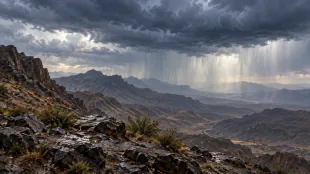
A small patch of ice among bare rock is all that remains of Venezuela’s last glacier, which the government hopes to restore to its former glory using a geothermal blanket.
Experts say that would be too little too late.
While glacier melt is a global phenomenon blamed on climate change, Venezuela is the first country in the Andes mountain range -- which stretches all the way to Chile in the south -- to lose all its glaciers.
Venezuela has lost five in total, adding up to some 1,000 hectares of ice, in the last century or so.
"In Venezuela there are no more glaciers," Julio Cesar Centeno, a university professor and advisor to the UN Conference on Environment and Development (UNCED), told AFP.
"What we have is a piece of ice that is 0.4 percent of its original size."
Centeno and other experts are convinced the loss of La Corona glacier on Humboldt peak, some 4,900 meters (more than 16,000 feet) above sea level, is irreversible.
But the government announced a plan in December to slow and even reverse the thaw by covering the area with a thermal mesh made of polypropylene plastic warding off the Sun's rays.
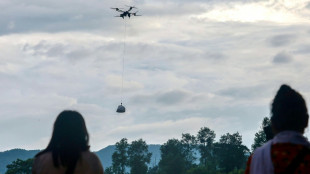
The cover was delivered to Humboldt peak by helicopter in 35 separate pieces, each measuring 2.75 meters by 80 meters, in December, but the government has not said whether it has already been unrolled.
Similar covers are used in European countries, mainly to protect ski slopes in warmer weather.
"It allows us to maintain the temperature of the area and prevent the entire glacier from melting," said Jehyson Guzman, governor of the western state of Merida that used to be home to Venezuela's glaciers.
- Nothing left to save -
But scientists of the University of Los Andes (ULA) are skeptical.
They say La Corona ceased to be a glacier since shrinking to just two hectares of the 450 hectares it used to cover. Scientists use a guideline of 10 hectares as the minimum size of a glacier.
Before La Corona, Venezuela also lost its glaciers on the peaks of El Leon, La Concha, El Toro and Bolivar.
"It is an illusory thing, a hallucination, it is completely absurd," said Centeno of the government's plan.
He and a team of other scientists will ask Venezuela's supreme court to scrap the project, which they say could have other, negative, impacts as the plastic blanket degrades over time.
"These micro plastics are practically invisible, they end up in the soil and from there they go to crops, lagoons, into the air, so people will end up eating and breathing that," he said.
Enrique La Marca, zoologist and ecologist, fears the cover could harm rare species of mosses and lichens, even hummingbirds that call the rocky environment home.
"That life will die because it will not have the necessary oxygen," he said.
- An ice remnant -
The most optimistic estimates give the remaining ice-cover "four to five years" before disappearing completely, said La Marca, who researches the impacts of glacier melt due to climate change.
Some calculations point to a mere two years.
"It’s an ice remnant," not a glacier, added physicist Alejandra Melfo, a ULA expert on the topic.
Forestry engineer and mountaineer Susana Rodriguez said the disappearance of La Corona will also affect Venezuelan tourism, as many people who used to climb the Humboldt peak did so on the ice.
"Now everything is rock, and what remains is so deteriorated that it is risky to step on it. There are cracks," said Rodriguez, who has accompanied several outings on the glacier.
C.Cassis--PC