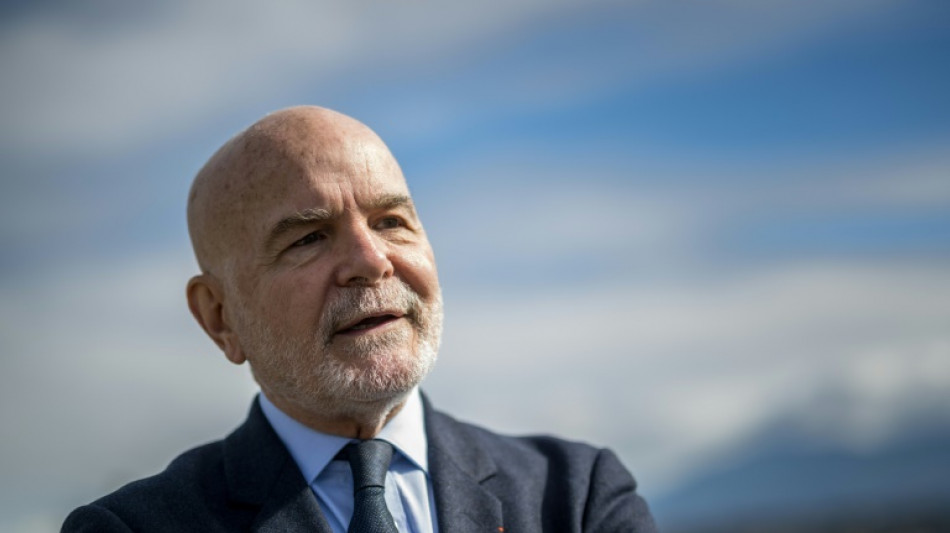
Climate protesters under fire in Europe: UN expert / Photo: Fabrice COFFRINI - AFP

 Ed Sheeran returns to stage after Palestinian controversy

 Asian Games to open in Japan after troubled build-up

 Drone owners rush to offload devices ahead of Beijing ban

 Trump's beef policies irk Texas ranchers, testing their loyalty

 Nvidia, OpenAI CEOs to attend Xi dinner at White House

 Anthropic picks Accenture for in-house AI safety evaluation

 Balogun returns as Monaco beat Lens to continue strong Ligue 1 start

 'Pause' on overt repression in Venezuela, but reforms still needed: HRW

 Global stocks mixed as yen falls despite Bank of Japan rate hike

 Cuba hit with seventh major blackout of the year

 Murray out with concussion so Wentz will start for Vikings

 UN chief 'deeply regrets' US visa refusal to Abbas for annual meeting

 England quick Carse to face no charges over alleged nightclub assault

 Mancini brings nine newcomers into the first squad of his Italy comeback

 Czechs level Davis Cup tie against USA as South Korea eye Finals

 New France boss Zidane confirms Mbappe as captain after naming first squad

 California governor signs order to explore AI 'kill switch'

 Head leads run spree as Australia win Zimbabwe ODI series

 In-form Raphinha wants to finish career at Barcelona

 Warren Buffett steps down as Berkshire Hathaway chairman

 Carrick confident Man Utd can 'work through' tough time

 Mbappe ends Nike partnership to join Swiss brand On

 Liverpool boss Iraola puts Bournemouth love affair on hold

 'A disaster' if Man City do not win says Maresca after flawless start

 Kerry James Marshall: American 'blackness' painter celebrated in Europe

Environmental activists are increasingly facing hostility across Europe, a UN expert said, warning that the very right to protest was "at risk" in countries usually considered beacons of democracy.
Michel Forst, the UN special rapporteur on environmental defenders, told AFP in an interview this week that he was deeply troubled by the hardening tone against climate activists in countries including France, Austria, Germany and Britain.
Government ministers have been throwing about terms like "eco terrorists" and "Green Talibans" to describe non-violent activists, he claimed, also blaming some media reporting for contributing to an increasingly hostile public attitude.
"It creates a sort of chilling effect," warned Forst, an independent expert appointed under the UN's Aarhus Convention -- a legally-binding text that provides for justice in environmental matters.
"Currently, the right to protest is at risk in Europe."
Forst said he had recently visited several European countries after receiving complaints that activists faced treatment that allegedly violated the convention and international human rights law.
Following a visit to Britain, he publicly voiced alarm at the "toxic discourse" and "increasingly severe crackdown" on environmental defenders.
- 'Regressive laws' -
Forst charged that "regressive laws" in Britain were being used to slap climate activists with harsh penalties, with one activist sent to prison for six months for a 30-minute slow march disrupting traffic.
Another activist had been sentenced to 27 months behind bars in the UK, he said.
He also decried harsh sentences in other countries, including Germany.
Forst travelled to France last month following complaints about a crackdown on a drawn-out anti-motorway protest near the southwestern city of Toulouse.
Activists, called "squirrels", who have been squatting in trees destined to be chopped down to make way for the A69 motorway, have accused law enforcement of denying them access to food and water and using floodlights to deprive them of sleep.
Forst said he had been blocked from bringing food to the activists, and was "shocked" by what he found.
"Obviously, deprivation of food, of drinking water, of sleep is clearly against international law," said Forst, a French national.
They are "considered acts of torture in international texts", he added.
- 'Dangerous' -
Forst said that European media coverage often focuses exclusively on the drama around demonstrations and not on the climate crisis prompting the protests.
The world is in a very "dangerous time", he said, but the general public often do not understand why young people are "blocking access to airports, or gluing their hands on the floor".
As a result, states have felt justified in developing new policies and laws, paving the way for police crackdowns, and increasingly harsh sentences.
In Britain, he said that some judges were even barring environmental defenders from using the word "climate" to explain their motivation to the jury.
Forst said that he was investigating whether big companies, especially in the oil and energy sector, might be lobbying to increase the pressure on climate activists.
"The most dangerous" companies were even "using security forces, connections with the mafia... to target and sometimes to kill defenders," he said.
Forst said he was currently organising consultations in Latin America and Africa with environmental activists there who are facing attacks by companies.
He is also investigating whether companies based in Europe are, through local subsidiaries, contributing to attacks on activists.
And the expert blasted European countries for "a double standard" by supporting environmental defenders in other parts of the world but "not protecting their defenders inside Europe".
S.Pimentel--PC