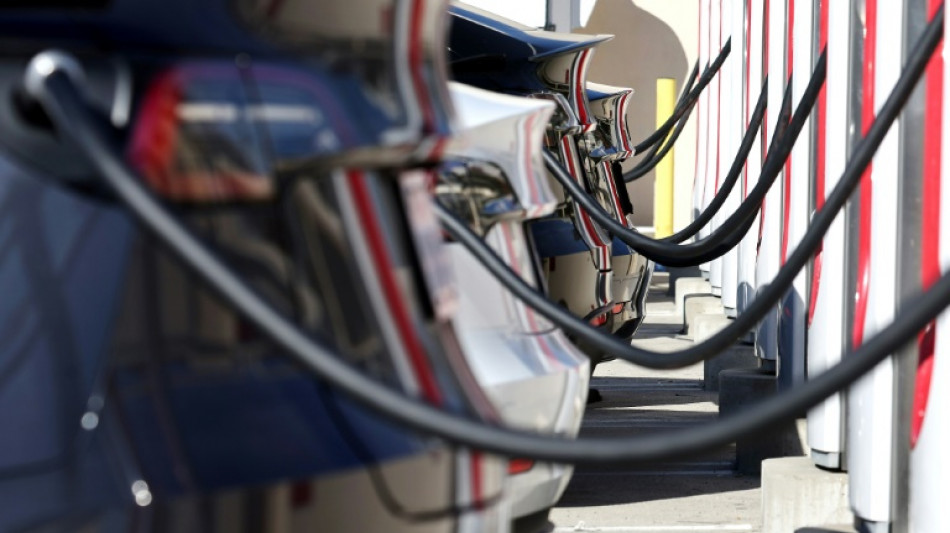
Electric cars credited with lower CO2 emissions in US neighborhoods / Photo: MARIO TAMA - GETTY IMAGES NORTH AMERICA/AFP

 Ed Sheeran returns to stage after Palestinian controversy

 Asian Games to open in Japan after troubled build-up

 Drone owners rush to offload devices ahead of Beijing ban

 Trump's beef policies irk Texas ranchers, testing their loyalty

 Nvidia, OpenAI CEOs to attend Xi dinner at White House

 Anthropic picks Accenture for in-house AI safety evaluation

 Balogun returns as Monaco beat Lens to continue strong Ligue 1 start

 'Pause' on overt repression in Venezuela, but reforms still needed: HRW

 Global stocks mixed as yen falls despite Bank of Japan rate hike

 Cuba hit with seventh major blackout of the year

 Murray out with concussion so Wentz will start for Vikings

 UN chief 'deeply regrets' US visa refusal to Abbas for annual meeting

 England quick Carse to face no charges over alleged nightclub assault

 Mancini brings nine newcomers into the first squad of his Italy comeback

 Czechs level Davis Cup tie against USA as South Korea eye Finals

 New France boss Zidane confirms Mbappe as captain after naming first squad

 California governor signs order to explore AI 'kill switch'

 Head leads run spree as Australia win Zimbabwe ODI series

 In-form Raphinha wants to finish career at Barcelona

 Warren Buffett steps down as Berkshire Hathaway chairman

 Carrick confident Man Utd can 'work through' tough time

 Mbappe ends Nike partnership to join Swiss brand On

 Liverpool boss Iraola puts Bournemouth love affair on hold

 'A disaster' if Man City do not win says Maresca after flawless start

 Kerry James Marshall: American 'blackness' painter celebrated in Europe

The booming use of electric vehicles in parts of California is reducing CO2 emissions in those areas, a study showed Thursday, bolstering a key pillar of the state's drive towards net zero.
Scientists at the University of California, Berkeley, say a network of sensors set up around the San Francisco Bay Area -- where Teslas and other EVs are a common sight -- has logged a small but steady drop in the volume of planet-warming carbon dioxide being pumped out every year.
"We show from atmospheric measurements that adoption of electric vehicles is working, that it's having the intended effect on CO2 emissions," said chemistry professor Ronald Cohen, the study's lead author.
Carbon dioxide is one of the main contributors to global warming, the human-caused phenomenon of rising temperatures that is increasingly playing havoc with global weather patterns.
Scientists agree that nations have to rapidly shift away from burning fossil fuels in order to keep global temperature rises to a manageable level and avoid the worst environmental calamities.
More than two-thirds of CO2 emissions come from cities, but granular information about those emissions is scant -- leaving policymakers guessing at how best to tamp them down.
Cohen's network of dozens of sensors, which he started installing in 2012, has started to change that. It logged a 1.8 percent drop in emissions every year over a five-year period.
Cross-referencing this data with vehicle registration information in the Bay Area -- where almost one in every 20 vehicles is electric or hybrid -- led Cohen and his team to conclude electrification was having a measurable effect.
"The state of California has an ambition to be net zero in 2045 and that requires a decrease (in emissions) of a little more than three and a half percent per year for the next 20 plus years," Cohen told AFP.
"1.8 percent per year is half the rate that we need to decrease. But I think it's an amazing down payment on our way to the right future."
- 'Good news' -
California's ambitious plan for net zero -- where CO2 production is vastly reduced and any remaining emissions are offset -- puts it ahead of the 2050 target of the United States as a whole.
The state, which if it were a country would have the fifth-biggest economy in the world, has some of the strictest environmental standards in the United States, including a plan to ban the sale of new gas-powered cars by 2035.
Cohen, who plans to roll out his sensor network in Los Angeles, in Providence, Rhode Island and in the Scottish city of Glasgow, acknowledges that the Bay Area's enthusiastic adoption of EVs in a state sympathetic to the cause makes it an atypical case study.
"This is what a good news story looks like in the place that's most aggressive," he said.
"But it shows it's possible. It shows both how we can make measurements that allow us to report on how cities are doing with their policies, and it shows us those policies can make changes that are observable at scale," he said.
X.Brito--PC