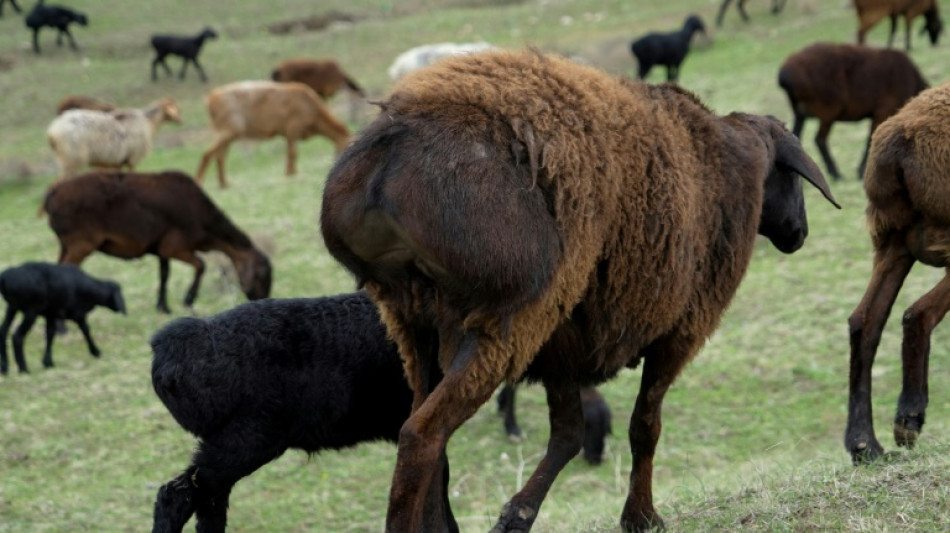
The giant sheep helping Tajikistan weather climate change / Photo: amir isaev - AFP

 Indians living in Japan on stand-by to house Asian Games athletes

 Trump signs bill authorizing sweeping Russia sanctions

 Protesters form human chain at Kennedy Center after Trump threat

 Death toll from attack at police HQ in Pakistan rises to 31

 Trump says Denmark to give US 'permanent control' over Greenland security

 Kennedy Center: future unclear for iconic Washington arts hub

 Trump claims 'infinite' Greenland security deal with Denmark

 Helicopters battle wildfire threatening Ecuador's capital

 Brentford batter Chelsea to undo Alonso's promising start

 Kane hits Bundesliga century as Bayern rout Union

 Trump says CNN, MS NOW, Politico banned from White House

 Hushing and hedging: US companies retreat on climate

 Springboks to face Fiji before 2027 Rugby World Cup

 Nigeria miners struggled to breathe in cell before 37 died: survivors

 McIlroy on the charge at PGA Championship as Reed withdraws

 McIlroy on the charge at PGA Championship

 Crisis-wracked Volkswagen warns of 10-bn-euro hit to profits

 Costa Rica's Grynspan tops third informal poll for UN chief: diplomat

 Stock markets retreat after central bank rate hikes

 Russia labels director of Cannes Grand Prix winner a 'foreign agent'

 Macron warns of Russian 'hybrid' threat after meeting presidential hopefuls

 UN holds third informal poll for new chief

 Kulusevski return can spark Spurs: De Zerbi

 Shakira to cap off world tour with Madrid 12-gig run

 Isolated Syrian-Druze city blames Damascus for shortages

In the hills outside the Tajik capital Dushanbe, shepherd Bakhtior Sharipov was watching over his flock of giant Hissar sheep.
The breed, prized for profitability and an ability to adapt to climate change, garners celebrity status in the Central Asian country, which is beset by a shortage of both meat and suitable grazing land.
"They rapidly gain weight even when there is little water and pasture available," 18-year-old Sharipov said.
Facing a serious degradation in farmland due to years of overgrazing and global warming, the hardy sheep offer a potential boon to Tajikistan's farmers and plentiful supply of mutton to consumers.
Around 250 of the animals -- instantly recognisable by two fatty lumps on their rear end -- were grazing in the early spring sun under Sharipov's watch.
"These weigh an average of 135 kilograms (300 pounds). It's the end of winter, so they're not as heavy, but they'll put on weight quickly," he said.
A white Central Asian shepherd dog, almost as large as the sheep he was watching over, stood on guard.
The largest Hissar rams can weigh over 210 kilograms (460 pounds).
Able to yield meat and fat of around two-thirds their total weight -- more than most other breeds, many of which also consume more -- they can be highly profitable for farmers.
- 'Improve the land' -
"The Hissars are a unique breed, first because of their weight," Sharofzhon Rakhimov, a member of the Tajik Academy of Agricultural Sciences, told AFP.
"Plus these sheep never stay in the same spot so they contribute to improving the land's ecosystem," he said.
They can wander up to 500 kilometres (300 miles) in search of grazing land between seasons, helping pastures in different regions regenerate.
The decline in land quality is one of the main environmental challenges facing Central Asia.
Around 20 percent of the region's land is already degraded, affecting 18 million people, according to a United Nations report.
That is an area of 800,000 square kilometres (nearly 310,000 square miles), equivalent to the size of Turkey.
The dust churned up by the arid ground can fuel cardio-respiratory diseases.
Facing a hit to their livelihoods as their land becomes ever less productive, many farmers choose to emigrate.
In such an environment, the status of Hissar sheep -- able to thrive in the tough conditions -- is of serious public interest for Tajikistan.
Among the dozens of posters glorifying Tajik President Emomali Rahmon that line the road into the Hissar valley, stands a golden-coloured monument to the three kinds of Hissar sheep.
- A $40,000 sheep -
At his biotech centre near the capital, scientist and breeder Ibrokhim Bobokalonov harnesses genetic samples of the very best specimens in the hope of rearing the largest and most profitable sheep.
"Demand for Hissar sheep is growing not only in Tajikistan, but also in Kazakhstan, Kyrgyzstan, Russia, Turkey, Azerbaijan, China and even the United States," Bobokalonov said.
The animals have even become a source of rivalry in the region.
Tajikistan recently accused its neighbours of tampering with the breed, crossing it with other local varieties to create even heavier sheep.
A Hissar weighing 230 kilos was recorded at an agricultural competition in Kazakhstan last year, setting a Guinness World Record.
Others in Kyrgyzstan have surpassed 210 kilos.
Tajik breeders say they are intent on staying ahead.
"Here's Misha. He weighs 152 kilograms and is worth $15,000," Bobokalonov said, standing in front of a sheep lying on the scales with its legs tied together.
The sum is equivalent to six years' average salary in Tajikistan. Bobokalonov plans to sell him later this year.
"I hope that by the time of the competition this summer, he will weigh 220-230 kilograms. Just by feeding him natural products, without doping, he can put on around 800 grams a day," Bobokalonov said.
In Kazakhstan, a sheep sold for $40,000 in 2021.
While farmers like the Hissars for their profitability, the sheep is famed among the wider population for its flavour.
Mutton is an essential ingredient in central Asian fare.
Scouring the offering at a local market, shopper Umedjon Yuldachev agreed.
"You can cook any Tajik national dish with this mutton."
A.P.Maia--PC