-
 Indians living in Japan on stand-by to house Asian Games athletes
-
We don't want Games host Japan losing money, says Asian Olympic official

-
 Trump signs bill authorizing sweeping Russia sanctions
-
Ed Sheeran returns to stage after Palestinian controversy

-
 Protesters form human chain at Kennedy Center after Trump threat
-
Asian Games to open in Japan after troubled build-up

-
 Death toll from attack at police HQ in Pakistan rises to 31
-
Drone owners rush to offload devices ahead of Beijing ban

-
 Trump says Denmark to give US 'permanent control' over Greenland security
-
Trump's beef policies irk Texas ranchers, testing their loyalty

-
 Kennedy Center: future unclear for iconic Washington arts hub
-
Nvidia, OpenAI CEOs to attend Xi dinner at White House

-
 Trump claims 'infinite' Greenland security deal with Denmark
-
Anthropic picks Accenture for in-house AI safety evaluation

-
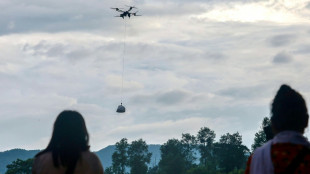
 Helicopters battle wildfire threatening Ecuador's capital
-
Balogun returns as Monaco beat Lens to continue strong Ligue 1 start

-
 Brentford batter Chelsea to undo Alonso's promising start
-
'Pause' on overt repression in Venezuela, but reforms still needed: HRW

-
 Kane hits Bundesliga century as Bayern rout Union
-
Global stocks mixed as yen falls despite Bank of Japan rate hike

-
 Trump says CNN, MS NOW, Politico banned from White House
-
Cuba hit with seventh major blackout of the year

-
 Hushing and hedging: US companies retreat on climate
-
Murray out with concussion so Wentz will start for Vikings

-
 Springboks to face Fiji before 2027 Rugby World Cup
-
UN chief 'deeply regrets' US visa refusal to Abbas for annual meeting

-
 Nigeria miners struggled to breathe in cell before 37 died: survivors
-
England quick Carse to face no charges over alleged nightclub assault

-
 McIlroy on the charge at PGA Championship as Reed withdraws
-
Mancini brings nine newcomers into the first squad of his Italy comeback

-
 McIlroy on the charge at PGA Championship
-
Czechs level Davis Cup tie against USA as South Korea eye Finals

-
 Crisis-wracked Volkswagen warns of 10-bn-euro hit to profits
-
New France boss Zidane confirms Mbappe as captain after naming first squad

-
 Costa Rica's Grynspan tops third informal poll for UN chief: diplomat
-
California governor signs order to explore AI 'kill switch'

-
 Stock markets retreat after central bank rate hikes
-
Head leads run spree as Australia win Zimbabwe ODI series

-
 Russia labels director of Cannes Grand Prix winner a 'foreign agent'
-
In-form Raphinha wants to finish career at Barcelona

-
 Macron warns of Russian 'hybrid' threat after meeting presidential hopefuls
-
Warren Buffett steps down as Berkshire Hathaway chairman

-
 UN holds third informal poll for new chief
-
Carrick confident Man Utd can 'work through' tough time

-
 Kulusevski return can spark Spurs: De Zerbi
-
Mbappe ends Nike partnership to join Swiss brand On

-
 Shakira to cap off world tour with Madrid 12-gig run
-
Liverpool boss Iraola puts Bournemouth love affair on hold

-
 Isolated Syrian-Druze city blames Damascus for shortages
-
'A disaster' if Man City do not win says Maresca after flawless start

Rains, mudslides kill 29 in southern Brazil's 'worst disaster'
Brazilian President Luiz Inacio Lula da Silva on Thursday visited the country's south where floods and mudslides caused by torrential rains have killed 29 people, with the toll expected to rise.
Authorities in Rio Grande do Sul have declared a state of emergency as rescuers continue to search for dozens of people reported missing among the ruins of collapsed homes, bridges and roads.
Storm damage has affected nearly 150 municipalities in the state, also injuring at least a dozen people and displacing close to 10,000.
Governor Eduardo Leite said Rio Grande do Sul was dealing with "the worst disaster in (its) history."
In a live broadcast, he updated the death toll from 13 earlier Thursday to 29, and the number of people missing from 21 to 60.
"With the deepest pain in my heart, I know it will be even more," said the governor.
Lula, who has blamed the torrent on climate change, arrived in the town of Santa Maria in the morning with a delegation of ministers and held a working meeting with Leite and other officials to coordinate rescue efforts, the government said.
The president promised "there will be no lack of human or material resources" to "minimize the suffering this extreme event... is causing in the state."
The federal government, he added, "will be 100 percent at the disposition" of state officials.
Central authorities has already made available 12 aircraft, 45 vehicles and 12 boats as well as 626 soldiers to help clear roads, distribute food, water and mattresses, and set up shelters, a press statement said.
As the rains continued, forecasts warned the state's main Guaiba River, which has already overflowed its banks in some areas, would reach an extraordinary level of three meters (9.8 feet) by Thursday and four meters the next day.
- 'Completely destroyed' -
Entire communities in Rio Grande do Sul have been completely cut off as persistent rains have destroyed bridges and blocked roads, and left towns without even telephone or internet services.
Rescuers and soldiers have been scrambling to free families trapped in their homes, many stuck on rooftops to escape rising waters.
"I've never seen anything like this... it's all under water," said Raul Metzel, a 52-year-old machine operator in the municipality of Capela de Santana.
Authorities have urged people to avoid areas along state highways due to a risk of mudslides, and those who live near rivers or on hillsides to evacuate.
Hundreds of thousands of people have been left without access to electricity and drinking water, while classes have been suspended state-wide.
On Wednesday, the state's deputy governor, Gabriel Souza, said damages have been estimated at $20 million.
Mayor Sandra Backes of Sinimbu said the situation in her town was "a nightmare."
"Sinimbu is like a war zone, completely destroyed... All the stores, businesses, supermarkets -- everything is devastated," she said in a video posted on Instagram.
Elsewhere, in Santa Cruz do Sul, lifeguards used boats to transport residents, many of them children, to safety.
The region's rivers had already been swollen from previous storms.
Last September at least 31 people died as a cyclone hit the state.
South America's largest country has suffered a string of recent extreme weather events, which experts say are made more likely by climate change.
The floods came amid a cold front battering the south and southeast, following a wave of extreme heat.
A.Silveira--PC