No let up yet for flood-battered south Brazil / Photo: Carlos FABAL - AFP

 Indians living in Japan on stand-by to house Asian Games athletes

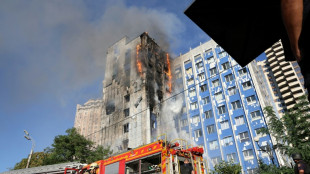 Trump signs bill authorizing sweeping Russia sanctions

 Protesters form human chain at Kennedy Center after Trump threat

 Death toll from attack at police HQ in Pakistan rises to 31

 Trump says Denmark to give US 'permanent control' over Greenland security

 Kennedy Center: future unclear for iconic Washington arts hub

 Trump claims 'infinite' Greenland security deal with Denmark

 Helicopters battle wildfire threatening Ecuador's capital

 Brentford batter Chelsea to undo Alonso's promising start

 Kane hits Bundesliga century as Bayern rout Union

 Trump says CNN, MS NOW, Politico banned from White House

 Hushing and hedging: US companies retreat on climate

 Springboks to face Fiji before 2027 Rugby World Cup

 Nigeria miners struggled to breathe in cell before 37 died: survivors

 McIlroy on the charge at PGA Championship as Reed withdraws

 McIlroy on the charge at PGA Championship

 Crisis-wracked Volkswagen warns of 10-bn-euro hit to profits

 Costa Rica's Grynspan tops third informal poll for UN chief: diplomat

 Stock markets retreat after central bank rate hikes

 Russia labels director of Cannes Grand Prix winner a 'foreign agent'

 Macron warns of Russian 'hybrid' threat after meeting presidential hopefuls

 UN holds third informal poll for new chief

 Kulusevski return can spark Spurs: De Zerbi

 Shakira to cap off world tour with Madrid 12-gig run

 Isolated Syrian-Druze city blames Damascus for shortages

The rains may have abated, but floodwaters on Monday continued their assault on southern Brazil, with hundreds of municipalities in ruins amid fears that food and drinking water may soon run out.
Since the unprecedented deluge started last week, at least 83 people have died and 129,000 were ejected from their homes by floods and mudslides in Rio Grande do Sul state, authorities said.
The search is becoming ever more desperate for 111 reported missing among the devastation.
The disaster, which experts and the government have linked to climate change, has left the state resembling "a scene out of a war," the state's governor Eduardo Leite said Sunday.
In total, 364 cities, towns and villages have been hit, many of which remain cut off from the world without access to drinking water or electricity or any means of calling for help.
In Porto Alegre, the state capital with 1.4 million inhabitants, many suburbs remained under water even as the sun shone Monday.
"Last night, the water came up to the corner and had stabilized. Today, we woke up and it was outside my house and rising," Neucir Carmo, a 62-year-old resident of the Floresta neighborhood, told AFP.
"We don't know how high it will go."
The Guaiba River, which flows through the mega-city of high-rise buildings and wide streets, reached a record high level of 5.3 meters (17.4 feet) Sunday -- well above the historic peak of 4.76 meters that accompanied devastating floods in 1941.
By Monday morning, the level had receded slightly, to 5.27 meters.
The MetSul meteorological agency said on its website that some parts of Porto Alegre, the wider metropolitan region and valley settlements "will be uninhabitable for weeks to months."
Some regions had received the equivalent of a third of average annual rainfall in just a few days, it said.
"The scenario is complicated because the weather conditions, excellent today, will not continue like this. On Wednesday, the areas affected by flooding in Greater Porto Alegre and the valleys may experience rain again."
- 'Disastrous cocktail' -
The deluge, which started a week ago, has swept away bridges and dozens of roads, complicating relief efforts that have to rely instead on helicopters and boats.
Some 14,000 soldiers are aiding search and rescue professionals and volunteers working against the clock as concerns grow about supplies of food, potable water and other essentials.
Donations of food and medicine poured in from around the country, and good Samaritans have contributed the equivalent of about $7.6 million to a rescue fund.
At the state's civil defense logistics center in Porto Alegre, mountains of donations were awaiting distribution as state officials flew critical medical supplies to flooded areas.
Authorities said there were more than 20,000 people in public shelters and field hospitals set up after hospitals and clinics were flooded.
Classes in Porto Alegre have been suspended until Wednesday, and schools are being used as makeshift shelters, officials said.
President Luiz Inacio Lula da Silva visited the region Sunday for the second time in days, promising the federal government would provide "all the necessary" resources needed for the reconstruction of the state of 11 million inhabitants.
South America's largest country has recently experienced a string of extreme weather events, including a cyclone in September that killed at least 31 people in the same region.
Brazilian climatologist Francisco Eliseu Aquino told AFP the flooding was the consequence of a "disastrous cocktail" of climate change and the meteorological phenomenon of El Nino.
According to MetSul, "the biggest concern is the indications... that between the 10th and 15th of May there would be a new episode of instability with a risk of excessive rain in Rio Grande do Sul."
These would once again affect Porto Alegre and the Guaiba River, it said.
L.Henrique--PC