Loss and hope: US park rangers' climate crisis fight / Photo: Lucie AUBOURG - AFP

 Indians living in Japan on stand-by to house Asian Games athletes
 Trump signs bill authorizing sweeping Russia sanctions

 Protesters form human chain at Kennedy Center after Trump threat

 Death toll from attack at police HQ in Pakistan rises to 31

 Trump says Denmark to give US 'permanent control' over Greenland security

 Kennedy Center: future unclear for iconic Washington arts hub

 Trump claims 'infinite' Greenland security deal with Denmark

 Helicopters battle wildfire threatening Ecuador's capital

 Brentford batter Chelsea to undo Alonso's promising start

 Kane hits Bundesliga century as Bayern rout Union

 Trump says CNN, MS NOW, Politico banned from White House

 Hushing and hedging: US companies retreat on climate

 Springboks to face Fiji before 2027 Rugby World Cup

 Nigeria miners struggled to breathe in cell before 37 died: survivors

 McIlroy on the charge at PGA Championship as Reed withdraws

 McIlroy on the charge at PGA Championship

 Crisis-wracked Volkswagen warns of 10-bn-euro hit to profits

 Costa Rica's Grynspan tops third informal poll for UN chief: diplomat

 Stock markets retreat after central bank rate hikes

 Russia labels director of Cannes Grand Prix winner a 'foreign agent'

 Macron warns of Russian 'hybrid' threat after meeting presidential hopefuls

 UN holds third informal poll for new chief

 Kulusevski return can spark Spurs: De Zerbi

 Shakira to cap off world tour with Madrid 12-gig run

 Isolated Syrian-Druze city blames Damascus for shortages

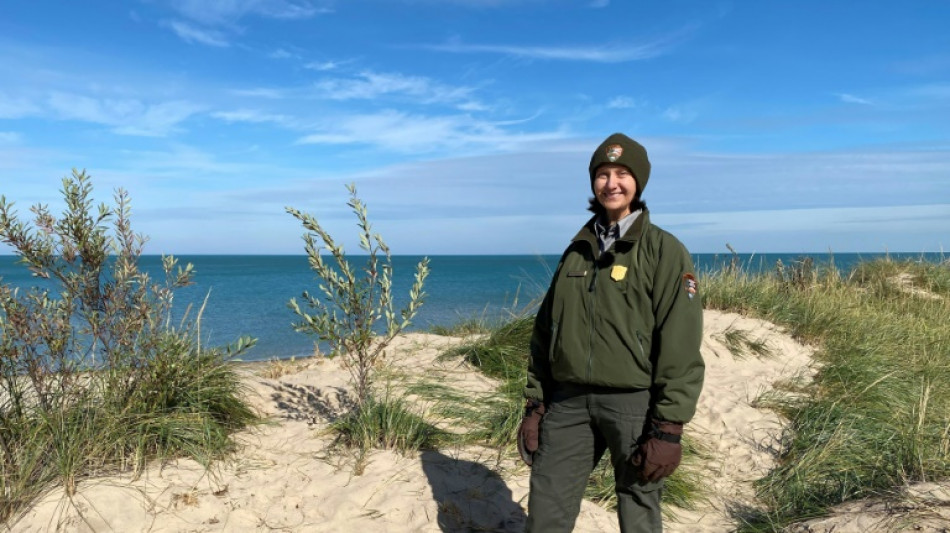
American biologist Laura Brennan describes the coin-sized Karner blue butterfly as "very delicate and graceful" with a "lovely blue" coloring and "just a little speckling of orange."
The species, declared endangered in 1992, used to flourish in Indiana Dunes National Park, where Brennan has worked for two decades.
But the butterfly is now believed to have disappeared entirely from the midwestern US park -- becoming a victim of rising temperatures fueled by human activity, among other stressors.
Brennan and thousands of others in the National Park Service (NPS) are witnessing firsthand the consequences of the climate crisis and struggling to mitigate its impacts.
In picturesque Glacier National Park, near the US-Canada border in Montana, biologist Dawn LaFleur is working to save an at-risk pine species.
"Pretty much everything we do is in light of climate change," she told AFP.
Some battles, like hers, seem winnable. Others are already lost.
In Indiana, the Karner blue butterfly (Plebejus samuelis) is the first known endangered species to have disappeared from an American national park due to global warming.
Though they remain in other places, their loss in the park was "heartbreaking" and "incredibly scary," Brennan told AFP.
It's "terrifying to know how fragile these systems are, and how interconnected everything is, and how little control we have," she said.
- 'Nothing to eat' -
John Gross with the NPS climate change response program told AFP that witnessing the crisis impacts "is hugely emotional" for park rangers.
"It's not a career for many people. It's a way of life," he said, explaining that many employees are the second or third generation in their families to work at the parks.
"So they're very connected to their resources and their parks and care very deeply about it."
Brennan grew up just a few hours from the Indiana Dunes site, which lies along Lake Michigan, some 40 miles (65 kilometers) east of Chicago.
In 2012, her beloved butterflies fell victim to what scientists call a "phenological mismatch."
Due to unusually warm springtime weather, the butterfly larvae emerged ahead of their plant food source, lupine.
"Plants are more reliant on soil temperatures, whereas insects are more reliant on the air temperatures" for seasonal transitions, she explained.
Once emerged, the larvae "have nothing to eat," she said.
"That was the beginning of the end of the Karner story here at Indiana Dunes National Park."
Strenuous efforts were made to restore the butterfly habitat -- as lupines need ample light to grow, major clearing operations were launched, but to no avail.
Models and research on how to make lands more "resilient" against climate change need to be ramped up, she said.
"We need the ability to remove those stressors faster."
- Genetic selection -
In Montana, the whitebark pine has been threatened for years by an invasive fungus known as blister rust, but is increasingly threatened by drought due to early snowmelts and changing weather patterns.
Declared endangered, the trees grow only in the western United States and Canada, and at high altitudes that are particularly sensitive to global warming.
With rising temperatures, mountain pine beetles also risk spreading to those higher altitudes, where they would then attack whitebark pines.
Saving the pines is essential, as their seeds provide food for many species, including grizzly bears and the Clark's nutcracker bird.
For over 20 years, some 1,000 whitebark pines have been replanted every year in Glacier National Park -- a difficult task due to the park's mountainous terrain.
The seeds are chosen after genetic testing for blister rust resistance, and increasingly for drought resistance, LaFleur said.
Having worked in the park for over three decades, she said the work can sometimes leave her feeling "overwhelmed."
"The more we spend in these environments, we realize how fragile they are in terms of the changes being wrought by climate change," she said.
Nonetheless, LaFleur said she remains hopeful about saving the pines.
"We can't change how hot and dry it gets in the summer now, for extended periods of time, we can't control that," she said philosophically.
"So it's more coming up with solutions to be able to adapt and direct our resources... to be able to really address what things we have control over and make a difference that way."
R.J.Fidalgo--PC