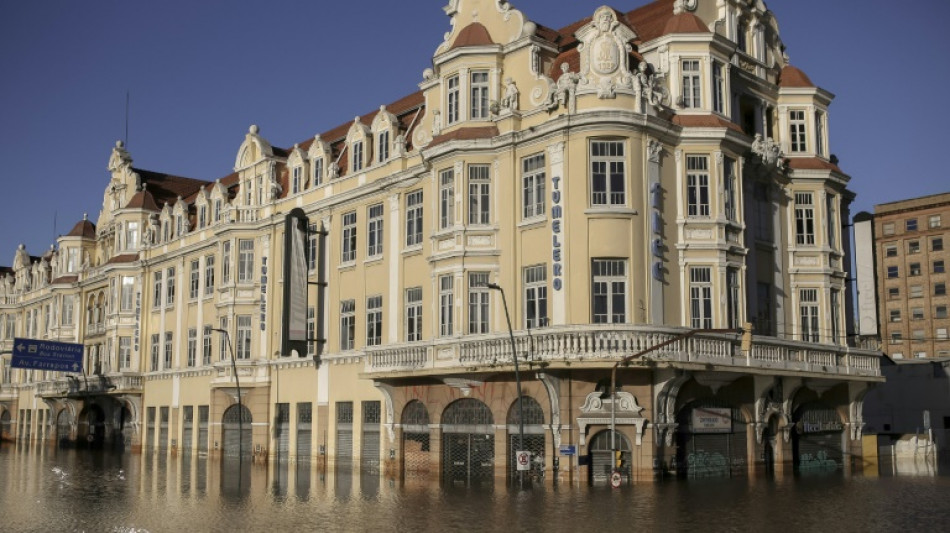
Brazil's Porto Alegre: a flood disaster waiting to happen / Photo: Anselmo Cunha - AFP

 Indians living in Japan on stand-by to house Asian Games athletes

 Trump signs bill authorizing sweeping Russia sanctions

 Protesters form human chain at Kennedy Center after Trump threat

 Death toll from attack at police HQ in Pakistan rises to 31

 Trump says Denmark to give US 'permanent control' over Greenland security

 Kennedy Center: future unclear for iconic Washington arts hub

 Trump claims 'infinite' Greenland security deal with Denmark

 Helicopters battle wildfire threatening Ecuador's capital

 Brentford batter Chelsea to undo Alonso's promising start

 Kane hits Bundesliga century as Bayern rout Union

 Trump says CNN, MS NOW, Politico banned from White House

 Hushing and hedging: US companies retreat on climate

 Springboks to face Fiji before 2027 Rugby World Cup

 Nigeria miners struggled to breathe in cell before 37 died: survivors

 McIlroy on the charge at PGA Championship as Reed withdraws

 McIlroy on the charge at PGA Championship

 Crisis-wracked Volkswagen warns of 10-bn-euro hit to profits

 Costa Rica's Grynspan tops third informal poll for UN chief: diplomat

 Stock markets retreat after central bank rate hikes

 Russia labels director of Cannes Grand Prix winner a 'foreign agent'

 Macron warns of Russian 'hybrid' threat after meeting presidential hopefuls

 UN holds third informal poll for new chief

 Kulusevski return can spark Spurs: De Zerbi

 Shakira to cap off world tour with Madrid 12-gig run

 Isolated Syrian-Druze city blames Damascus for shortages

Porto Alegre, the Brazilian metropolis left submerged after torrential rains, had been lulled into a "false sense" of security by a vast but aging system of flood defenses, an urban drainage engineer told AFP.
Leomar Teichmann said a network of dikes, levees and a massive wall was meant to protect about 40 percent of the capital city of Rio Grande do Sul state in southern Brazil, where 150 people have died and hundreds of thousands were forced from their homes.
Teichmann is an engineering consultant and former deputy director of water and sewerage services for Porto Alegre, a city of 1.4 million people on the banks of the Guaiba estuary.
He told AFP he had already warned in 2019 that the city was at risk.
- What does system consist of? -
"The system was designed after floods in 1967 and built in the 1970s. It includes about 65 kilometers (40 miles) of dykes and a concrete wall of 2.67 km, as well as 14 floodgates and 22 storm water pumping stations.
"It was a simple system that seemed functional, since it guaranteed the protection of the urbanized part of Porto Alegre.
"However, it was never tested in practice until November 2023, because it was only on this occasion that the level of the Jacui River exceeded three meters (10 feet), which is the level of the Maua wall," leading to flooding, he explained.
"In other words, the system stood for 51 years without the water of the Jacui River ever touching the wall."
- Why did it fail with latest floods? -
"Gate Number 14 buckled under the great pressure of the water and began to leak with great volume and speed.
"The amount of water was so great that the nearby pumping stations were quickly flooded, causing the pumps to shut down.
"The flooding caused by the gate failure was so rapid that the entire region was flooded in a few hours.
"This flood eventually caused a power outage in the flooded areas, and as a result, all the pumping stations north of the Gasometer Plant stopped working," he said, referring to an out-of-service power plant.
"There were several failures in sequence. In about 24 hours, the water level on either side of the system was exactly the same."
- What were consequences of these failures? -
"Already in 2019, I stated that the protection system installed in Porto Alegre gave the population a false sense of protection and security, because there was no way to contain water in case of failure of any of the elements that make up this system.
"It is an old system, with many points subject to failure and requiring high investments in operation and maintenance.
"Much is said about Porto Alegre, but this same type of flood protection system was built in Canoas, Sao Leopoldo and Novo Hamburgo (other municipalities in the state) where the system was also overwhelmed by the water level.
"In all these cities the water very quickly invaded areas that should have been protected and caused greater tragedies than if the system did not exist."
Teichmann explained that water spilling over the dikes moved much faster than rising river levels.
"I'm not saying that dikes are useless, but with a flood of this size, as soon as the dikes were overcome by water, the speed with which water passed to the other side of these was much higher than if the dikes did not exist."
E.Paulino--PC