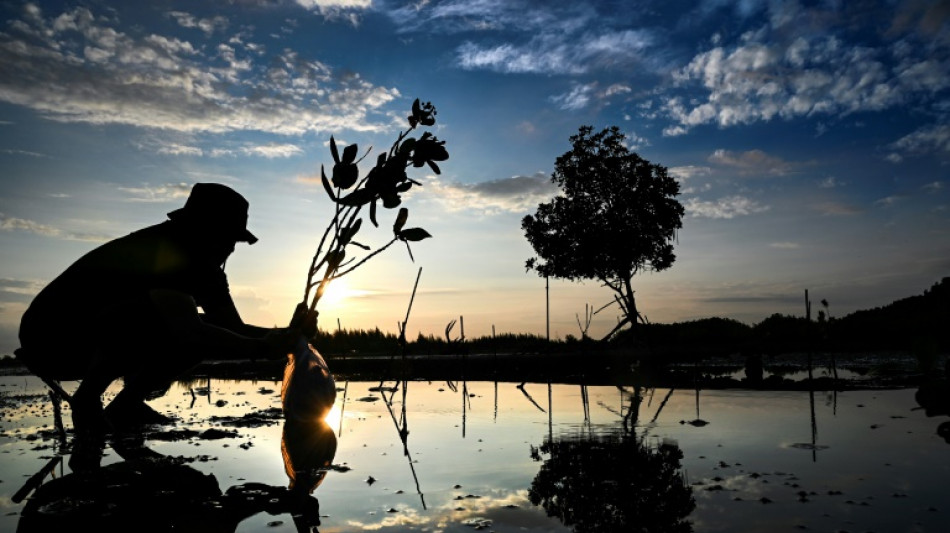
Half of mangrove ecosystems at risk: conservationists / Photo: CHAIDEER MAHYUDDIN - AFP/File

 Indians living in Japan on stand-by to house Asian Games athletes
 Trump signs bill authorizing sweeping Russia sanctions

 Protesters form human chain at Kennedy Center after Trump threat

 Death toll from attack at police HQ in Pakistan rises to 31

 Trump says Denmark to give US 'permanent control' over Greenland security

 Kennedy Center: future unclear for iconic Washington arts hub

 Trump claims 'infinite' Greenland security deal with Denmark

 Helicopters battle wildfire threatening Ecuador's capital

 Brentford batter Chelsea to undo Alonso's promising start

 Kane hits Bundesliga century as Bayern rout Union

 Trump says CNN, MS NOW, Politico banned from White House

 Hushing and hedging: US companies retreat on climate

 Springboks to face Fiji before 2027 Rugby World Cup

 Nigeria miners struggled to breathe in cell before 37 died: survivors

 McIlroy on the charge at PGA Championship as Reed withdraws

 McIlroy on the charge at PGA Championship

 Crisis-wracked Volkswagen warns of 10-bn-euro hit to profits

 Costa Rica's Grynspan tops third informal poll for UN chief: diplomat

 Stock markets retreat after central bank rate hikes

 Russia labels director of Cannes Grand Prix winner a 'foreign agent'

 Macron warns of Russian 'hybrid' threat after meeting presidential hopefuls

 UN holds third informal poll for new chief

 Kulusevski return can spark Spurs: De Zerbi

 Shakira to cap off world tour with Madrid 12-gig run

 Isolated Syrian-Druze city blames Damascus for shortages

Half of the world's mangrove ecosystems are at risk of collapse due to climate change, deforestation and pollution, according to a study published Wednesday.
The International Union for Conservation of Nature (IUCN), known for its red list of threatened species, has for the first time taken stock of the world's mangroves, evaluating 36 different regions.
IUCN director general Grethel Aguilar said the assessment "highlights the urgent need for coordinated conservation of mangroves -- crucial habitats for millions in vulnerable communities worldwide".
Mangroves are trees or shrubs that grow mainly in seawater or brackish water along coastlines and tidal rivers, in equatorial climes.
Released on the International Day for Biodiversity, IUCN said its findings show that "50 percent of the mangrove ecosystems assessed are at risk of collapse" -- categorised as either vulnerable, endangered or critically endangered.
According to the assessment, 20 percent were at severe risk of collapse.
Mangroves are threatened by deforestation, development, pollution, and dam construction.
However, the risk is increasing due to sea-level rise and the greater frequency of severe storms associated with climate change.
Around 15 percent of the world's coasts are covered by mangroves, covering about 150,000 square kilometres.
- Disastrous disappearance -
Climate change threatens a third of mangrove ecosystems assessed, due to rising sea levels.
According to estimates, at the current rate, a quarter of the global area of mangroves is expected to be submerged in the next 50 years, IUCN said.
The northwest Atlantic Ocean, the northern Indian Ocean, the Red Sea, the South China Sea, and the Gulf of Aden coasts are expected to be particularly severely affected.
"Mangrove ecosystems are exceptional in their ability to provide essential services to people, including coastal disaster risk reduction, carbon storage and sequestration, and support for fisheries," said Angela Andrade, chair of the IUCN commission on ecosystem management.
"Their loss stands to be disastrous for nature and people across the globe."
The study said looking after mangroves was essential for mitigating the effects of climate change, with healthy ecosystems coping better with sea level rise and providing inland protection from the effects of severe storms.
Without significant improvement by 2050, climate change and rising sea levels will lead to the loss of 1.8 billion tonnes of carbon stored in mangroves.
Mangroves currently store nearly 11 billion tons of carbon -- almost three times the amount of carbon stored by tropical forests of the same size.
Maintaining good sediment circulation and allowing mangroves to expand inland will help them cope with sea level rise, IUCN said. It also called for the restoration of mangroves which have already disappeared.
"A very good study of mangrove change globally that was published in 2022 indicates about 5,000 square kilometres of mangrove were lost" between 1996 and 2020, IUCN's Marco Valderrabano told AFP.
X.M.Francisco--PC