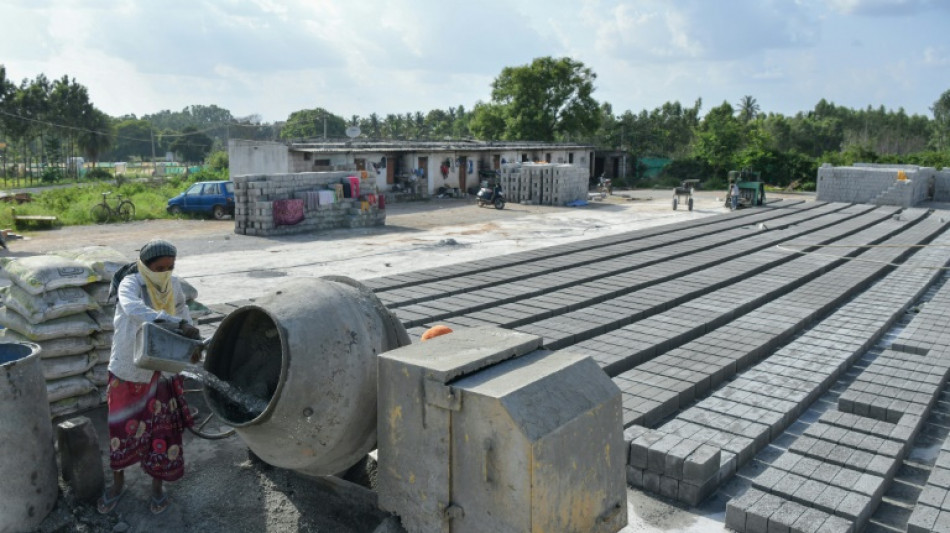
Scientists say they can make zero-emission cement / Photo: Manjunath KIRAN - AFP

 Indians living in Japan on stand-by to house Asian Games athletes
 Trump signs bill authorizing sweeping Russia sanctions

 Protesters form human chain at Kennedy Center after Trump threat

 Death toll from attack at police HQ in Pakistan rises to 31

 Trump says Denmark to give US 'permanent control' over Greenland security

 Kennedy Center: future unclear for iconic Washington arts hub

 Trump claims 'infinite' Greenland security deal with Denmark

 Helicopters battle wildfire threatening Ecuador's capital

 Brentford batter Chelsea to undo Alonso's promising start

 Kane hits Bundesliga century as Bayern rout Union

 Trump says CNN, MS NOW, Politico banned from White House

 Hushing and hedging: US companies retreat on climate

 Springboks to face Fiji before 2027 Rugby World Cup

 Nigeria miners struggled to breathe in cell before 37 died: survivors

 McIlroy on the charge at PGA Championship as Reed withdraws

 McIlroy on the charge at PGA Championship

 Crisis-wracked Volkswagen warns of 10-bn-euro hit to profits

 Costa Rica's Grynspan tops third informal poll for UN chief: diplomat

 Stock markets retreat after central bank rate hikes

 Russia labels director of Cannes Grand Prix winner a 'foreign agent'

 Macron warns of Russian 'hybrid' threat after meeting presidential hopefuls

 UN holds third informal poll for new chief

 Kulusevski return can spark Spurs: De Zerbi

 Shakira to cap off world tour with Madrid 12-gig run

 Isolated Syrian-Druze city blames Damascus for shortages

Researchers on Wednesday said they were a step closer to solving one of the trickiest problems in tackling climate change -- how to keep making cement despite its enormous carbon footprint.
In a world first, engineers from Britain's University of Cambridge have shown that cement can be recycled without the same steep cost to the environment as making it from scratch.
Cement binds concrete together but the whitish powder is highly carbon-intensive to produce, with the sector generating more than triple the emissions of global air travel.
Demand for concrete -- already the most widely used construction material on Earth -- is soaring, but the notoriously polluting industry has struggled to produce it in a less harmful way to the climate.
The team at Cambridge believes it has a solution, pioneering a method that tweaks an existing process for steel manufacturing to produce recycled cement without the associated CO2 pollution.
This discovery, published in the journal Nature, could provoke "an absolutely massive change" by providing low-cost and low-emission cement at scale, said Julian Allwood, who co-authored the research.
"It is an extremely exciting project... I think it's going to have a huge impact," said Allwood, an expert on industrial emissions and key contributor to reports from the UN's scientific panel on climate change.
To produce cement, the basic ingredient in concrete, limestone must be fired in kilns at very high temperatures usually achieved by burning fossil fuels like coal.
On top of that, limestone produces significant additional CO2 when heated.
- 'Bright hope' -
The cement industry alone accounts for nearly eight percent of human-caused CO2 emissions -- more than any country except China and the United States.
Some 14 billion cubic metres of concrete are cast every year, according to industry figures, and more still will be needed as economies and cities grow in future.
The International Energy Agency says that if emissions from the cement industry continue to increase, a pledge of carbon neutrality by 2050 will almost certainly remain out of reach.
Many efforts to produce low-carbon or so-called "green cement" are too expensive or difficult to deploy at scale, rely on unproven technologies, or don't come near zero emissions.
The Cambridge researchers approached the problem by looking at an industry that was already well established -- steel recycling, which uses electric-powered furnaces to produce the alloy.
They substituted a key ingredient in that process with old cement sourced from demolished buildings, Allwood said.
Instead of waste being produced, the end result was recycled cement ready for use in concrete, bypassing the emissions-heavy process of superheating limestone in kilns.
This method -- which has a patent pending -- was "a very low disruption innovation" requiring little change or additional cost on the part of business, Allwood said.
If powered by renewable energy, he said, these furnaces could hope to produce zero-emission concrete at scale.
"Once the electricity has no emissions, then our process would have no emissions," Allwood said.
Countries could not hope to bring CO2 emissions to zero by 2050 -- the key pledge of the Paris climate agreement -- using concrete as it exists today, he added.
"This is the big bright hope, I think," Allwood said.
F.Ferraz--PC