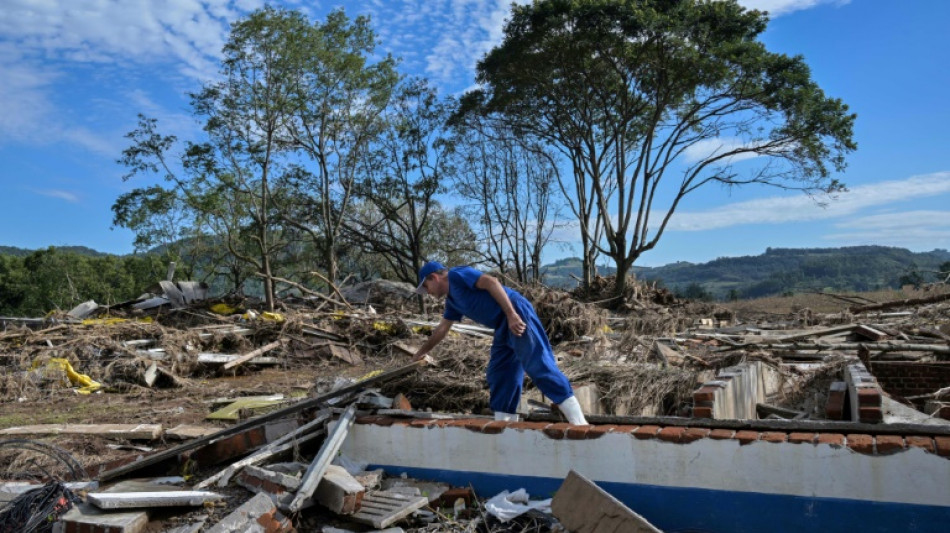
Brazil farmer who lost everything to floods recalls water's fury / Photo: Nelson ALMEIDA - AFP

 Indians living in Japan on stand-by to house Asian Games athletes

 Trump signs bill authorizing sweeping Russia sanctions

 Protesters form human chain at Kennedy Center after Trump threat

 Death toll from attack at police HQ in Pakistan rises to 31

 Trump says Denmark to give US 'permanent control' over Greenland security

 Kennedy Center: future unclear for iconic Washington arts hub

 Trump claims 'infinite' Greenland security deal with Denmark

 Helicopters battle wildfire threatening Ecuador's capital

 Brentford batter Chelsea to undo Alonso's promising start

 Kane hits Bundesliga century as Bayern rout Union

 Trump says CNN, MS NOW, Politico banned from White House

 Hushing and hedging: US companies retreat on climate

 Springboks to face Fiji before 2027 Rugby World Cup

 Nigeria miners struggled to breathe in cell before 37 died: survivors

 McIlroy on the charge at PGA Championship as Reed withdraws

 McIlroy on the charge at PGA Championship

 Crisis-wracked Volkswagen warns of 10-bn-euro hit to profits

 Costa Rica's Grynspan tops third informal poll for UN chief: diplomat

 Stock markets retreat after central bank rate hikes

 Russia labels director of Cannes Grand Prix winner a 'foreign agent'

 Macron warns of Russian 'hybrid' threat after meeting presidential hopefuls

 UN holds third informal poll for new chief

 Kulusevski return can spark Spurs: De Zerbi

 Shakira to cap off world tour with Madrid 12-gig run

 Isolated Syrian-Druze city blames Damascus for shortages

It was 6:00 in the morning when Brazilian farmer Vernei Kunz heard the roar of water as the Forqueta river overflowed its banks and swept away most of his 5,000 pigs.
Kunz, 60, has been farming for the past 42 years in the town of Travesseiro, one of hundreds devastated by weeks of cataclysmic flooding that killed more than 160 people in the southern state of Rio Grande do Sul.
"The sows and piglets were all in the sheds," he told AFP of the morning of May 2.
"We opened the doors to let them out. We managed to grab some that were swimming in the water. We pulled them out and brought them to the road, where they were safe."
Kunz and his workers managed to save about 700 pigs, he said. The slaughterhouse he works with collected them and is sending them to other farms in the region.
"The rest drowned," said Kunz, pointing to piles of rubble that used to be concrete-and-metal sheds.
A foul smell fills the air, a pungent reminder of the pigs still buried beneath the mud three weeks later.
- 'Burn it all' -
The river, about 500 meters (yards) from Kunz's property, swelled as torrential rains pounded the region in late April.
It finally burst its banks with a vengeance, sweeping up virtually everything in its path, including the bridge into Travesseiro.
Today, only the two ends of the nearly 20-meter-high bridge remain, suspended in the air.
Kunz laid off his 12 employees the same day with severance pay, he said.
Without any insurance coverage, he estimates his losses at between 10 million and 15 million reais ($2 million to $3 million).
Overall, the agricultural sector -- the engine of the region's economy -- lost around $430 million, according to the National Confederation of Municipalities.
The pig farmers' association for Rio Grande do Sul, one of Brazil's biggest producers and exporters of pork, said the devastation affected between 25 and 28 percent of production.
"I had been through big floods before in 2010, but nothing like this," said Kunz.
"That time, we could rebuild. This time, the water destroyed everything."
Experts say the intensity of the floods was linked to climate change.
"You can't go against nature," said Kunz, still wearing galoshes.
His property, which spans several thousand square meters, is littered with twisted metal, aluminum sheets, pieces of walls and tree trunks.
"I'll have to burn it all. What else can I do?" he said.
His son, Eduardo, 34, explains that the farm was a modern operation, including using artificial insemination to breed animals with the best characteristics.
"We had very expensive machines. It would be difficult to get that back," he said.
Eduardo, his wife and their two-year-old son share a small house with his parents on higher ground up the road, where the water did not reach this time.
- Restarting from scratch -
The family plans to stay in Travesseiro, a quiet farming town of 2,000 people.
Mayor Gilmar Southier estimates 80 percent of the local population were affected by the floods.
He said the priority is to rebuild the bridge, the key link between the town and the region's main cities.
Kunz, for his part, plans to start over. But instead of pigs, he wants to farm corn and soybeans.
"If I lose everything again, it will cost less to start over next time."
He expects his first harvest in August 2026. Until then, he said, he will have to find loans to get back on his feet.
F.Santana--PC