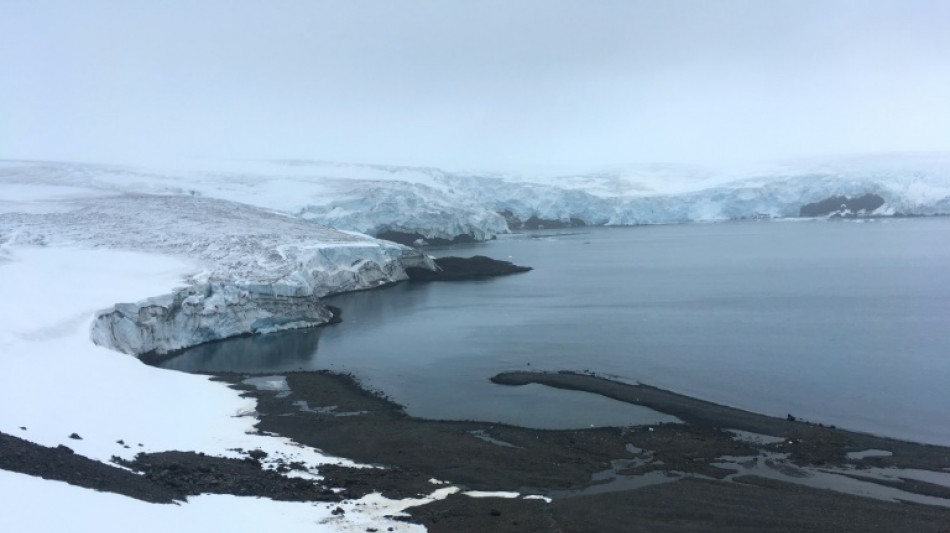
Antarctic faces melting 'tipping point' as oceans warm: study / Photo: Mathilde BELLENGER - AFP/File

 Indians living in Japan on stand-by to house Asian Games athletes
 Trump signs bill authorizing sweeping Russia sanctions

 Protesters form human chain at Kennedy Center after Trump threat

 Death toll from attack at police HQ in Pakistan rises to 31

 Trump says Denmark to give US 'permanent control' over Greenland security

 Kennedy Center: future unclear for iconic Washington arts hub

 Trump claims 'infinite' Greenland security deal with Denmark

 Helicopters battle wildfire threatening Ecuador's capital

 Brentford batter Chelsea to undo Alonso's promising start

 Kane hits Bundesliga century as Bayern rout Union

 Trump says CNN, MS NOW, Politico banned from White House

 Hushing and hedging: US companies retreat on climate

 Springboks to face Fiji before 2027 Rugby World Cup

 Nigeria miners struggled to breathe in cell before 37 died: survivors

 McIlroy on the charge at PGA Championship as Reed withdraws

 McIlroy on the charge at PGA Championship

 Crisis-wracked Volkswagen warns of 10-bn-euro hit to profits

 Costa Rica's Grynspan tops third informal poll for UN chief: diplomat

 Stock markets retreat after central bank rate hikes

 Russia labels director of Cannes Grand Prix winner a 'foreign agent'

 Macron warns of Russian 'hybrid' threat after meeting presidential hopefuls

 UN holds third informal poll for new chief

 Kulusevski return can spark Spurs: De Zerbi

 Shakira to cap off world tour with Madrid 12-gig run

 Isolated Syrian-Druze city blames Damascus for shortages

Scientists have discovered a new tipping point toward "runaway melting" of Antarctic ice sheets, caused by warm ocean water intruding between the ice and the land it sits on, according to a study published on Tuesday.
While this type of melting has been previously studied, models used by the United Nation's Intergovernmental Panel on Climate Change (IPCC) to project the impact of global warming on the Antarctic have yet to factor in this phenomenon.
They have also systematically underestimated ice loss seen thus far, said the study, published in the journal Nature Geoscience.
As ocean temperatures rise due to human-caused global warming, Antarctic ice sheets are melting, threatening a rise in global sea levels and putting coastal communities at risk.
"Increases in ocean temperature can lead to a tipping point being passed, beyond which ocean water intrudes in an unbounded manner beneath the ice sheet, via a process of runaway melting," the study said.
Antarctic ice sheets sit atop the bedrock and extend beyond the coast to float on the sea.
Previous studies have shown that warm seawater is seeping into the "grounding zone" -- where land and ice meet -- and further inland from under the floating ice.
As the water warms, even by a fraction, the intrusion accelerates from short distances of 100 metres (330 feet) to tens of kilometres (miles), melting ice along the way by heating it from below, explained the study's lead author Alexander Bradley.
"Every 10th of a degree (of warming) makes these kind of processes closer, these tipping points closer," said Bradley, a researcher with the British Antarctic Survey.
The risk to sea-level rise comes when the accelerated melting outpaces the formation of new ice on the continent.
Some areas of Antarctica are more vulnerable to this process than others due to the shape of the land mass, which has valleys and cavities where sea water can pool beneath the ice.
The Pine Island glacier, currently Antarctica's largest contributor to sea-level rise, is at high risk of melting due to the slope of the land that allows in more sea water, the study said.
Scientific models need to be updated to take into account the element of melt to better predict the risk of sea-level rise in the future and prepare for it, Bradley said.
"And it really just stresses the need for urgent climate action in order to prevent these tipping points from being passed," he added.
M.A.Vaz--PC