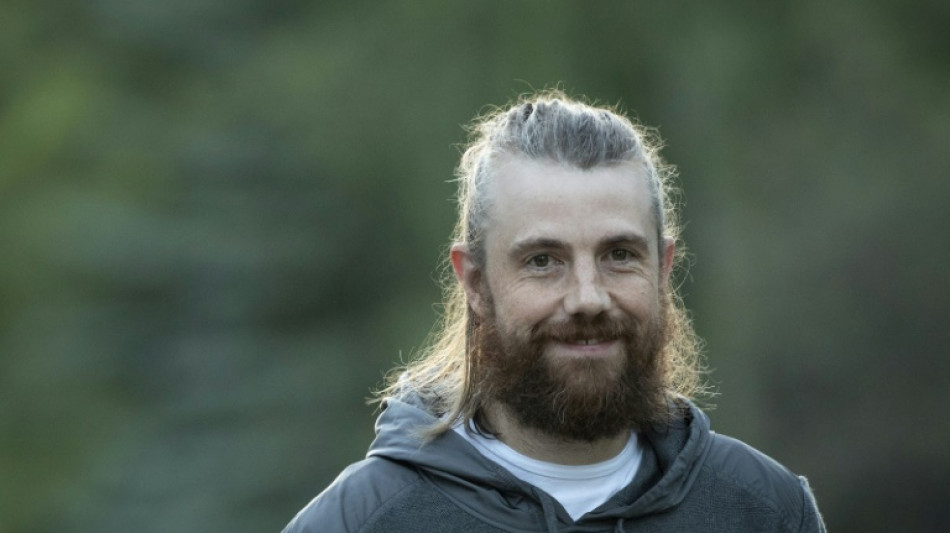
Cannon-Brookes: Australia's billionaire climate warrior / Photo: Drew Angerer - GETTY IMAGES NORTH AMERICA/AFP

 Indians living in Japan on stand-by to house Asian Games athletes
 Trump signs bill authorizing sweeping Russia sanctions

 Protesters form human chain at Kennedy Center after Trump threat

 Death toll from attack at police HQ in Pakistan rises to 31

 Trump says Denmark to give US 'permanent control' over Greenland security

 Kennedy Center: future unclear for iconic Washington arts hub

 Trump claims 'infinite' Greenland security deal with Denmark

 Helicopters battle wildfire threatening Ecuador's capital

 Brentford batter Chelsea to undo Alonso's promising start

 Kane hits Bundesliga century as Bayern rout Union

 Trump says CNN, MS NOW, Politico banned from White House

 Hushing and hedging: US companies retreat on climate

 Springboks to face Fiji before 2027 Rugby World Cup

 Nigeria miners struggled to breathe in cell before 37 died: survivors

 McIlroy on the charge at PGA Championship as Reed withdraws

 McIlroy on the charge at PGA Championship

 Crisis-wracked Volkswagen warns of 10-bn-euro hit to profits

 Costa Rica's Grynspan tops third informal poll for UN chief: diplomat

 Stock markets retreat after central bank rate hikes

 Russia labels director of Cannes Grand Prix winner a 'foreign agent'

 Macron warns of Russian 'hybrid' threat after meeting presidential hopefuls

 UN holds third informal poll for new chief

 Kulusevski return can spark Spurs: De Zerbi

 Shakira to cap off world tour with Madrid 12-gig run

 Isolated Syrian-Druze city blames Damascus for shortages

Tech billionaire Mike Cannon-Brookes once joked he could not tell the difference between an AA battery in his kids' toys and the gigantic lithium-ion units powering today's green energy revolution.
Today, he is the driving force behind a $24 billion project to build the world's largest solar battery hub in Australia's remote outback.
The 44-year-old was born in the United States before moving to Sydney at an early age.
He gained riches and public attention through software start-up Atlassian and investments in high-profile sports teams like the NBA's Utah Jazz.
But a lost wager with Elon Musk seven years ago set him on a path towards massive renewable energy investments -- and he has not looked back since.
He and university friend Scott Farquhar founded Atlassian in 2002 with few expectations.
"Our goals when we started were not to have to get a real job and to not have to wear a suit to work every day," Cannon-Brookes once recalled.
Atlassian now has 12,000 employees in 13 countries and "our software is being used on not just one, but two planets" he boasts, referencing the firm's involvement with NASA Mars rovers.
It also made him one of Australia's richest people -- with an estimated net worth of more than $10 billion.
His involvement with renewables began almost by accident -- thanks to self-described "idiocy on Twitter".
- Twitter 'idiocy' -
Back in March 2017, Australia was in the grip of an energy crisis, which Musk claimed Tesla batteries could solve in 100 days.
"Without thinking, I fired off a bunch of tweets, challenging them and saying 'were they really serious about this?'" Cannon-Brookes recalled in a TEDx talk a few months later.
If Musk could deliver what was then the world's biggest lithium-ion battery within 100 days, Cannon-Brookes promised to pay for it.
If Musk took longer than that, the battery would be free.
Within 60 days, the battery was switched on and Cannon-Brookes had lost the bet.
He was, he admits, "miles out of my depth".
"At the time, I really couldn't tell you the difference between a one-and-a-half volt battery that goes in my kids' toys and a 100-megawatt-hour industrial-scale battery facility," he later said.
"I remember thinking to myself, 'Shit. I've kind of started something here and I can't really get out."
"So I spent a week trying to learn everything I could about industrial-scale batteries and the electricity grid and renewables and the economics of all of this".
That was the spark that led to billions of dollars worth of green projects, including renewable energy initiatives and a plant-based meat startup.
He now holds the largest stake in AGL, Australia's largest electricity provider.
His ties with coal-hungry AGL might seem surprising at first, especially since he once called the company "one of the most toxic" on the planet.
But his Trojan Horse campaign is forcing the firm to decarbonise by closing two of its biggest coal-fired power stations years earlier than planned.
His latest SunCable project is perhaps even more radical.
It will include a vast array of solar panels, batteries and, eventually, a cable linking Australia with Singapore. It is slated to power three million homes.
Cannon-Brookes believes the case for renewables -- and projects like the one he is building in northern Australia -- make both business and climate sense.
"The green economy is Australia's golden ticket," he insists.
"At this point in history -- we no longer need to talk as much about stopping things, because the economy has done that for us.
"Fossil fuels are unreliable and expensive compared to renewables when it comes to energy generation. We'll see this filter through industry after industry. We will electrify everything."
For a man who never wanted a "real job", Cannon-Brookes has certainly kept himself busy.
L.Torres--PC