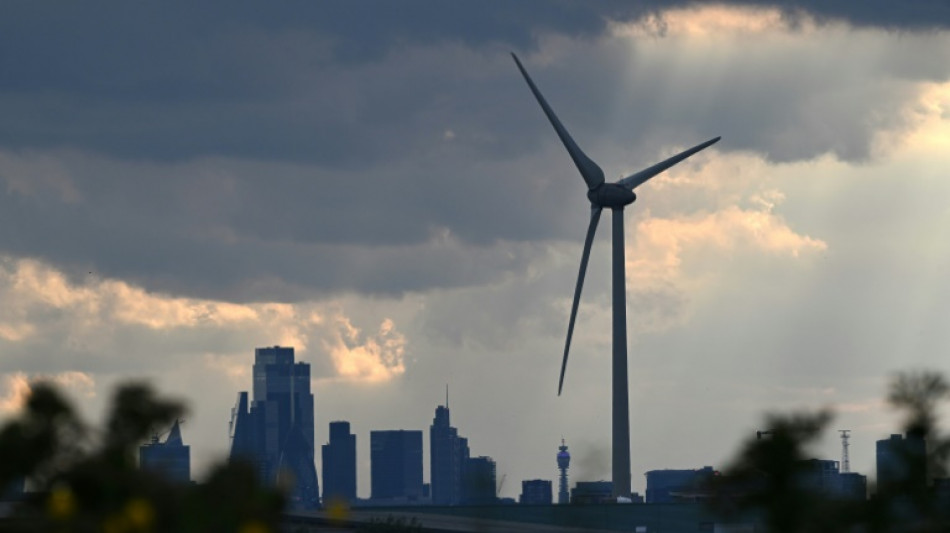
Combining climate measures key to slashing emissions: study / Photo: JUSTIN TALLIS - AFP

 Indians living in Japan on stand-by to house Asian Games athletes

 Trump signs bill authorizing sweeping Russia sanctions

 Protesters form human chain at Kennedy Center after Trump threat

 Death toll from attack at police HQ in Pakistan rises to 31

 Trump says Denmark to give US 'permanent control' over Greenland security

 Kennedy Center: future unclear for iconic Washington arts hub

 Trump claims 'infinite' Greenland security deal with Denmark

 Helicopters battle wildfire threatening Ecuador's capital

 Brentford batter Chelsea to undo Alonso's promising start

 Kane hits Bundesliga century as Bayern rout Union

 Trump says CNN, MS NOW, Politico banned from White House

 Hushing and hedging: US companies retreat on climate

 Springboks to face Fiji before 2027 Rugby World Cup

 Nigeria miners struggled to breathe in cell before 37 died: survivors

 McIlroy on the charge at PGA Championship as Reed withdraws

 McIlroy on the charge at PGA Championship

 Crisis-wracked Volkswagen warns of 10-bn-euro hit to profits

 Costa Rica's Grynspan tops third informal poll for UN chief: diplomat

 Stock markets retreat after central bank rate hikes

 Russia labels director of Cannes Grand Prix winner a 'foreign agent'

 Macron warns of Russian 'hybrid' threat after meeting presidential hopefuls

 UN holds third informal poll for new chief

 Kulusevski return can spark Spurs: De Zerbi

 Shakira to cap off world tour with Madrid 12-gig run

 Isolated Syrian-Druze city blames Damascus for shortages

A major new study published Thursday on the effectiveness of climate measures such as taxes or subsidies in reducing greenhouse gases has found stand-alone measures fail to make a big difference.
Published in the journal Science, the study examined 25 years of public policies in 41 countries across six continents.
It concluded that out of the 1,500 policies analysed in sectors including energy, transport and construction, "only 63 cases of successful climate policies, each leading to average emission reductions of 19 percent, were identified."
"The researchers show that bans on coal-fired power plants or combustion engine cars do not result in major emissions reductions when implemented alone," said the Potsdam Institute for Climate Impact Research (PIK) that led the study with Mercator Research Institute on Global Commons and Climate Change (MCC).
"Successful cases only arise in tandem with tax or price incentives in well-designed policy mixes, as shown in the UK for coal-fired power generation or in Norway for cars," the researchers said.
The study used a new OECD database and an innovative approach that combined machine learning methods with established statistical analyses.
It "identified 63 successful policy interventions with total emission reductions between 0.6 billion and 1.8 billion tonnes CO2".
By comparison, humanity emitted 57.4 billion tonnes of CO2 equivalent in 2022, according to United Nations estimates.
Among the successes identified was Britain's introduction in 2013 of a minimum carbon price, subsidies for renewable energy, and a coal phase-out plan.
The researchers hope their work will influence the climate roadmaps countries are updating and must submit to the UN by February 2025.
The aim of these roadmaps is to keep alive the Paris Agreement's flagship goal of limiting warming to 1.5 degrees Celsius from pre-industrial levels.
- 'Right mix is crucial' -
An interactive website, "Climate Policy Explorer", provides an overview of the results, analysis and methods, and is accessible to the public.
"Our findings demonstrate that more policies do not necessarily equate to better outcomes. Instead, the right mix of measures is crucial," explained the study's lead author Nicolas Koch of PIK and MCC.
"For example, subsidies or regulations alone are insufficient; only in combination with price-based instruments, such as carbon and energy taxes, can they deliver substantial emission reductions."
"But by focusing only on 69 statistically identifiable large trend breaks, they miss the impact of thousands of smaller efforts globally, and the cumulative and often self-reinforcing impact of many smaller measures", said Michael Grubb at University College London.
He also acknowledged "the most sophisticated study to date".
"Their conclusion that big impacts require combinations of policies makes absolute sense," he added.
"The study only looks for policies making sudden reductions, whereas most climate policies work on the efficiency of new things or the long-term trajectory of emissions, taking many years to build up greener infrastructure or ways of living," said Robin Lamboll at Imperial College London.
G.Teles--PC