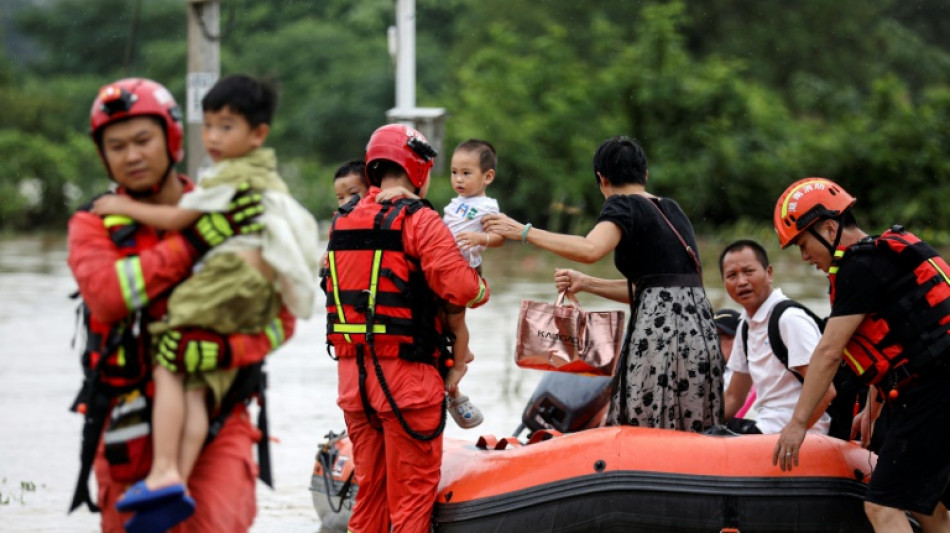
Climate change fuelled deadly Typhoon Gaemi: study / Photo: STR - AFP

 Indians living in Japan on stand-by to house Asian Games athletes

 Trump signs bill authorizing sweeping Russia sanctions

 Protesters form human chain at Kennedy Center after Trump threat

 Death toll from attack at police HQ in Pakistan rises to 31

 Trump says Denmark to give US 'permanent control' over Greenland security

 Kennedy Center: future unclear for iconic Washington arts hub

 Trump claims 'infinite' Greenland security deal with Denmark

 Helicopters battle wildfire threatening Ecuador's capital

 Brentford batter Chelsea to undo Alonso's promising start

 Kane hits Bundesliga century as Bayern rout Union

 Trump says CNN, MS NOW, Politico banned from White House

 Hushing and hedging: US companies retreat on climate

 Springboks to face Fiji before 2027 Rugby World Cup

 Nigeria miners struggled to breathe in cell before 37 died: survivors

 McIlroy on the charge at PGA Championship as Reed withdraws

 McIlroy on the charge at PGA Championship

 Crisis-wracked Volkswagen warns of 10-bn-euro hit to profits

 Costa Rica's Grynspan tops third informal poll for UN chief: diplomat

 Stock markets retreat after central bank rate hikes

 Russia labels director of Cannes Grand Prix winner a 'foreign agent'

 Macron warns of Russian 'hybrid' threat after meeting presidential hopefuls

 UN holds third informal poll for new chief

 Kulusevski return can spark Spurs: De Zerbi

 Shakira to cap off world tour with Madrid 12-gig run

 Isolated Syrian-Druze city blames Damascus for shortages

Climate change turbocharged the winds and rain of Typhoon Gaemi, which killed dozens of people across the Philippines, Taiwan and China earlier this year, a group of scientists said Thursday.
Gaemi skirted the Philippines in July, triggering floods and landslides that killed at least 40 people, before making landfall in Taiwan and China.
In China, the weather system caused torrential downpours that killed 50 people and prompted authorities to evacuate 300,000.
World Weather Attribution (WWA), a network of scientists who have pioneered peer-reviewed methods for assessing the role of climate change in extreme events, looked at three regions worst affected by the typhoon: the northern Philippines, Taiwan and China's Hunan province.
It found the system's wind speeds were seven percent more intense due to man-made climate change, and its rainfall was 14 percent heavier in Taiwan and nine percent heavier in Hunan.
The study could not draw definitive conclusions about the role of climate change on the rainfall in the Philippines, because of the region's complex monsoon rain patterns.
Still, they found the warm seas that helped form and fuel Typhoon Gaemi "would have been virtually impossible" in a world that had not warmed to the current 1.2 Celsius above pre-industrial levels.
And the group's modelling found this warming has already increased the number of similarly strong storms by 30 percent -- up from around five a year to six or seven.
"This study confirms what we've expected –- hotter seas and atmospheres are giving rise to more powerful, longer-lived and deadlier typhoons," said Ralf Toumi, director of the Grantham Institute-Climate Change and the Environment, at Imperial College London.
Teasing out the impact of climate change on tropical cyclones is complicated, but scientists are focusing more work on these weather systems.
WWA's method involves assessing how unusual an extreme event is, then modelling the likelihood of a similar event and its intensity in two scenarios: today's world, and one without current levels of warming.
The scientists used that method and a new approach developed by Imperial College London that is tailored specifically to tropical storms.
It uses computer modelling to overcome the relative lack of historical data on tropical cyclones.
While the Asia-Pacific region has long dealt with typhoons, the scientists warned that their work highlighted "gaps in typhoon preparedness and the massive impacts caused by Gaemi."
They called for better urban flood management and targeted warnings that offer more information on the likely impacts of a storm.
The study was released as Typhoon Shanshan made landfall in Japan, which issued its highest level warning for wind and storm surges.
P.Cavaco--PC