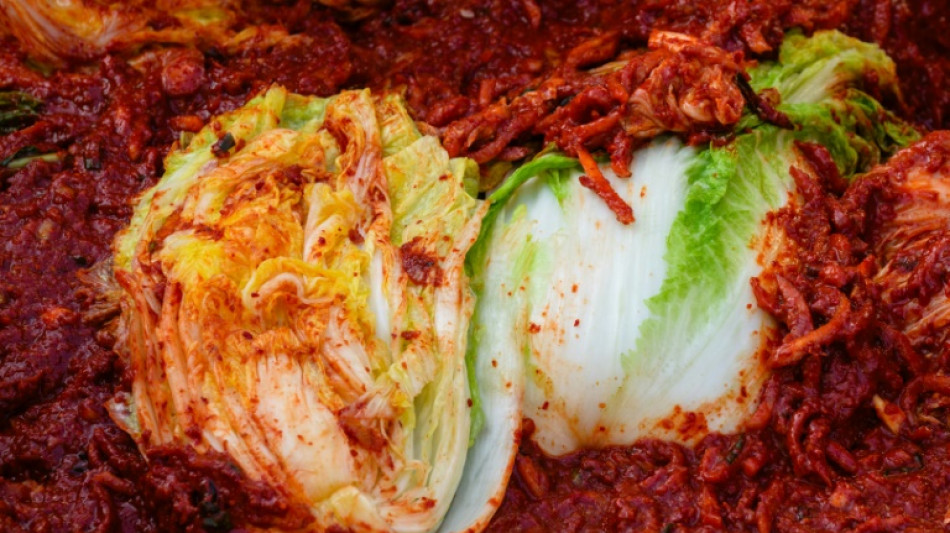
Kimchi threat as heatwave drives up South Korea cabbage prices / Photo: ANTHONY WALLACE - AFP/File

 Manchester United rallies past Roma as PSG dominates in Champions League

 Qatar sees tentative opening for renewed regional diplomacy

 Qatar Tourism joins Pacific Asia Travel Association at London travel market

 Abdul El-Sayed Wins Michigan Senate Seat in Historic Election

 Qatar media bodies discuss support for humanitarian initiatives

 No. 22 UCLA defeats No. 5 Arizona 84-75 despite Kharchenkov's 38 points

 Vessel operator seeks witnesses after Vancouver grounding

 US Air Force deploys F-16 fighters to remote Aleutian base for readiness drill

 Bezos grant helps Seattle nonprofit move thousands of families toward housing

 Shrini Srivastava joins crew of Varanasi-Delhi Vande Bharat Sleeper service

 Nearly Half of Australian Workers Overqualified, Survey Finds

An unprecedented heat wave across South Korea has driven up the price of cabbages, data revealed Friday, with the vegetable used in the famed national dish kimchi surging by nearly 70 percent year-on-year.
The price of a single cabbage hit 9,337 won (US$ 7.02) on Thursday -- up 69.1 percent from the same day a year ago, according to data released by the state-run Korea Agro-Fisheries & Food Trade Corporation.
Cabbage is a key ingredient of kimchi, the country's famed fiery fermented dish which many Koreans eat every day.
Experts say rising summer temperatures are leading to supply instability -- especially for highland cabbage, which thrives in cooler climates.
"Additionally, climate change has changed the patterns of soil disease outbreaks," said Lee Young-gyu, a virologist at the National Institute of Crop Science.
"For instance, soil-borne fungal diseases like root rot, which causes wilting in cabbage, are spreading," he told AFP.
Lee said there have also been reports of seedlings perishing from the extreme heat, or being scorched by the intense sunlight.
This month, South Korea's Rural Development Administration established a dedicated research institute to address the supply instability of highland cabbage.
The body has warned that if no measures are taken to address climate change, suitable areas for summer cabbage cultivation could vanish by 2090.
This year South Korea experienced its highest average summertime temperature since such records began half a century ago -- nearly two degrees higher than the historic average, the weather agency said earlier this month.
L.Torres--PC