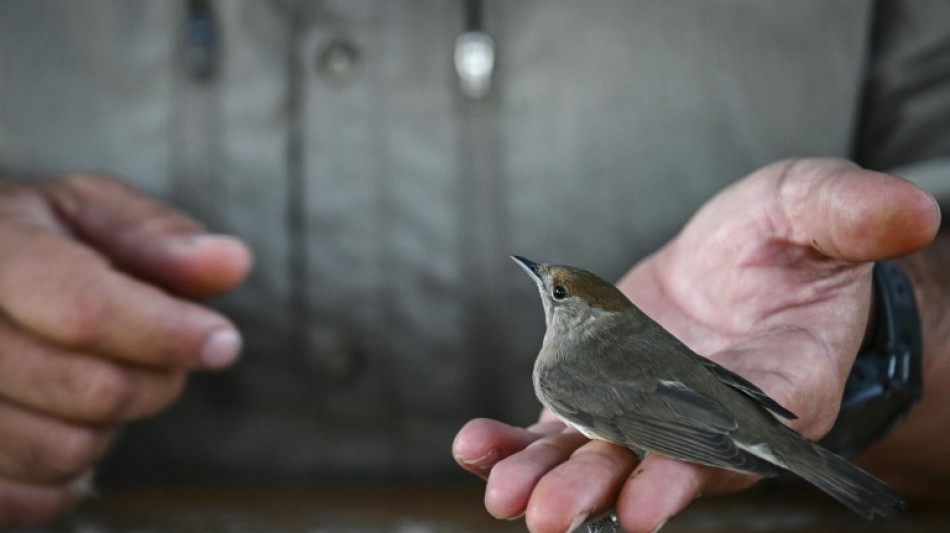
On remote Greek island, migratory birds offer climate clues / Photo: Aris MESSINIS - AFP

 Indians living in Japan on stand-by to house Asian Games athletes
 Trump signs bill authorizing sweeping Russia sanctions

 Protesters form human chain at Kennedy Center after Trump threat

 Death toll from attack at police HQ in Pakistan rises to 31

 Trump says Denmark to give US 'permanent control' over Greenland security

 Kennedy Center: future unclear for iconic Washington arts hub

 Trump claims 'infinite' Greenland security deal with Denmark

 Helicopters battle wildfire threatening Ecuador's capital

 Brentford batter Chelsea to undo Alonso's promising start

 Kane hits Bundesliga century as Bayern rout Union

 Trump says CNN, MS NOW, Politico banned from White House

 Hushing and hedging: US companies retreat on climate

 Springboks to face Fiji before 2027 Rugby World Cup

 Nigeria miners struggled to breathe in cell before 37 died: survivors

 McIlroy on the charge at PGA Championship as Reed withdraws

 McIlroy on the charge at PGA Championship

 Crisis-wracked Volkswagen warns of 10-bn-euro hit to profits

 Costa Rica's Grynspan tops third informal poll for UN chief: diplomat

 Stock markets retreat after central bank rate hikes

 Russia labels director of Cannes Grand Prix winner a 'foreign agent'

 Macron warns of Russian 'hybrid' threat after meeting presidential hopefuls

 UN holds third informal poll for new chief

 Kulusevski return can spark Spurs: De Zerbi

 Shakira to cap off world tour with Madrid 12-gig run

 Isolated Syrian-Druze city blames Damascus for shortages

Gently holding a blackcap warbler in his palm, ornithologist Christos Barboutis blew on its feathers to reveal the size of its belly: a good indicator of how far the bird can migrate.
Acutely vulnerable to climate change, migratory birds offer valuable clues to scientists about how our warming planet is affecting wildlife: from their shifting migration patterns to their body weight.
"Observing them warns us if something is changing or going wrong," said Barboutis, a researcher at the Hellenic Ornithological Society.
Birds "are among the first to be affected by climate change such as drought, which poses a big problem for their distant travel," he told AFP at an observation station on the small Aegean island of Antikythera.
At the crack of dawn, the researcher and his colleagues lay out nets to capture and ring the birds.
The tiny island in the eastern Mediterranean lies on a popular corridor for birds migrating from northern Europe to Africa in the autumn, and in the opposite direction in springtime.
Barboutis came to the sparsely populated rock between the Peloponnese and the western tip of Crete some 15 years ago.
His team have seen and observed a variety of birds: from turtle doves and warblers to colourful bee-eaters and buzzards.
The rare Eleonora's falcon with its distinctive, elegant wings often nests on the cliffs of the island. Greece becomes host to around 80 percent of the bird's population during their breeding season.
- 'State of nature' -
At sunrise, volunteers Nefeli Marinou, a 21-year-old biology student, and Jennifer Evans, a 25-year-old environmentalist from Canada, scour the deployed nets for trapped birds and carefully place them in small bags.
A metal ring placed on a bird's finger bears a unique identification number.
In a book, Marinou notes the species, age, sex, date and time.
"From this number we deduce how long it took the bird to get here, whether the population is declining or stable," Evans said.
Around 40 birds were ringed in a day's work.
The bird capturing programme began 20 years ago, Barboutis said, although he cautioned it was a scientifically short period to make long-term conclusions about the impacts of climate change.
From the top of a rock, student volunteer Nikolas Promponas, using a telescope and binoculars, watched for falcons and white-headed vultures, a species whose numbers are declining in Europe.
Many species of birds including birds of prey need coastlines and ridges to gain height before taking off, he said, a resource that is abundant on Antikythera.
Unlike the nearby tourist islands of Kythera and Crete, rugged Antikythera has just two restaurant-cafes and can only handle around forty tourists in summer.
Like other islands in the southern Mediterranean, Antikythera serves as a vital stopover point where migratory birds can replenish ahead of their long journey.
It is part of the EU Natura network of nature protection areas due to its biodiversity.
Declining insect populations have made it harder for some species to find food, while human activity, intense droughts and wildfires worsened by climate change have contributed to the loss of their habitat.
Forest fires, the use of pesticides, and urban expansion are also factors that affect their population.
This year, Greece experienced its warmest winter and warmest summer since detailed records began in 1960.
Less greenery means less food.
"If there are fewer birds feeding on insects, it probably means that insects are also in decline," Evans said.
"Whatever the case, birds are a very good indicator of the state of nature."
E.Raimundo--PC